

4.7 Problem of Superfield Effective Potential
87
U
(1)
=
∞
n=1
1
2n
d
4 k
(2π) 4 (
V
(()
k 2 )
n
= −
d
4 k
(2π) 4 log(1 −
V
(()
k 2 ). (4.142)
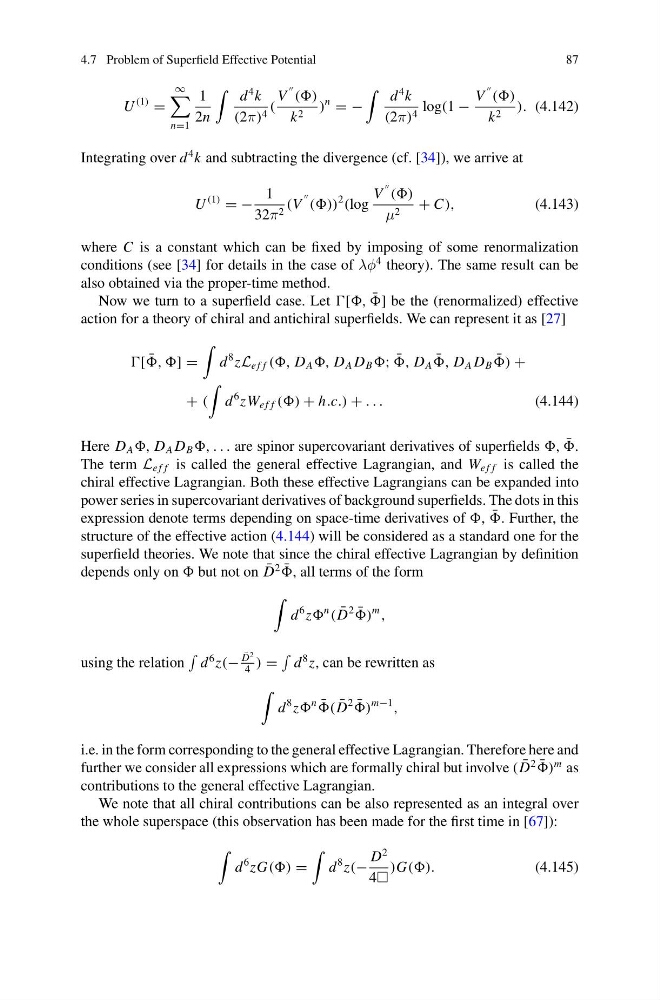
Integrating over d
4 k and subtracting the divergence (cf. [34]), we arrive at
U
(1)
= −
1
32π 2 (V
(())
2
(log
V
(()
μ 2 + C),
(4.143)
where C is a constant which can be fixed by imposing of some renormalization
conditions (see [34] for details in the case of λφ
4 theory). The same result can be
also obtained via the proper-time method.
Now we turn to a superfield case. Let [, ¯
] be the (renormalized) effective
action for a theory of chiral and antichiral superfields. We can represent it as [27]
[ ¯
,] =
d
8 zL e f f ((, D A , D A D B ; ¯
, D A ¯
, D A D B ¯
) +
+ (
d
6 zW e f f (() + h.c.) + . . .
(4.144)
Here D A , D A D B , . . . are spinor supercovariant derivatives of superfields , ¯
.
The term L e f f is called the general effective Lagrangian, and W e f f is called the
chiral effective Lagrangian. Both these effective Lagrangians can be expanded into
power series in supercovariant derivatives of background superfields. The dots in this
expression denote terms depending on space-time derivatives of , ¯
. Further, the
structure of the effective action (4.144) will be considered as a standard one for the
superfield theories. We note that since the chiral effective Lagrangian by definition
depends only on but not on ¯
D
2 ¯
, all terms of the form
d
6 z
n
( ¯
D
2 ¯
)
m
,
using the relation
d
6 z(−
¯
D
2
4
) =
d
8 z, can be rewritten as
d
8 z
n ¯
( ¯
D
2 ¯
)
m−1
,
i.e. in the form corresponding to the general effective Lagrangian. Therefore here and
further we consider all expressions which are formally chiral but involve ( ¯
D
2 ¯
)
m as
contributions to the general effective Lagrangian.
We note that all chiral contributions can be also represented as an integral over
the whole superspace (this observation has been made for the first time in [67]):
d
6 zG(() =
d
8 z(−
D
2
4
)G(().
(4.145)
87
U
(1)
=
∞
n=1
1
2n
d
4 k
(2π) 4 (
V
(()
k 2 )
n
= −
d
4 k
(2π) 4 log(1 −
V
(()
k 2 ). (4.142)
Integrating over d
4 k and subtracting the divergence (cf. [34]), we arrive at
U
(1)
= −
1
32π 2 (V
(())
2
(log
V
(()
μ 2 + C),
(4.143)
where C is a constant which can be fixed by imposing of some renormalization
conditions (see [34] for details in the case of λφ
4 theory). The same result can be
also obtained via the proper-time method.
Now we turn to a superfield case. Let [, ¯
] be the (renormalized) effective
action for a theory of chiral and antichiral superfields. We can represent it as [27]
[ ¯
,] =
d
8 zL e f f ((, D A , D A D B ; ¯
, D A ¯
, D A D B ¯
) +
+ (
d
6 zW e f f (() + h.c.) + . . .
(4.144)
Here D A , D A D B , . . . are spinor supercovariant derivatives of superfields , ¯
.
The term L e f f is called the general effective Lagrangian, and W e f f is called the
chiral effective Lagrangian. Both these effective Lagrangians can be expanded into
power series in supercovariant derivatives of background superfields. The dots in this
expression denote terms depending on space-time derivatives of , ¯
. Further, the
structure of the effective action (4.144) will be considered as a standard one for the
superfield theories. We note that since the chiral effective Lagrangian by definition
depends only on but not on ¯
D
2 ¯
, all terms of the form
d
6 z
n
( ¯
D
2 ¯
)
m
,
using the relation
d
6 z(−
¯
D
2
4
) =
d
8 z, can be rewritten as
d
8 z
n ¯
( ¯
D
2 ¯
)
m−1
,
i.e. in the form corresponding to the general effective Lagrangian. Therefore here and
further we consider all expressions which are formally chiral but involve ( ¯
D
2 ¯
)
m as
contributions to the general effective Lagrangian.
We note that all chiral contributions can be also represented as an integral over
the whole superspace (this observation has been made for the first time in [67]):
d
6 zG(() =
d
8 z(−
D
2
4
)G(().
(4.145)