

86
4 Four-Dimensional Superfield Supersymmetry
First, let us shortly describe the effective potential in a usual quantum field theory.
The effective action can be presented as a derivative expansion:
=
d
4 x(−V e f f (φ) +
1
2
Z (φ)∂ m φ∂
m
φ + . . .),
(4.137)
where Z (φ) is some function of φ, and V e f f (φ) is the effective potential. Therefore,
for slowly varying fields one has
= −
d
4 x V e f f (φ),
so, effective potential is a low-energy leading term. It can be represented in the form
of the loop expansion
V e f f (φ) = V (φ) +
∞
n=1
n V
(n)
(φ).
(4.138)
For example, let us consider the theory with the action
S =
d
4 x(−
1
2
φ − V (φ)).
(4.139)
After background-quantum splitting φ → + χ where is the background superfield and χ is the quantum one, we find the quadratic action of quantum superfields
S 2 = −
1
2
d
4 xχ( + V
(())χ,
(4.140)
which leads to the one-loop effective action
(1)
[ of the form
(1)
[] =
i
2
Tr log( + V
(()).
(4.141)
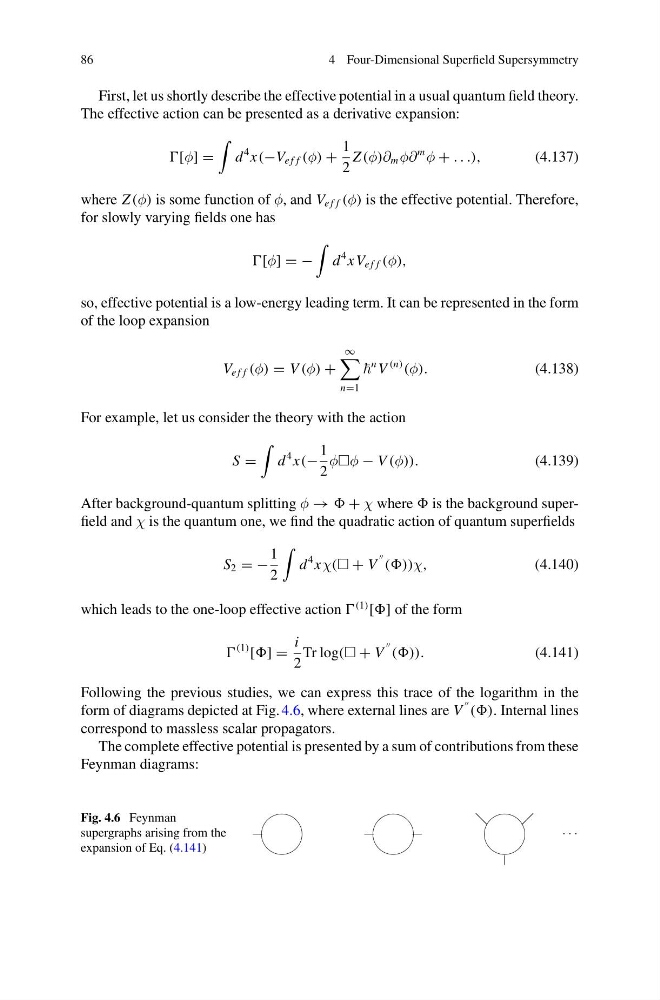
Following the previous studies, we can express this trace of the logarithm in the
form of diagrams depicted at Fig. 4.6, where external lines are V
((). Internal lines
correspond to massless scalar propagators.
The complete effective potential is presented by a sum of contributions from these
Feynman diagrams:
Fig. 4.6 Feynman
supergraphs arising from the
expansion of Eq. (4.141)
. . .
4 Four-Dimensional Superfield Supersymmetry
First, let us shortly describe the effective potential in a usual quantum field theory.
The effective action can be presented as a derivative expansion:
=
d
4 x(−V e f f (φ) +
1
2
Z (φ)∂ m φ∂
m
φ + . . .),
(4.137)
where Z (φ) is some function of φ, and V e f f (φ) is the effective potential. Therefore,
for slowly varying fields one has
= −
d
4 x V e f f (φ),
so, effective potential is a low-energy leading term. It can be represented in the form
of the loop expansion
V e f f (φ) = V (φ) +
∞
n=1
n V
(n)
(φ).
(4.138)
For example, let us consider the theory with the action
S =
d
4 x(−
1
2
φ − V (φ)).
(4.139)
After background-quantum splitting φ → + χ where is the background superfield and χ is the quantum one, we find the quadratic action of quantum superfields
S 2 = −
1
2
d
4 xχ( + V
(())χ,
(4.140)
which leads to the one-loop effective action
(1)
[ of the form
(1)
[] =
i
2
Tr log( + V
(()).
(4.141)
Following the previous studies, we can express this trace of the logarithm in the
form of diagrams depicted at Fig. 4.6, where external lines are V
((). Internal lines
correspond to massless scalar propagators.
The complete effective potential is presented by a sum of contributions from these
Feynman diagrams:
Fig. 4.6 Feynman
supergraphs arising from the
expansion of Eq. (4.141)
. . .