

4.6 Effective Action in Superfield Theories. Superfield Proper-Time Technique
85
A| s=0 = ˜
A| s=0 = B
α
| s=0 = ˜
B ˙
α | s=0 = C| s=0 = ˜
C| s=0 = 0.
(4.133)
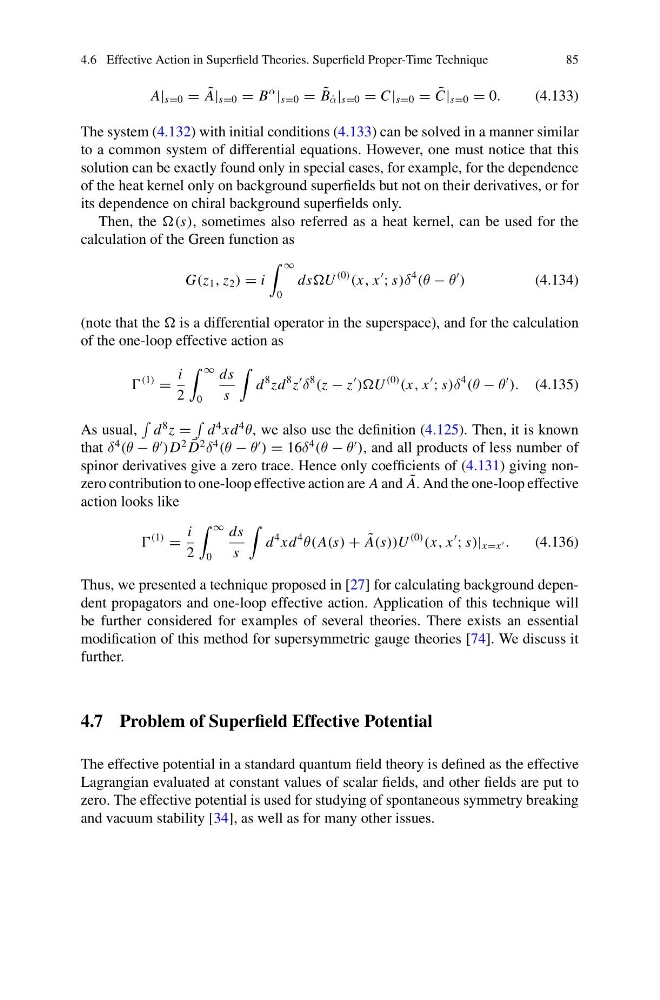
The system (4.132) with initial conditions (4.133) can be solved in a manner similar
to a common system of differential equations. However, one must notice that this
solution can be exactly found only in special cases, for example, for the dependence
of the heat kernel only on background superfields but not on their derivatives, or for
its dependence on chiral background superfields only.
Then, the (s), sometimes also referred as a heat kernel, can be used for the
calculation of the Green function as
G(z 1 , z 2 ) = i
∞
0
dsU
(0)
(x, x
; s)δ
4
(θ − θ
)
(4.134)
(note that the is a differential operator in the superspace), and for the calculation
of the one-loop effective action as
(1)
=
i
2
∞
0
ds
s
d
8 zd
8 z
δ
8
(z − z
))U
(0)
(x, x
; s)δ
4
(θ − θ
). (4.135)
As usual,
d
8 z =
d
4 xd
4
θ, we also use the definition (4.125). Then, it is known
that δ
4
(θ − θ
)D
2 ¯
D
2
δ
4
(θ − θ
) = 16δ
4
(θ − θ
), and all products of less number of
spinor derivatives give a zero trace. Hence only coefficients of (4.131) giving nonzero contribution to one-loop effective action are A and ˜
A. And the one-loop effective
action looks like
(1)
=
i
2
∞
0
ds
s
d
4 xd
4
θ(A(s) + ˜
A(s))U
(0)
(x, x
; s)| x=x .
(4.136)
Thus, we presented a technique proposed in [27] for calculating background dependent propagators and one-loop effective action. Application of this technique will
be further considered for examples of several theories. There exists an essential
modification of this method for supersymmetric gauge theories [74]. We discuss it
further.
4.7 Problem of Superfield Effective Potential
The effective potential in a standard quantum field theory is defined as the effective
Lagrangian evaluated at constant values of scalar fields, and other fields are put to
zero. The effective potential is used for studying of spontaneous symmetry breaking
and vacuum stability [34], as well as for many other issues.
85
A| s=0 = ˜
A| s=0 = B
α
| s=0 = ˜
B ˙
α | s=0 = C| s=0 = ˜
C| s=0 = 0.
(4.133)
The system (4.132) with initial conditions (4.133) can be solved in a manner similar
to a common system of differential equations. However, one must notice that this
solution can be exactly found only in special cases, for example, for the dependence
of the heat kernel only on background superfields but not on their derivatives, or for
its dependence on chiral background superfields only.
Then, the (s), sometimes also referred as a heat kernel, can be used for the
calculation of the Green function as
G(z 1 , z 2 ) = i
∞
0
dsU
(0)
(x, x
; s)δ
4
(θ − θ
)
(4.134)
(note that the is a differential operator in the superspace), and for the calculation
of the one-loop effective action as
(1)
=
i
2
∞
0
ds
s
d
8 zd
8 z
δ
8
(z − z
))U
(0)
(x, x
; s)δ
4
(θ − θ
). (4.135)
As usual,
d
8 z =
d
4 xd
4
θ, we also use the definition (4.125). Then, it is known
that δ
4
(θ − θ
)D
2 ¯
D
2
δ
4
(θ − θ
) = 16δ
4
(θ − θ
), and all products of less number of
spinor derivatives give a zero trace. Hence only coefficients of (4.131) giving nonzero contribution to one-loop effective action are A and ˜
A. And the one-loop effective
action looks like
(1)
=
i
2
∞
0
ds
s
d
4 xd
4
θ(A(s) + ˜
A(s))U
(0)
(x, x
; s)| x=x .
(4.136)
Thus, we presented a technique proposed in [27] for calculating background dependent propagators and one-loop effective action. Application of this technique will
be further considered for examples of several theories. There exists an essential
modification of this method for supersymmetric gauge theories [74]. We discuss it
further.
4.7 Problem of Superfield Effective Potential
The effective potential in a standard quantum field theory is defined as the effective
Lagrangian evaluated at constant values of scalar fields, and other fields are put to
zero. The effective potential is used for studying of spontaneous symmetry breaking
and vacuum stability [34], as well as for many other issues.