

84
4 Four-Dimensional Superfield Supersymmetry
U (z, z
; s) = exp(is)δ
8
(z − z
) ≡ exp(is ˜
) exp(is)δ
8
(z − z
). (4.128)
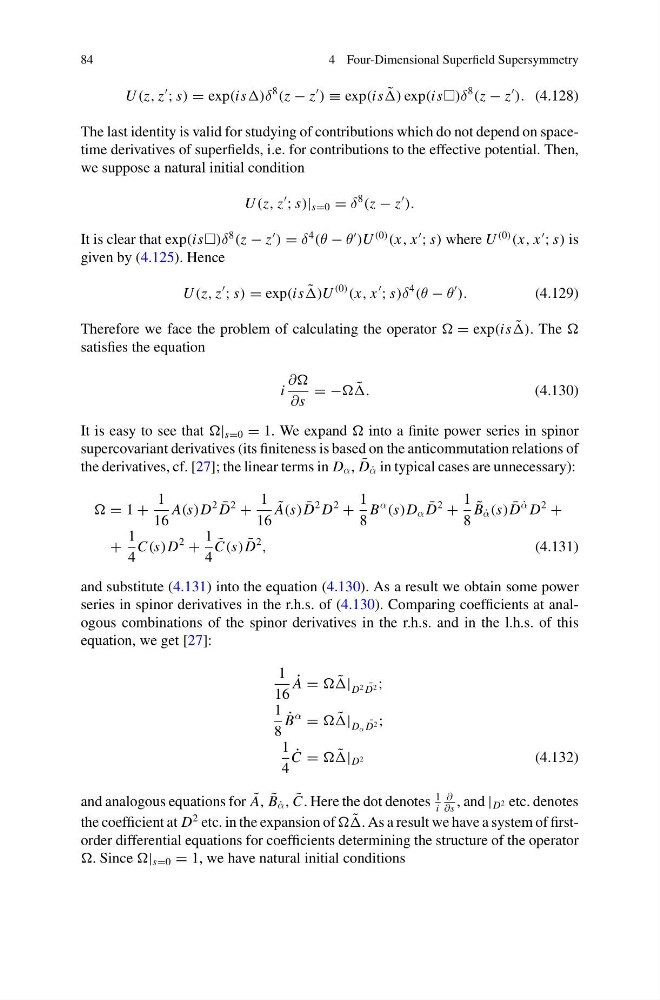
The last identity is valid for studying of contributions which do not depend on spacetime derivatives of superfields, i.e. for contributions to the effective potential. Then,
we suppose a natural initial condition
U (z, z
; s)| s=0 = δ
8
(z − z
).
It is clear that exp(is)δ
8
(z − z
) = δ
4
(θ − θ
)U
(0)
(x, x
; s) where U
(0)
(x, x
; s) is
given by (4.125). Hence
U (z, z
; s) = exp(is ˜
)U
(0)
(x, x
; s)δ
4
(θ − θ
).
(4.129)
Therefore we face the problem of calculating the operator = exp(is ˜
). The
satisfies the equation
i
∂
∂s
= − ˜
.
(4.130)
It is easy to see that | s=0 = 1. We expand into a finite power series in spinor
supercovariant derivatives (its finiteness is based on the anticommutation relations of
the derivatives, cf. [27]; the linear terms in D α , ¯
D ˙
α in typical cases are unnecessary):
= 1 +
1
16
A(s)D
2 ¯
D
2
+
1
16
˜
A(s) ¯
D
2 D
2
+
1
8
B
α
(s)D α ¯
D
2
+
1
8
˜
B ˙
α (s) ¯
D
˙
α D
2
+
+
1
4
C(s)D
2
+
1
4
˜
C(s) ¯
D
2
,
(4.131)
and substitute (4.131) into the equation (4.130). As a result we obtain some power
series in spinor derivatives in the r.h.s. of (4.130). Comparing coefficients at analogous combinations of the spinor derivatives in the r.h.s. and in the l.h.s. of this
equation, we get [27]:
1
16
˙
A = ˜
| D 2 ¯
D 2 ;
1
8
˙
B
α
= ˜
| D α ¯
D 2 ;
1
4
˙
C = ˜
| D 2
(4.132)
and analogous equations for ˜
A, ˜
B ˙
α , ˜
C. Here the dot denotes
1
i
∂
∂s
, and | D 2 etc. denotes
the coefficient at D
2 etc. in the expansion of ˜
. As a result we have a system of firstorder differential equations for coefficients determining the structure of the operator
. Since | s=0 = 1, we have natural initial conditions
4 Four-Dimensional Superfield Supersymmetry
U (z, z
; s) = exp(is)δ
8
(z − z
) ≡ exp(is ˜
) exp(is)δ
8
(z − z
). (4.128)
The last identity is valid for studying of contributions which do not depend on spacetime derivatives of superfields, i.e. for contributions to the effective potential. Then,
we suppose a natural initial condition
U (z, z
; s)| s=0 = δ
8
(z − z
).
It is clear that exp(is)δ
8
(z − z
) = δ
4
(θ − θ
)U
(0)
(x, x
; s) where U
(0)
(x, x
; s) is
given by (4.125). Hence
U (z, z
; s) = exp(is ˜
)U
(0)
(x, x
; s)δ
4
(θ − θ
).
(4.129)
Therefore we face the problem of calculating the operator = exp(is ˜
). The
satisfies the equation
i
∂
∂s
= − ˜
.
(4.130)
It is easy to see that | s=0 = 1. We expand into a finite power series in spinor
supercovariant derivatives (its finiteness is based on the anticommutation relations of
the derivatives, cf. [27]; the linear terms in D α , ¯
D ˙
α in typical cases are unnecessary):
= 1 +
1
16
A(s)D
2 ¯
D
2
+
1
16
˜
A(s) ¯
D
2 D
2
+
1
8
B
α
(s)D α ¯
D
2
+
1
8
˜
B ˙
α (s) ¯
D
˙
α D
2
+
+
1
4
C(s)D
2
+
1
4
˜
C(s) ¯
D
2
,
(4.131)
and substitute (4.131) into the equation (4.130). As a result we obtain some power
series in spinor derivatives in the r.h.s. of (4.130). Comparing coefficients at analogous combinations of the spinor derivatives in the r.h.s. and in the l.h.s. of this
equation, we get [27]:
1
16
˙
A = ˜
| D 2 ¯
D 2 ;
1
8
˙
B
α
= ˜
| D α ¯
D 2 ;
1
4
˙
C = ˜
| D 2
(4.132)
and analogous equations for ˜
A, ˜
B ˙
α , ˜
C. Here the dot denotes
1
i
∂
∂s
, and | D 2 etc. denotes
the coefficient at D
2 etc. in the expansion of ˜
. As a result we have a system of firstorder differential equations for coefficients determining the structure of the operator
. Since | s=0 = 1, we have natural initial conditions