

88
4 Four-Dimensional Superfield Supersymmetry
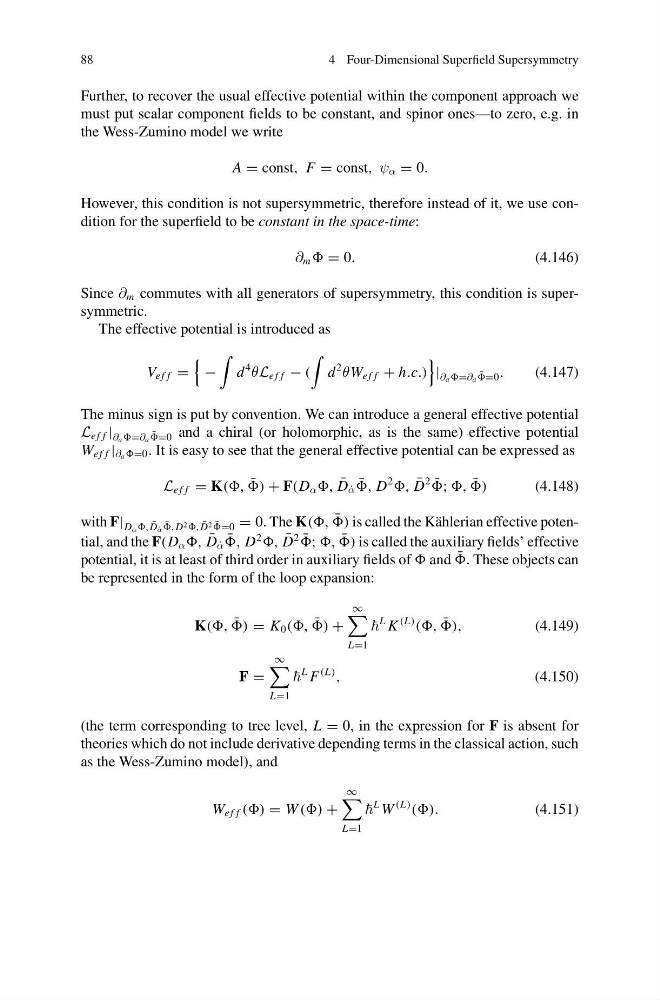
Further, to recover the usual effective potential within the component approach we
must put scalar component fields to be constant, and spinor ones—to zero, e.g. in
the Wess-Zumino model we write
A = const, F = const, ψ α = 0.
However, this condition is not supersymmetric, therefore instead of it, we use condition for the superfield to be constant in the space-time:
∂ m = 0.
(4.146)
Since ∂ m commutes with all generators of supersymmetry, this condition is supersymmetric.
The effective potential is introduced as
V e f f =
−
d
4
θL e f f − (
d
2
θW e f f + h.c.)
| ∂ a =∂ a ¯
=0 .
(4.147)
The minus sign is put by convention. We can introduce a general effective potential
L e f f | ∂ a =∂ a ¯
=0 and a chiral (or holomorphic, as is the same) effective potential
W e f f | ∂ a =0 . It is easy to see that the general effective potential can be expressed as
L e f f = K((, ¯
) + F(D α , ¯
D ˙
α ¯
, D
2
, ¯
D
2 ¯
; , ¯
)
(4.148)
with F| D α , ¯
D ˙
α ¯
,D 2 , ¯
D 2 ¯
=0 = 0. The K((, ¯
) is called the Kählerian effective potential, and the F(D α , ¯
D ˙
α
¯
, D
2
, ¯
D
2 ¯
; , ¯
) is called the auxiliary fields’ effective
potential, it is at least of third order in auxiliary fields of and ¯
. These objects can
be represented in the form of the loop expansion:
K((, ¯
) = K 0 ((, ¯
) +
∞
L=1
L K
(L)
((, ¯
),
(4.149)
F =
∞
L=1
L F
(L)
,
(4.150)
(the term corresponding to tree level, L = 0, in the expression for F is absent for
theories which do not include derivative depending terms in the classical action, such
as the Wess-Zumino model), and
W e f f (() = W (() +
∞
L=1
L W
(L)
(().
(4.151)
4 Four-Dimensional Superfield Supersymmetry
Further, to recover the usual effective potential within the component approach we
must put scalar component fields to be constant, and spinor ones—to zero, e.g. in
the Wess-Zumino model we write
A = const, F = const, ψ α = 0.
However, this condition is not supersymmetric, therefore instead of it, we use condition for the superfield to be constant in the space-time:
∂ m = 0.
(4.146)
Since ∂ m commutes with all generators of supersymmetry, this condition is supersymmetric.
The effective potential is introduced as
V e f f =
−
d
4
θL e f f − (
d
2
θW e f f + h.c.)
| ∂ a =∂ a ¯
=0 .
(4.147)
The minus sign is put by convention. We can introduce a general effective potential
L e f f | ∂ a =∂ a ¯
=0 and a chiral (or holomorphic, as is the same) effective potential
W e f f | ∂ a =0 . It is easy to see that the general effective potential can be expressed as
L e f f = K((, ¯
) + F(D α , ¯
D ˙
α ¯
, D
2
, ¯
D
2 ¯
; , ¯
)
(4.148)
with F| D α , ¯
D ˙
α ¯
,D 2 , ¯
D 2 ¯
=0 = 0. The K((, ¯
) is called the Kählerian effective potential, and the F(D α , ¯
D ˙
α
¯
, D
2
, ¯
D
2 ¯
; , ¯
) is called the auxiliary fields’ effective
potential, it is at least of third order in auxiliary fields of and ¯
. These objects can
be represented in the form of the loop expansion:
K((, ¯
) = K 0 ((, ¯
) +
∞
L=1
L K
(L)
((, ¯
),
(4.149)
F =
∞
L=1
L F
(L)
,
(4.150)
(the term corresponding to tree level, L = 0, in the expression for F is absent for
theories which do not include derivative depending terms in the classical action, such
as the Wess-Zumino model), and
W e f f (() = W (() +
∞
L=1
L W
(L)
(().
(4.151)