

58
4 Four-Dimensional Superfield Supersymmetry
4.2.1 Chiral Superfield Models
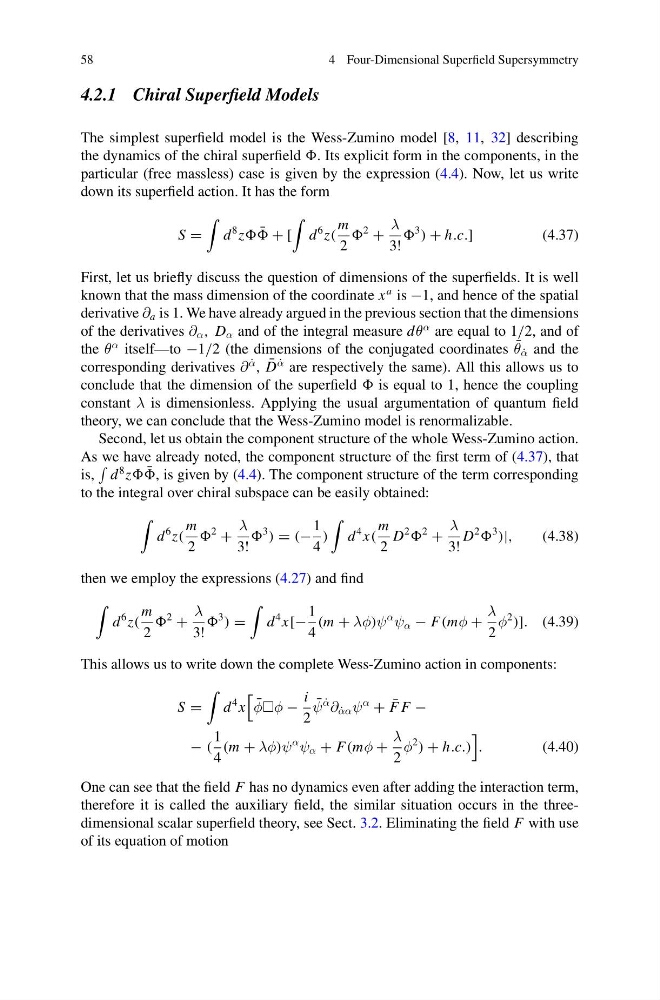
The simplest superfield model is the Wess-Zumino model [8, 11, 32] describing
the dynamics of the chiral superfield . Its explicit form in the components, in the
particular (free massless) case is given by the expression (4.4). Now, let us write
down its superfield action. It has the form
S =
d
8 z ¯
+ [
d
6 z(
m
2
2
+
λ
3!
3
) + h.c.]
(4.37)
First, let us briefly discuss the question of dimensions of the superfields. It is well
known that the mass dimension of the coordinate x
a is −1, and hence of the spatial
derivative ∂ a is 1. We have already argued in the previous section that the dimensions
of the derivatives ∂ α , D α and of the integral measure dθ
α are equal to 1/2, and of
the θ
α itself—to −1/2 (the dimensions of the conjugated coordinates ¯
θ ˙
α and the
corresponding derivatives ∂
˙
α , ¯
D
˙
α are respectively the same). All this allows us to
conclude that the dimension of the superfield is equal to 1, hence the coupling
constant λ is dimensionless. Applying the usual argumentation of quantum field
theory, we can conclude that the Wess-Zumino model is renormalizable.
Second, let us obtain the component structure of the whole Wess-Zumino action.
As we have already noted, the component structure of the first term of (4.37), that
is,
d
8 z ¯
, is given by (4.4). The component structure of the term corresponding
to the integral over chiral subspace can be easily obtained:
d
6 z(
m
2
2
+
λ
3!
3
) = (−
1
4
)
d
4 x(
m
2
D
2
2
+
λ
3!
D
2
3
)|,
(4.38)
then we employ the expressions (4.27) and find
d
6 z(
m
2
2
+
λ
3!
3
) =
d
4 x[−
1
4
(m + λφ)ψ
α
ψ α − F(mφ +
λ
2
φ
2
)]. (4.39)
This allows us to write down the complete Wess-Zumino action in components:
S =
d
4 x
¯
φφ −
i
2
¯
ψ
˙
α
∂ ˙
αα ψ
α
+ ¯
F F −
− (
1
4
(m + λφ)ψ
α
ψ α + F(mφ +
λ
2
φ
2
) + h.c.)
.
(4.40)
One can see that the field F has no dynamics even after adding the interaction term,
therefore it is called the auxiliary field, the similar situation occurs in the threedimensional scalar superfield theory, see Sect. 3.2. Eliminating the field F with use
of its equation of motion
4 Four-Dimensional Superfield Supersymmetry
4.2.1 Chiral Superfield Models
The simplest superfield model is the Wess-Zumino model [8, 11, 32] describing
the dynamics of the chiral superfield . Its explicit form in the components, in the
particular (free massless) case is given by the expression (4.4). Now, let us write
down its superfield action. It has the form
S =
d
8 z ¯
+ [
d
6 z(
m
2
2
+
λ
3!
3
) + h.c.]
(4.37)
First, let us briefly discuss the question of dimensions of the superfields. It is well
known that the mass dimension of the coordinate x
a is −1, and hence of the spatial
derivative ∂ a is 1. We have already argued in the previous section that the dimensions
of the derivatives ∂ α , D α and of the integral measure dθ
α are equal to 1/2, and of
the θ
α itself—to −1/2 (the dimensions of the conjugated coordinates ¯
θ ˙
α and the
corresponding derivatives ∂
˙
α , ¯
D
˙
α are respectively the same). All this allows us to
conclude that the dimension of the superfield is equal to 1, hence the coupling
constant λ is dimensionless. Applying the usual argumentation of quantum field
theory, we can conclude that the Wess-Zumino model is renormalizable.
Second, let us obtain the component structure of the whole Wess-Zumino action.
As we have already noted, the component structure of the first term of (4.37), that
is,
d
8 z ¯
, is given by (4.4). The component structure of the term corresponding
to the integral over chiral subspace can be easily obtained:
d
6 z(
m
2
2
+
λ
3!
3
) = (−
1
4
)
d
4 x(
m
2
D
2
2
+
λ
3!
D
2
3
)|,
(4.38)
then we employ the expressions (4.27) and find
d
6 z(
m
2
2
+
λ
3!
3
) =
d
4 x[−
1
4
(m + λφ)ψ
α
ψ α − F(mφ +
λ
2
φ
2
)]. (4.39)
This allows us to write down the complete Wess-Zumino action in components:
S =
d
4 x
¯
φφ −
i
2
¯
ψ
˙
α
∂ ˙
αα ψ
α
+ ¯
F F −
− (
1
4
(m + λφ)ψ
α
ψ α + F(mφ +
λ
2
φ
2
) + h.c.)
.
(4.40)
One can see that the field F has no dynamics even after adding the interaction term,
therefore it is called the auxiliary field, the similar situation occurs in the threedimensional scalar superfield theory, see Sect. 3.2. Eliminating the field F with use
of its equation of motion