

4.2 Field Theory Models in the Four-Dimensional Superspace
59
F − (m ¯
φ +
λ
2
¯
φ
2
) = 0
(4.41)
implies in the theory with the φ
4 interaction, by this reason the Wess-Zumino model
is treated as a supersymmetric extension of the φ
4 theory.
It is instructive to calculate the numbers of bosonic and fermionic degrees of
freedom in the Wess-Zumino model. It follows from (4.40) that in this model there
are four bosonic degrees of freedom (which correspond to two complex scalar fields
φ and F) and four fermionic ones (which corresponds to two components of the
complex spinor ψ α ). This confirms again that in any supersymmetric theory, numbers
of bosonic and fermionic degrees of freedom are equal. Also, we note that masses of
all component fields of the supermultiplet are equal. As we argued in the previous
chapter, the same situation takes place in three-dimensional supersymmetric theories.
We note that the Wess-Zumino model is not an unique theory describing the
quantum dynamics of the chiral superfield. Other important examples are the higherderivative chiral superfield theories (in particular, dilaton supergravity) and general
chiral superfield theories. The examples of actions of these theories in superfield
form are respectively
S =
d
8 z ¯
( − M
2
)) + (
d
6 zW (() + h.c.)
(4.42)
and
S =
d
8 zK ((, ¯
) + (
d
6 zW (() + h.c.).
(4.43)
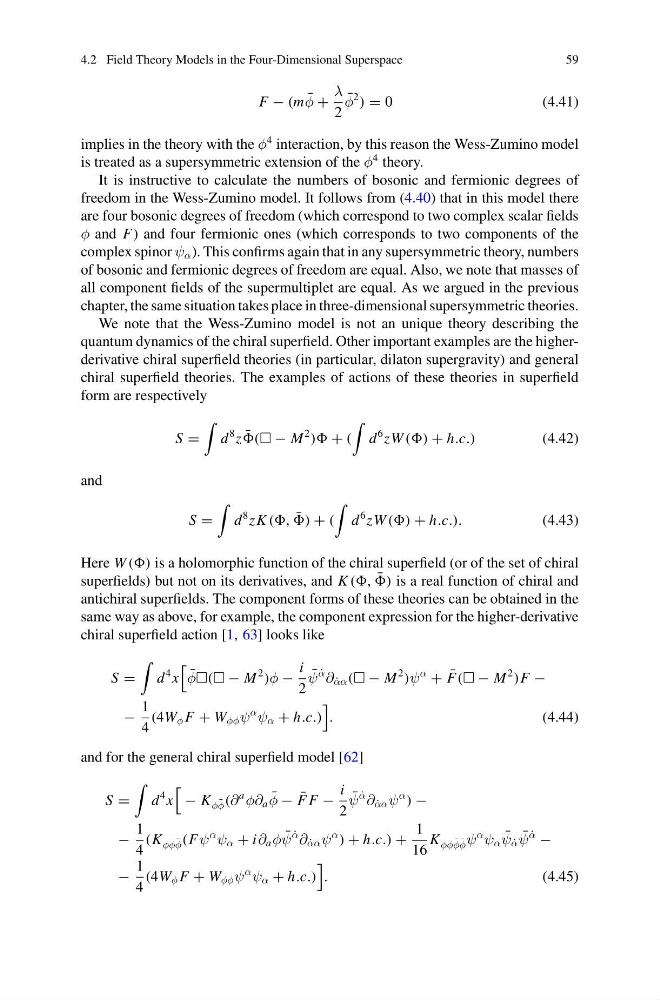
Here W (() is a holomorphic function of the chiral superfield (or of the set of chiral
superfields) but not on its derivatives, and K ((, ¯
) is a real function of chiral and
antichiral superfields. The component forms of these theories can be obtained in the
same way as above, for example, the component expression for the higher-derivative
chiral superfield action [1, 63] looks like
S =
d
4 x
¯
φ( − M
2
)φ −
i
2
¯
ψ
˙
α
∂ ˙
αα ( − M
2
)ψ
α
+ ¯
F( − M
2
)F −
−
1
4
(4W φ F + W φφ ψ
α
ψ α + h.c.)
.
(4.44)
and for the general chiral superfield model [62]
S =
d
4 x
− K φ ¯
φ (∂
a
φ∂ a ¯
φ − ¯
F F −
i
2
¯
ψ
˙
α
∂ ˙
αα ψ
α
) −
−
1
4
(K φφ ¯
φ (Fψ
α
ψ α + i∂ a φ ¯
ψ
˙
α
∂ ˙
αα ψ
α
) + h.c.) +
1
16
K φφ ¯
φ ¯
φ ψ
α
ψ α ¯
ψ ˙
α
¯
ψ
˙
α
−
−
1
4
(4W φ F + W φφ ψ
α
ψ α + h.c.)
.
(4.45)
59
F − (m ¯
φ +
λ
2
¯
φ
2
) = 0
(4.41)
implies in the theory with the φ
4 interaction, by this reason the Wess-Zumino model
is treated as a supersymmetric extension of the φ
4 theory.
It is instructive to calculate the numbers of bosonic and fermionic degrees of
freedom in the Wess-Zumino model. It follows from (4.40) that in this model there
are four bosonic degrees of freedom (which correspond to two complex scalar fields
φ and F) and four fermionic ones (which corresponds to two components of the
complex spinor ψ α ). This confirms again that in any supersymmetric theory, numbers
of bosonic and fermionic degrees of freedom are equal. Also, we note that masses of
all component fields of the supermultiplet are equal. As we argued in the previous
chapter, the same situation takes place in three-dimensional supersymmetric theories.
We note that the Wess-Zumino model is not an unique theory describing the
quantum dynamics of the chiral superfield. Other important examples are the higherderivative chiral superfield theories (in particular, dilaton supergravity) and general
chiral superfield theories. The examples of actions of these theories in superfield
form are respectively
S =
d
8 z ¯
( − M
2
)) + (
d
6 zW (() + h.c.)
(4.42)
and
S =
d
8 zK ((, ¯
) + (
d
6 zW (() + h.c.).
(4.43)
Here W (() is a holomorphic function of the chiral superfield (or of the set of chiral
superfields) but not on its derivatives, and K ((, ¯
) is a real function of chiral and
antichiral superfields. The component forms of these theories can be obtained in the
same way as above, for example, the component expression for the higher-derivative
chiral superfield action [1, 63] looks like
S =
d
4 x
¯
φ( − M
2
)φ −
i
2
¯
ψ
˙
α
∂ ˙
αα ( − M
2
)ψ
α
+ ¯
F( − M
2
)F −
−
1
4
(4W φ F + W φφ ψ
α
ψ α + h.c.)
.
(4.44)
and for the general chiral superfield model [62]
S =
d
4 x
− K φ ¯
φ (∂
a
φ∂ a ¯
φ − ¯
F F −
i
2
¯
ψ
˙
α
∂ ˙
αα ψ
α
) −
−
1
4
(K φφ ¯
φ (Fψ
α
ψ α + i∂ a φ ¯
ψ
˙
α
∂ ˙
αα ψ
α
) + h.c.) +
1
16
K φφ ¯
φ ¯
φ ψ
α
ψ α ¯
ψ ˙
α
¯
ψ
˙
α
−
−
1
4
(4W φ F + W φφ ψ
α
ψ α + h.c.)
.
(4.45)