

4.1 General Properties of the Four-Dimensional Superspace
57
δ
δ(z)
d
8 z
G(z
))(z
) =
δ
δ(z)
d
6 z
(−
1
4
¯
D
2
)G(z
))(z
) = −
1
4
¯
D
2 G(z).
(4.32)
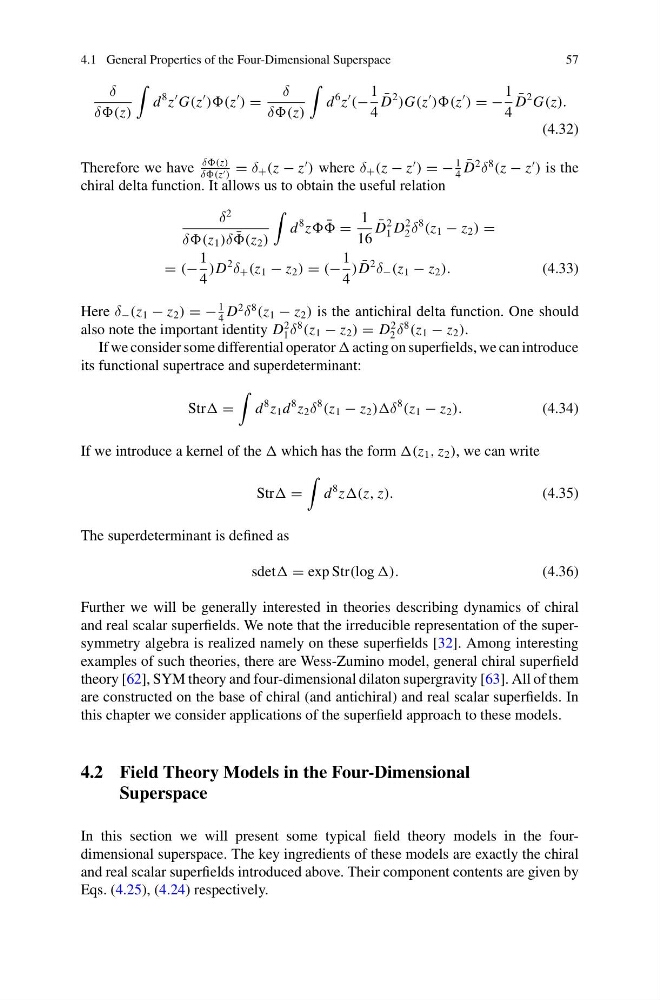
Therefore we have
δ(z)
δ(z )
= δ + (z − z
) where δ + (z − z
) = −
1
4
¯
D
2
δ
8
(z − z
) is the
chiral delta function. It allows us to obtain the useful relation
δ
2
δ(z 1 )δ ¯
(z 2 )
d
8 z ¯
=
1
16
¯
D
2
1 D
2
2 δ
8
(z 1 − z 2 ) =
= (−
1
4
)D
2
δ + (z 1 − z 2 ) = (−
1
4
) ¯
D
2
δ − (z 1 − z 2 ).
(4.33)
Here δ − (z 1 − z 2 ) = −
1
4
D
2
δ
8
(z 1 − z 2 ) is the antichiral delta function. One should
also note the important identity D
2
1 δ
8
(z 1 − z 2 ) = D
2
2 δ
8
(z 1 − z 2 ).
If we consider some differential operator acting on superfields, we can introduce
its functional supertrace and superdeterminant:
Str =
d
8 z 1 d
8 z 2 δ
8
(z 1 − z 2 ))δ
8
(z 1 − z 2 ).
(4.34)
If we introduce a kernel of the which has the form (z 1 , z 2 ), we can write
Str =
d
8 z(z, z).
(4.35)
The superdeterminant is defined as
sdet = exp Str(log ).
(4.36)
Further we will be generally interested in theories describing dynamics of chiral
and real scalar superfields. We note that the irreducible representation of the supersymmetry algebra is realized namely on these superfields [32]. Among interesting
examples of such theories, there are Wess-Zumino model, general chiral superfield
theory [62], SYM theory and four-dimensional dilaton supergravity [63]. All of them
are constructed on the base of chiral (and antichiral) and real scalar superfields. In
this chapter we consider applications of the superfield approach to these models.
4.2 Field Theory Models in the Four-Dimensional
Superspace
In this section we will present some typical field theory models in the fourdimensional superspace. The key ingredients of these models are exactly the chiral
and real scalar superfields introduced above. Their component contents are given by
Eqs. (4.25), (4.24) respectively.
57
δ
δ(z)
d
8 z
G(z
))(z
) =
δ
δ(z)
d
6 z
(−
1
4
¯
D
2
)G(z
))(z
) = −
1
4
¯
D
2 G(z).
(4.32)
Therefore we have
δ(z)
δ(z )
= δ + (z − z
) where δ + (z − z
) = −
1
4
¯
D
2
δ
8
(z − z
) is the
chiral delta function. It allows us to obtain the useful relation
δ
2
δ(z 1 )δ ¯
(z 2 )
d
8 z ¯
=
1
16
¯
D
2
1 D
2
2 δ
8
(z 1 − z 2 ) =
= (−
1
4
)D
2
δ + (z 1 − z 2 ) = (−
1
4
) ¯
D
2
δ − (z 1 − z 2 ).
(4.33)
Here δ − (z 1 − z 2 ) = −
1
4
D
2
δ
8
(z 1 − z 2 ) is the antichiral delta function. One should
also note the important identity D
2
1 δ
8
(z 1 − z 2 ) = D
2
2 δ
8
(z 1 − z 2 ).
If we consider some differential operator acting on superfields, we can introduce
its functional supertrace and superdeterminant:
Str =
d
8 z 1 d
8 z 2 δ
8
(z 1 − z 2 ))δ
8
(z 1 − z 2 ).
(4.34)
If we introduce a kernel of the which has the form (z 1 , z 2 ), we can write
Str =
d
8 z(z, z).
(4.35)
The superdeterminant is defined as
sdet = exp Str(log ).
(4.36)
Further we will be generally interested in theories describing dynamics of chiral
and real scalar superfields. We note that the irreducible representation of the supersymmetry algebra is realized namely on these superfields [32]. Among interesting
examples of such theories, there are Wess-Zumino model, general chiral superfield
theory [62], SYM theory and four-dimensional dilaton supergravity [63]. All of them
are constructed on the base of chiral (and antichiral) and real scalar superfields. In
this chapter we consider applications of the superfield approach to these models.
4.2 Field Theory Models in the Four-Dimensional
Superspace
In this section we will present some typical field theory models in the fourdimensional superspace. The key ingredients of these models are exactly the chiral
and real scalar superfields introduced above. Their component contents are given by
Eqs. (4.25), (4.24) respectively.