

56
4 Four-Dimensional Superfield Supersymmetry
and the definitions for the components of ¯
can be obtained via straightforward
conjugation of these definitions. Here, similarly to the previous chapter, we use the
notation (z)| ≡ (z)| θ= ¯
θ=0 , with the condition θ = ¯
θ = 0 is imposed after the
differentiation.
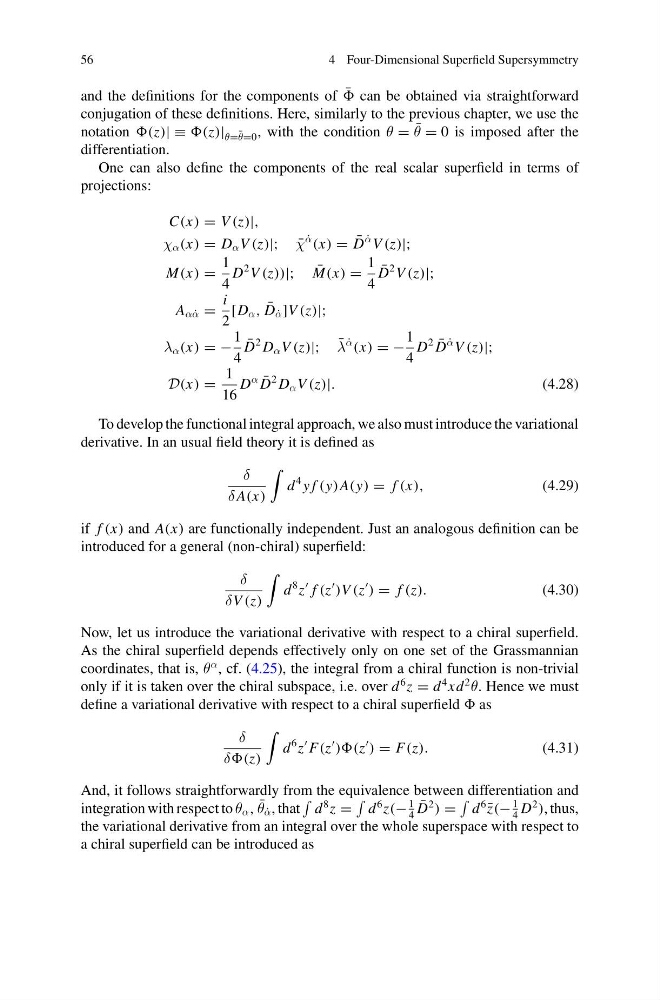
One can also define the components of the real scalar superfield in terms of
projections:
C(x) = V (z)|,
χ α (x) = D α V (z)|; ¯
χ
˙
α
(x) = ¯
D
˙
α V (z)|;
M(x) =
1
4
D
2 V (z))|;
¯
M(x) =
1
4
¯
D
2 V (z)|;
A α ˙
α =
i
2
[D α , ¯
D ˙
α ]V (z)|;
λ α (x) = −
1
4
¯
D
2 D α V (z)|; ¯
λ
˙
α
(x) = −
1
4
D
2 ¯
D
˙
α V (z)|;
D(x) =
1
16
D
α ¯
D
2 D α V (z)|.
(4.28)
To develop the functional integral approach, we also must introduce the variational
derivative. In an usual field theory it is defined as
δ
δ A(x)
d
4 y f (y)A(y) = f (x),
(4.29)
if f (x) and A(x) are functionally independent. Just an analogous definition can be
introduced for a general (non-chiral) superfield:
δ
δV (z)
d
8 z
f (z
)V (z
) = f (z).
(4.30)
Now, let us introduce the variational derivative with respect to a chiral superfield.
As the chiral superfield depends effectively only on one set of the Grassmannian
coordinates, that is, θ
α , cf. (4.25), the integral from a chiral function is non-trivial
only if it is taken over the chiral subspace, i.e. over d
6 z = d
4 xd
2
θ. Hence we must
define a variational derivative with respect to a chiral superfield as
δ
δ(z)
d
6 z
F(z
))(z
) = F(z).
(4.31)
And, it follows straightforwardly from the equivalence between differentiation and
integration with respect to θ α , ¯
θ ˙
α , that
d
8 z =
d
6 z(−
1
4
¯
D
2
) =
d
6
¯
z(−
1
4
D
2
), thus,
the variational derivative from an integral over the whole superspace with respect to
a chiral superfield can be introduced as
4 Four-Dimensional Superfield Supersymmetry
and the definitions for the components of ¯
can be obtained via straightforward
conjugation of these definitions. Here, similarly to the previous chapter, we use the
notation (z)| ≡ (z)| θ= ¯
θ=0 , with the condition θ = ¯
θ = 0 is imposed after the
differentiation.
One can also define the components of the real scalar superfield in terms of
projections:
C(x) = V (z)|,
χ α (x) = D α V (z)|; ¯
χ
˙
α
(x) = ¯
D
˙
α V (z)|;
M(x) =
1
4
D
2 V (z))|;
¯
M(x) =
1
4
¯
D
2 V (z)|;
A α ˙
α =
i
2
[D α , ¯
D ˙
α ]V (z)|;
λ α (x) = −
1
4
¯
D
2 D α V (z)|; ¯
λ
˙
α
(x) = −
1
4
D
2 ¯
D
˙
α V (z)|;
D(x) =
1
16
D
α ¯
D
2 D α V (z)|.
(4.28)
To develop the functional integral approach, we also must introduce the variational
derivative. In an usual field theory it is defined as
δ
δ A(x)
d
4 y f (y)A(y) = f (x),
(4.29)
if f (x) and A(x) are functionally independent. Just an analogous definition can be
introduced for a general (non-chiral) superfield:
δ
δV (z)
d
8 z
f (z
)V (z
) = f (z).
(4.30)
Now, let us introduce the variational derivative with respect to a chiral superfield.
As the chiral superfield depends effectively only on one set of the Grassmannian
coordinates, that is, θ
α , cf. (4.25), the integral from a chiral function is non-trivial
only if it is taken over the chiral subspace, i.e. over d
6 z = d
4 xd
2
θ. Hence we must
define a variational derivative with respect to a chiral superfield as
δ
δ(z)
d
6 z
F(z
))(z
) = F(z).
(4.31)
And, it follows straightforwardly from the equivalence between differentiation and
integration with respect to θ α , ¯
θ ˙
α , that
d
8 z =
d
6 z(−
1
4
¯
D
2
) =
d
6
¯
z(−
1
4
D
2
), thus,
the variational derivative from an integral over the whole superspace with respect to
a chiral superfield can be introduced as