

4.1 General Properties of the Four-Dimensional Superspace
55
d
4 x
d
4
θ
= d
4 xd
4
θ sdet(
∂z
∂z
),
(4.22)
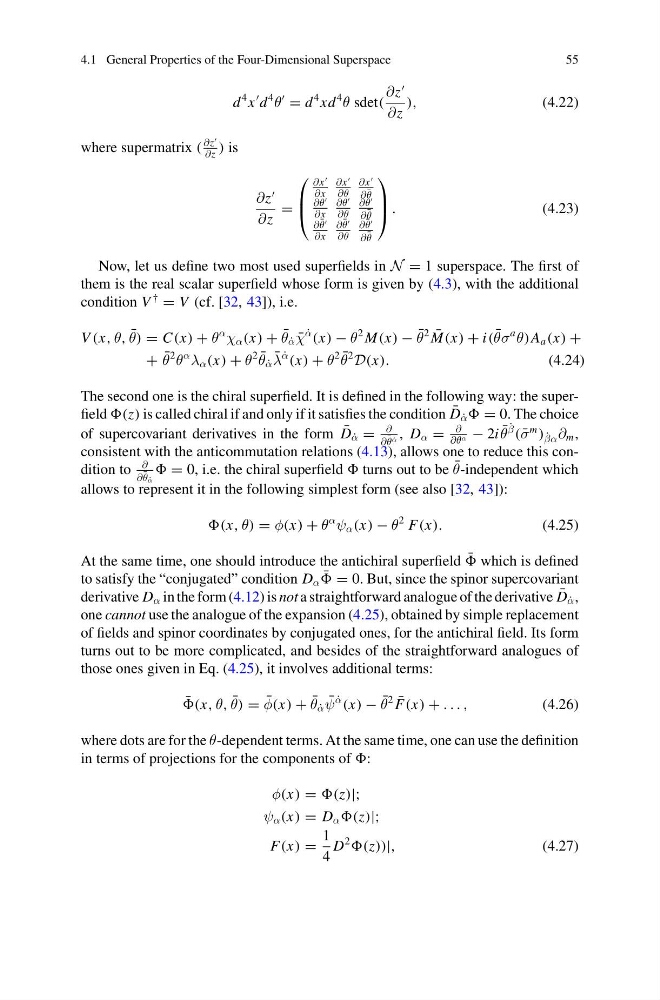
where supermatrix (
∂z
∂z
) is
∂z
∂z
=
⎛
⎜
⎝
∂x
∂x
∂x
∂θ
∂x
∂ ¯
θ
∂θ
∂x
∂θ
∂θ
∂θ
∂ ¯
θ
∂ ¯
θ
∂x
∂ ¯
θ
∂θ
∂ ¯
θ
∂ ¯
θ
⎞
⎟
⎠ .
(4.23)
Now, let us define two most used superfields in N = 1 superspace. The first of
them is the real scalar superfield whose form is given by (4.3), with the additional
condition V
†
= V (cf. [32, 43]), i.e.
V (x, θ, ¯
θ) = C(x) + θ
α
χ α (x) + ¯
θ ˙
α ¯
χ
˙
α
(x) − θ
2 M(x) − ¯
θ
2 ¯
M(x) + i( ¯
θσ
a
θ)A a (x) +
+ ¯
θ
2
θ
α
λ α (x) + θ
2 ¯
θ ˙
α
¯
λ
˙
α
(x) + θ
2 ¯
θ
2
D(x).
(4.24)
The second one is the chiral superfield. It is defined in the following way: the superfield (z) is called chiral if and only if it satisfies the condition ¯
D ˙
α = 0. The choice
of supercovariant derivatives in the form ¯
D ˙
α =
∂
∂ ¯
θ ˙
α , D α =
∂
∂θ α − 2i ¯
θ
˙
β
( ¯
σ
m
) ˙
βα ∂ m ,
consistent with the anticommutation relations (4.13), allows one to reduce this condition to
∂
∂ ¯
θ ˙
α
= 0, i.e. the chiral superfield turns out to be ¯
θ-independent which
allows to represent it in the following simplest form (see also [32, 43]):
(x, θ) = φ(x) + θ
α
ψ α (x) − θ
2 F(x).
(4.25)
At the same time, one should introduce the antichiral superfield ¯
which is defined
to satisfy the “conjugated” condition D α ¯
= 0. But, since the spinor supercovariant
derivative D α in the form (4.12) is not a straightforward analogue of the derivative ¯
D ˙
α ,
one cannot use the analogue of the expansion (4.25), obtained by simple replacement
of fields and spinor coordinates by conjugated ones, for the antichiral field. Its form
turns out to be more complicated, and besides of the straightforward analogues of
those ones given in Eq. (4.25), it involves additional terms:
¯
(x, θ, ¯
θ) = ¯
φ(x) + ¯
θ ˙
α
¯
ψ
˙
α
(x) − ¯
θ
2 ¯
F(x) + . . . ,
(4.26)
where dots are for the θ-dependent terms. At the same time, one can use the definition
in terms of projections for the components of :
φ(x) = (z)|;
ψ α (x) = D α (z)|;
F(x) =
1
4
D
2
(z))|,
(4.27)
55
d
4 x
d
4
θ
= d
4 xd
4
θ sdet(
∂z
∂z
),
(4.22)
where supermatrix (
∂z
∂z
) is
∂z
∂z
=
⎛
⎜
⎝
∂x
∂x
∂x
∂θ
∂x
∂ ¯
θ
∂θ
∂x
∂θ
∂θ
∂θ
∂ ¯
θ
∂ ¯
θ
∂x
∂ ¯
θ
∂θ
∂ ¯
θ
∂ ¯
θ
⎞
⎟
⎠ .
(4.23)
Now, let us define two most used superfields in N = 1 superspace. The first of
them is the real scalar superfield whose form is given by (4.3), with the additional
condition V
†
= V (cf. [32, 43]), i.e.
V (x, θ, ¯
θ) = C(x) + θ
α
χ α (x) + ¯
θ ˙
α ¯
χ
˙
α
(x) − θ
2 M(x) − ¯
θ
2 ¯
M(x) + i( ¯
θσ
a
θ)A a (x) +
+ ¯
θ
2
θ
α
λ α (x) + θ
2 ¯
θ ˙
α
¯
λ
˙
α
(x) + θ
2 ¯
θ
2
D(x).
(4.24)
The second one is the chiral superfield. It is defined in the following way: the superfield (z) is called chiral if and only if it satisfies the condition ¯
D ˙
α = 0. The choice
of supercovariant derivatives in the form ¯
D ˙
α =
∂
∂ ¯
θ ˙
α , D α =
∂
∂θ α − 2i ¯
θ
˙
β
( ¯
σ
m
) ˙
βα ∂ m ,
consistent with the anticommutation relations (4.13), allows one to reduce this condition to
∂
∂ ¯
θ ˙
α
= 0, i.e. the chiral superfield turns out to be ¯
θ-independent which
allows to represent it in the following simplest form (see also [32, 43]):
(x, θ) = φ(x) + θ
α
ψ α (x) − θ
2 F(x).
(4.25)
At the same time, one should introduce the antichiral superfield ¯
which is defined
to satisfy the “conjugated” condition D α ¯
= 0. But, since the spinor supercovariant
derivative D α in the form (4.12) is not a straightforward analogue of the derivative ¯
D ˙
α ,
one cannot use the analogue of the expansion (4.25), obtained by simple replacement
of fields and spinor coordinates by conjugated ones, for the antichiral field. Its form
turns out to be more complicated, and besides of the straightforward analogues of
those ones given in Eq. (4.25), it involves additional terms:
¯
(x, θ, ¯
θ) = ¯
φ(x) + ¯
θ ˙
α
¯
ψ
˙
α
(x) − ¯
θ
2 ¯
F(x) + . . . ,
(4.26)
where dots are for the θ-dependent terms. At the same time, one can use the definition
in terms of projections for the components of :
φ(x) = (z)|;
ψ α (x) = D α (z)|;
F(x) =
1
4
D
2
(z))|,
(4.27)