

54
4 Four-Dimensional Superfield Supersymmetry
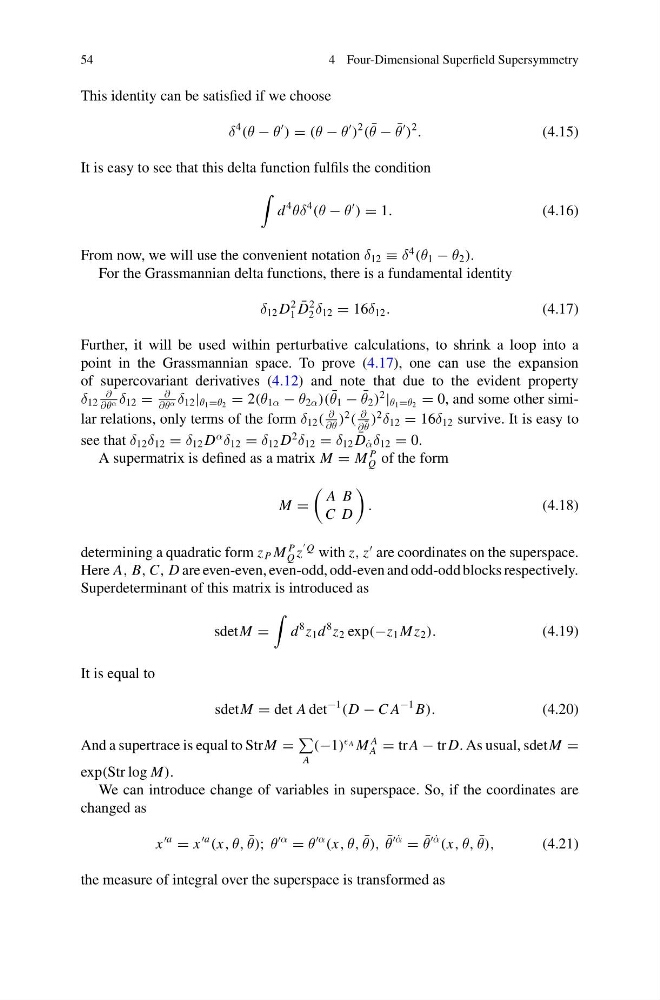
This identity can be satisfied if we choose
δ
4
(θ − θ
) = (θ − θ
)
2
( ¯
θ − ¯
θ
)
2
.
(4.15)
It is easy to see that this delta function fulfils the condition
d
4
θδ
4
(θ − θ
) = 1.
(4.16)
From now, we will use the convenient notation δ 12 ≡ δ
4
(θ 1 − θ 2 ).
For the Grassmannian delta functions, there is a fundamental identity
δ 12 D
2
1
¯
D
2
2 δ 12 = 16δ 12 .
(4.17)
Further, it will be used within perturbative calculations, to shrink a loop into a
point in the Grassmannian space. To prove (4.17), one can use the expansion
of supercovariant derivatives (4.12) and note that due to the evident property
δ 12
∂
∂θ α δ 12 =
∂
∂θ α δ 12 | θ 1 =θ 2 = 2(θ 1α − θ 2α )( ¯
θ 1 − ¯
θ 2 )
2
| θ 1 =θ 2 = 0, and some other similar relations, only terms of the form δ 12 (
∂
∂θ
)
2
(
∂
∂ ¯
θ
)
2
δ 12 = 16δ 12 survive. It is easy to
see that δ 12 δ 12 = δ 12 D
α
δ 12 = δ 12 D
2
δ 12 = δ 12 ¯
D ˙
α δ 12 = 0.
A supermatrix is defined as a matrix M = M
P
Q of the form
M =
A B
C D
.
(4.18)
determining a quadratic form z P M
P
Q z
Q with z, z
are coordinates on the superspace.
Here A, B, C, D are even-even, even-odd, odd-even and odd-odd blocks respectively.
Superdeterminant of this matrix is introduced as
sdetM =
d
8 z 1 d
8 z 2 exp(−z 1 Mz 2 ).
(4.19)
It is equal to
sdetM = det A det
−1
(D − C A
−1 B).
(4.20)
And a supertrace is equal to StrM =
A
(−1)
A M
A
A = tr A − tr D. As usual, sdetM =
exp(Str log M).
We can introduce change of variables in superspace. So, if the coordinates are
changed as
x
a
= x
a
(x, θ, ¯
θ); θ
α
= θ
α
(x, θ, ¯
θ), ¯
θ
˙
α
= ¯
θ
˙
α
(x, θ, ¯
θ),
(4.21)
the measure of integral over the superspace is transformed as
4 Four-Dimensional Superfield Supersymmetry
This identity can be satisfied if we choose
δ
4
(θ − θ
) = (θ − θ
)
2
( ¯
θ − ¯
θ
)
2
.
(4.15)
It is easy to see that this delta function fulfils the condition
d
4
θδ
4
(θ − θ
) = 1.
(4.16)
From now, we will use the convenient notation δ 12 ≡ δ
4
(θ 1 − θ 2 ).
For the Grassmannian delta functions, there is a fundamental identity
δ 12 D
2
1
¯
D
2
2 δ 12 = 16δ 12 .
(4.17)
Further, it will be used within perturbative calculations, to shrink a loop into a
point in the Grassmannian space. To prove (4.17), one can use the expansion
of supercovariant derivatives (4.12) and note that due to the evident property
δ 12
∂
∂θ α δ 12 =
∂
∂θ α δ 12 | θ 1 =θ 2 = 2(θ 1α − θ 2α )( ¯
θ 1 − ¯
θ 2 )
2
| θ 1 =θ 2 = 0, and some other similar relations, only terms of the form δ 12 (
∂
∂θ
)
2
(
∂
∂ ¯
θ
)
2
δ 12 = 16δ 12 survive. It is easy to
see that δ 12 δ 12 = δ 12 D
α
δ 12 = δ 12 D
2
δ 12 = δ 12 ¯
D ˙
α δ 12 = 0.
A supermatrix is defined as a matrix M = M
P
Q of the form
M =
A B
C D
.
(4.18)
determining a quadratic form z P M
P
Q z
Q with z, z
are coordinates on the superspace.
Here A, B, C, D are even-even, even-odd, odd-even and odd-odd blocks respectively.
Superdeterminant of this matrix is introduced as
sdetM =
d
8 z 1 d
8 z 2 exp(−z 1 Mz 2 ).
(4.19)
It is equal to
sdetM = det A det
−1
(D − C A
−1 B).
(4.20)
And a supertrace is equal to StrM =
A
(−1)
A M
A
A = tr A − tr D. As usual, sdetM =
exp(Str log M).
We can introduce change of variables in superspace. So, if the coordinates are
changed as
x
a
= x
a
(x, θ, ¯
θ); θ
α
= θ
α
(x, θ, ¯
θ), ¯
θ
˙
α
= ¯
θ
˙
α
(x, θ, ¯
θ),
(4.21)
the measure of integral over the superspace is transformed as