

3.6 Supersymmetry in Three-Dimensional Space-Time and Noncommutativity
43
i S 3 ( p) = −2
d 2 θ
d 3 k
(2π) 3
sin 2 (k ∧ p)
(k 2 + m 2 )[(k + p) 2 + m 2 ]
(3.158)
× (k γβ + mC γβ )
(D 2 A γ (− p, θ))A β ( p, θ) +
1
2
D γ D α A α (− p, θ)A β ( p, θ)
.
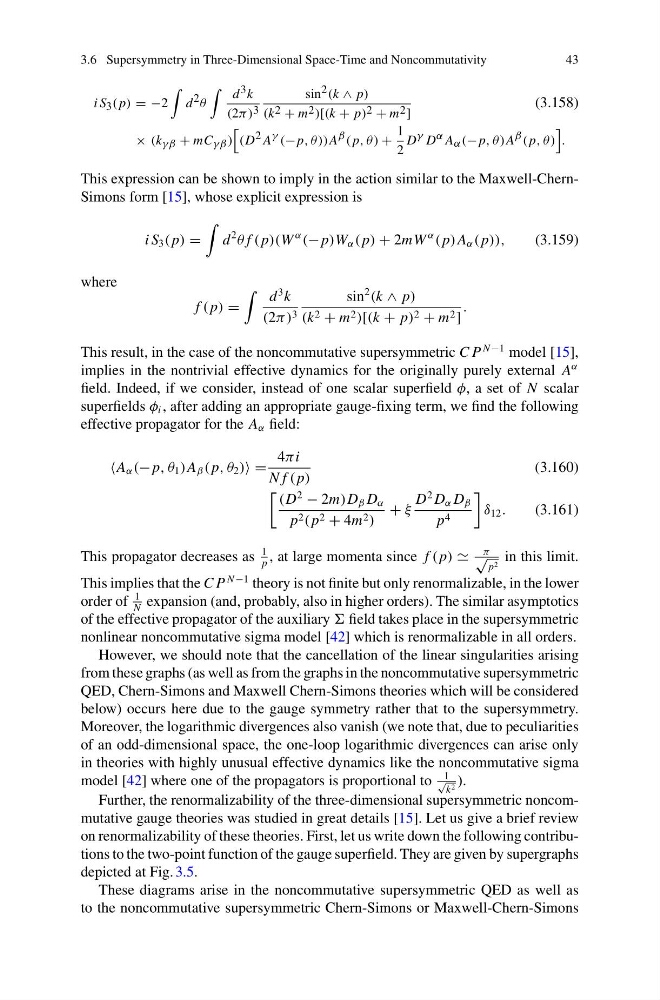
This expression can be shown to imply in the action similar to the Maxwell-ChernSimons form [15], whose explicit expression is
i S 3 ( p) =
d
2
θ f ( p)(W
α
(− p)W α ( p) + 2mW
α
( p)A α ( p)),
(3.159)
where
f ( p) =
d
3 k
(2π) 3
sin
2
(k ∧ p)
(k 2 + m 2 )[(k + p) 2 + m 2 ]
.
This result, in the case of the noncommutative supersymmetric C P
N −1 model [15],
implies in the nontrivial effective dynamics for the originally purely external A
α
field. Indeed, if we consider, instead of one scalar superfield φ, a set of N scalar
superfields φ i , after adding an appropriate gauge-fixing term, we find the following
effective propagator for the A α field:
A α (− p, θ 1 )A β ( p, θ 2 ) =
4πi
N f ( p)
(3.160)
(D
2
− 2m)D β D α
p 2 ( p 2 + 4m 2 )
+ ξ
D
2 D α D β
p 4
δ 12 .
(3.161)
This propagator decreases as
1
p
, at large momenta since f ( p)
π
√
p 2
in this limit.
This implies that the C P
N −1 theory is not finite but only renormalizable, in the lower
order of
1
N
expansion (and, probably, also in higher orders). The similar asymptotics
of the effective propagator of the auxiliary field takes place in the supersymmetric
nonlinear noncommutative sigma model [42] which is renormalizable in all orders.
However, we should note that the cancellation of the linear singularities arising
from these graphs (as well as from the graphs in the noncommutative supersymmetric
QED, Chern-Simons and Maxwell Chern-Simons theories which will be considered
below) occurs here due to the gauge symmetry rather that to the supersymmetry.
Moreover, the logarithmic divergences also vanish (we note that, due to peculiarities
of an odd-dimensional space, the one-loop logarithmic divergences can arise only
in theories with highly unusual effective dynamics like the noncommutative sigma
model [42] where one of the propagators is proportional to
1
√
k 2 ).
Further, the renormalizability of the three-dimensional supersymmetric noncommutative gauge theories was studied in great details [15]. Let us give a brief review
on renormalizability of these theories. First, let us write down the following contributions to the two-point function of the gauge superfield. They are given by supergraphs
depicted at Fig. 3.5.
These diagrams arise in the noncommutative supersymmetric QED as well as
to the noncommutative supersymmetric Chern-Simons or Maxwell-Chern-Simons
43
i S 3 ( p) = −2
d 2 θ
d 3 k
(2π) 3
sin 2 (k ∧ p)
(k 2 + m 2 )[(k + p) 2 + m 2 ]
(3.158)
× (k γβ + mC γβ )
(D 2 A γ (− p, θ))A β ( p, θ) +
1
2
D γ D α A α (− p, θ)A β ( p, θ)
.
This expression can be shown to imply in the action similar to the Maxwell-ChernSimons form [15], whose explicit expression is
i S 3 ( p) =
d
2
θ f ( p)(W
α
(− p)W α ( p) + 2mW
α
( p)A α ( p)),
(3.159)
where
f ( p) =
d
3 k
(2π) 3
sin
2
(k ∧ p)
(k 2 + m 2 )[(k + p) 2 + m 2 ]
.
This result, in the case of the noncommutative supersymmetric C P
N −1 model [15],
implies in the nontrivial effective dynamics for the originally purely external A
α
field. Indeed, if we consider, instead of one scalar superfield φ, a set of N scalar
superfields φ i , after adding an appropriate gauge-fixing term, we find the following
effective propagator for the A α field:
A α (− p, θ 1 )A β ( p, θ 2 ) =
4πi
N f ( p)
(3.160)
(D
2
− 2m)D β D α
p 2 ( p 2 + 4m 2 )
+ ξ
D
2 D α D β
p 4
δ 12 .
(3.161)
This propagator decreases as
1
p
, at large momenta since f ( p)
π
√
p 2
in this limit.
This implies that the C P
N −1 theory is not finite but only renormalizable, in the lower
order of
1
N
expansion (and, probably, also in higher orders). The similar asymptotics
of the effective propagator of the auxiliary field takes place in the supersymmetric
nonlinear noncommutative sigma model [42] which is renormalizable in all orders.
However, we should note that the cancellation of the linear singularities arising
from these graphs (as well as from the graphs in the noncommutative supersymmetric
QED, Chern-Simons and Maxwell Chern-Simons theories which will be considered
below) occurs here due to the gauge symmetry rather that to the supersymmetry.
Moreover, the logarithmic divergences also vanish (we note that, due to peculiarities
of an odd-dimensional space, the one-loop logarithmic divergences can arise only
in theories with highly unusual effective dynamics like the noncommutative sigma
model [42] where one of the propagators is proportional to
1
√
k 2 ).
Further, the renormalizability of the three-dimensional supersymmetric noncommutative gauge theories was studied in great details [15]. Let us give a brief review
on renormalizability of these theories. First, let us write down the following contributions to the two-point function of the gauge superfield. They are given by supergraphs
depicted at Fig. 3.5.
These diagrams arise in the noncommutative supersymmetric QED as well as
to the noncommutative supersymmetric Chern-Simons or Maxwell-Chern-Simons