

42
3 Superfield Description of Three-Dimensional Supersymmetric Theories
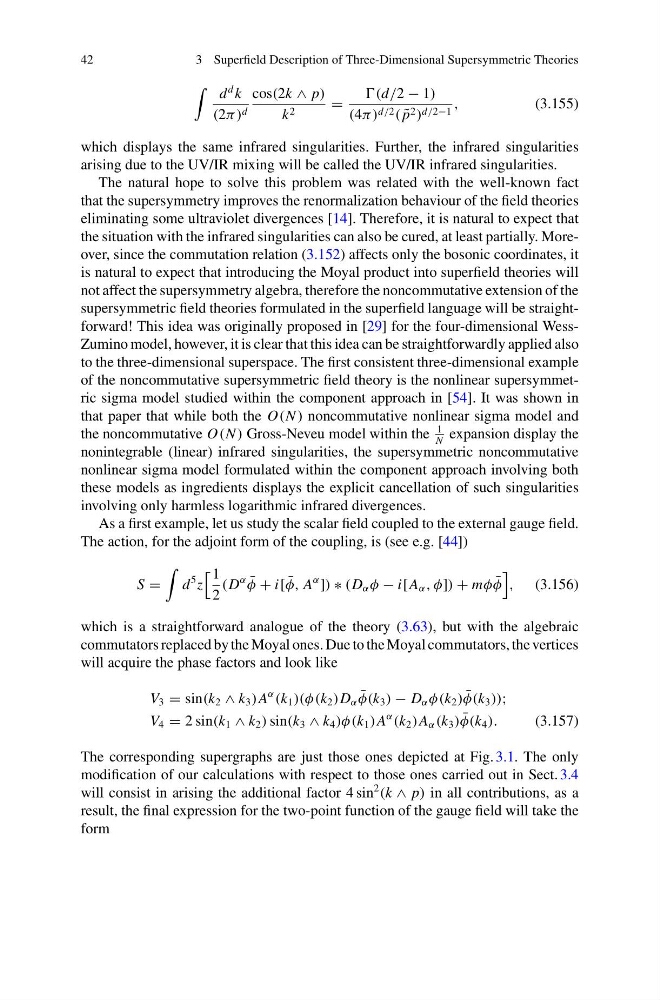
d
d k
(2π) d
cos(2k ∧ p)
k 2
=
(d/2 − 1)
(4π) d/2 ( ˜
p 2 ) d/2−1 ,
(3.155)
which displays the same infrared singularities. Further, the infrared singularities
arising due to the UV/IR mixing will be called the UV/IR infrared singularities.
The natural hope to solve this problem was related with the well-known fact
that the supersymmetry improves the renormalization behaviour of the field theories
eliminating some ultraviolet divergences [14]. Therefore, it is natural to expect that
the situation with the infrared singularities can also be cured, at least partially. Moreover, since the commutation relation (3.152) affects only the bosonic coordinates, it
is natural to expect that introducing the Moyal product into superfield theories will
not affect the supersymmetry algebra, therefore the noncommutative extension of the
supersymmetric field theories formulated in the superfield language will be straightforward! This idea was originally proposed in [29] for the four-dimensional WessZumino model, however, it is clear that this idea can be straightforwardly applied also
to the three-dimensional superspace. The first consistent three-dimensional example
of the noncommutative supersymmetric field theory is the nonlinear supersymmetric sigma model studied within the component approach in [54]. It was shown in
that paper that while both the O(N ) noncommutative nonlinear sigma model and
the noncommutative O(N ) Gross-Neveu model within the
1
N
expansion display the
nonintegrable (linear) infrared singularities, the supersymmetric noncommutative
nonlinear sigma model formulated within the component approach involving both
these models as ingredients displays the explicit cancellation of such singularities
involving only harmless logarithmic infrared divergences.
As a first example, let us study the scalar field coupled to the external gauge field.
The action, for the adjoint form of the coupling, is (see e.g. [44])
S =
d
5 z
1
2
(D
α ¯
φ + i[ ¯
φ, A
α
]) ∗ (D α φ − i[A α , φ]) + mφ ¯
φ
, (3.156)
which is a straightforward analogue of the theory (3.63), but with the algebraic
commutators replaced by the Moyal ones. Due to the Moyal commutators, the vertices
will acquire the phase factors and look like
V 3 = sin(k 2 ∧ k 3 )A
α
(k 1 )(φ(k 2 )D α ¯
φ(k 3 ) − D α φ(k 2 ) ¯
φ(k 3 ));
V 4 = 2 sin(k 1 ∧ k 2 ) sin(k 3 ∧ k 4 )φ(k 1 )A
α
(k 2 )A α (k 3 ) ¯
φ(k 4 ).
(3.157)
The corresponding supergraphs are just those ones depicted at Fig. 3.1. The only
modification of our calculations with respect to those ones carried out in Sect. 3.4
will consist in arising the additional factor 4 sin
2
(k ∧ p) in all contributions, as a
result, the final expression for the two-point function of the gauge field will take the
form
3 Superfield Description of Three-Dimensional Supersymmetric Theories
d
d k
(2π) d
cos(2k ∧ p)
k 2
=
(d/2 − 1)
(4π) d/2 ( ˜
p 2 ) d/2−1 ,
(3.155)
which displays the same infrared singularities. Further, the infrared singularities
arising due to the UV/IR mixing will be called the UV/IR infrared singularities.
The natural hope to solve this problem was related with the well-known fact
that the supersymmetry improves the renormalization behaviour of the field theories
eliminating some ultraviolet divergences [14]. Therefore, it is natural to expect that
the situation with the infrared singularities can also be cured, at least partially. Moreover, since the commutation relation (3.152) affects only the bosonic coordinates, it
is natural to expect that introducing the Moyal product into superfield theories will
not affect the supersymmetry algebra, therefore the noncommutative extension of the
supersymmetric field theories formulated in the superfield language will be straightforward! This idea was originally proposed in [29] for the four-dimensional WessZumino model, however, it is clear that this idea can be straightforwardly applied also
to the three-dimensional superspace. The first consistent three-dimensional example
of the noncommutative supersymmetric field theory is the nonlinear supersymmetric sigma model studied within the component approach in [54]. It was shown in
that paper that while both the O(N ) noncommutative nonlinear sigma model and
the noncommutative O(N ) Gross-Neveu model within the
1
N
expansion display the
nonintegrable (linear) infrared singularities, the supersymmetric noncommutative
nonlinear sigma model formulated within the component approach involving both
these models as ingredients displays the explicit cancellation of such singularities
involving only harmless logarithmic infrared divergences.
As a first example, let us study the scalar field coupled to the external gauge field.
The action, for the adjoint form of the coupling, is (see e.g. [44])
S =
d
5 z
1
2
(D
α ¯
φ + i[ ¯
φ, A
α
]) ∗ (D α φ − i[A α , φ]) + mφ ¯
φ
, (3.156)
which is a straightforward analogue of the theory (3.63), but with the algebraic
commutators replaced by the Moyal ones. Due to the Moyal commutators, the vertices
will acquire the phase factors and look like
V 3 = sin(k 2 ∧ k 3 )A
α
(k 1 )(φ(k 2 )D α ¯
φ(k 3 ) − D α φ(k 2 ) ¯
φ(k 3 ));
V 4 = 2 sin(k 1 ∧ k 2 ) sin(k 3 ∧ k 4 )φ(k 1 )A
α
(k 2 )A α (k 3 ) ¯
φ(k 4 ).
(3.157)
The corresponding supergraphs are just those ones depicted at Fig. 3.1. The only
modification of our calculations with respect to those ones carried out in Sect. 3.4
will consist in arising the additional factor 4 sin
2
(k ∧ p) in all contributions, as a
result, the final expression for the two-point function of the gauge field will take the
form