

44
3 Superfield Description of Three-Dimensional Supersymmetric Theories
a
b
c
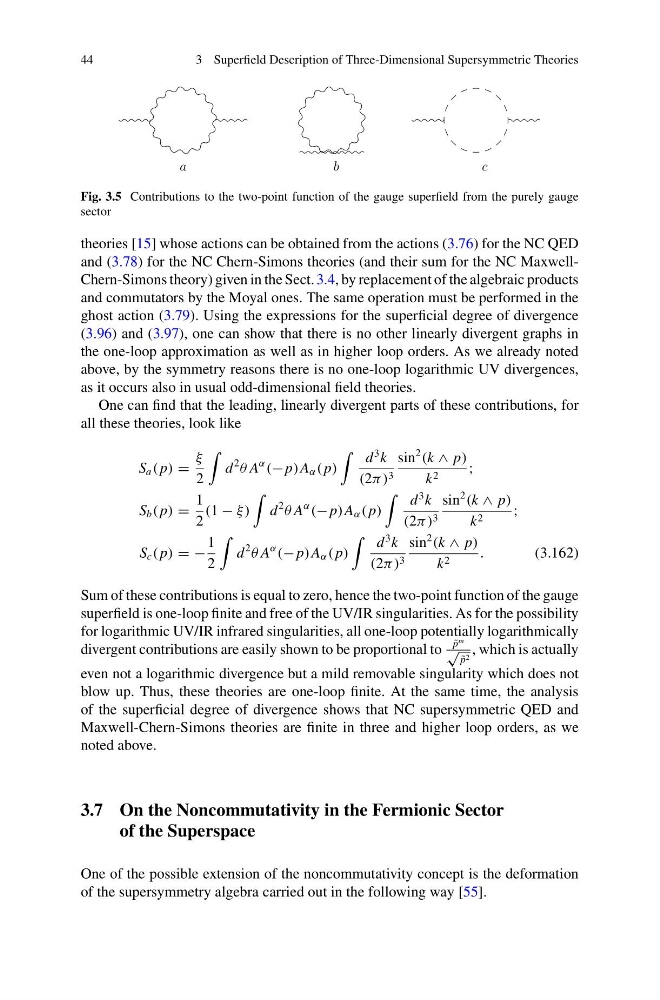
Fig. 3.5 Contributions to the two-point function of the gauge superfield from the purely gauge
sector
theories [15] whose actions can be obtained from the actions (3.76) for the NC QED
and (3.78) for the NC Chern-Simons theories (and their sum for the NC MaxwellChern-Simons theory) given in the Sect. 3.4, by replacement of the algebraic products
and commutators by the Moyal ones. The same operation must be performed in the
ghost action (3.79). Using the expressions for the superficial degree of divergence
(3.96) and (3.97), one can show that there is no other linearly divergent graphs in
the one-loop approximation as well as in higher loop orders. As we already noted
above, by the symmetry reasons there is no one-loop logarithmic UV divergences,
as it occurs also in usual odd-dimensional field theories.
One can find that the leading, linearly divergent parts of these contributions, for
all these theories, look like
S a ( p) =
ξ
2
d
2
θ A
α
(− p)A α ( p)
d
3 k
(2π) 3
sin
2
(k ∧ p)
k 2
;
S b ( p) =
1
2
(1 − ξ)
d
2
θ A
α
(− p)A α ( p)
d
3 k
(2π) 3
sin
2
(k ∧ p)
k 2
;
S c ( p) = −
1
2
d
2
θ A
α
(− p)A α ( p)
d
3 k
(2π) 3
sin
2
(k ∧ p)
k 2
.
(3.162)
Sum of these contributions is equal to zero, hence the two-point function of the gauge
superfield is one-loop finite and free of the UV/IR singularities. As for the possibility
for logarithmic UV/IR infrared singularities, all one-loop potentially logarithmically
divergent contributions are easily shown to be proportional to
˜
p
m
√
˜
p 2
, which is actually
even not a logarithmic divergence but a mild removable singularity which does not
blow up. Thus, these theories are one-loop finite. At the same time, the analysis
of the superficial degree of divergence shows that NC supersymmetric QED and
Maxwell-Chern-Simons theories are finite in three and higher loop orders, as we
noted above.
3.7 On the Noncommutativity in the Fermionic Sector
of the Superspace
One of the possible extension of the noncommutativity concept is the deformation
of the supersymmetry algebra carried out in the following way [55].
3 Superfield Description of Three-Dimensional Supersymmetric Theories
a
b
c
Fig. 3.5 Contributions to the two-point function of the gauge superfield from the purely gauge
sector
theories [15] whose actions can be obtained from the actions (3.76) for the NC QED
and (3.78) for the NC Chern-Simons theories (and their sum for the NC MaxwellChern-Simons theory) given in the Sect. 3.4, by replacement of the algebraic products
and commutators by the Moyal ones. The same operation must be performed in the
ghost action (3.79). Using the expressions for the superficial degree of divergence
(3.96) and (3.97), one can show that there is no other linearly divergent graphs in
the one-loop approximation as well as in higher loop orders. As we already noted
above, by the symmetry reasons there is no one-loop logarithmic UV divergences,
as it occurs also in usual odd-dimensional field theories.
One can find that the leading, linearly divergent parts of these contributions, for
all these theories, look like
S a ( p) =
ξ
2
d
2
θ A
α
(− p)A α ( p)
d
3 k
(2π) 3
sin
2
(k ∧ p)
k 2
;
S b ( p) =
1
2
(1 − ξ)
d
2
θ A
α
(− p)A α ( p)
d
3 k
(2π) 3
sin
2
(k ∧ p)
k 2
;
S c ( p) = −
1
2
d
2
θ A
α
(− p)A α ( p)
d
3 k
(2π) 3
sin
2
(k ∧ p)
k 2
.
(3.162)
Sum of these contributions is equal to zero, hence the two-point function of the gauge
superfield is one-loop finite and free of the UV/IR singularities. As for the possibility
for logarithmic UV/IR infrared singularities, all one-loop potentially logarithmically
divergent contributions are easily shown to be proportional to
˜
p
m
√
˜
p 2
, which is actually
even not a logarithmic divergence but a mild removable singularity which does not
blow up. Thus, these theories are one-loop finite. At the same time, the analysis
of the superficial degree of divergence shows that NC supersymmetric QED and
Maxwell-Chern-Simons theories are finite in three and higher loop orders, as we
noted above.
3.7 On the Noncommutativity in the Fermionic Sector
of the Superspace
One of the possible extension of the noncommutativity concept is the deformation
of the supersymmetry algebra carried out in the following way [55].