

28
3 Superfield Description of Three-Dimensional Supersymmetric Theories
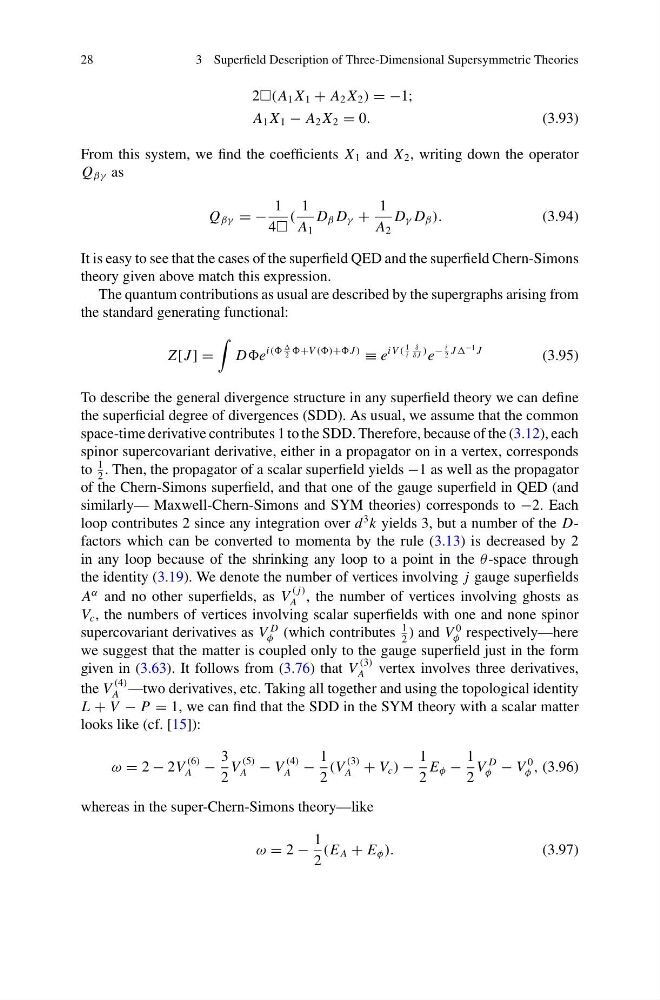
2(A 1 X 1 + A 2 X 2 ) = −1;
A 1 X 1 − A 2 X 2 = 0.
(3.93)
From this system, we find the coefficients X 1 and X 2 , writing down the operator
Q βγ as
Q βγ = −
1
4
(
1
A 1
D β D γ +
1
A 2
D γ D β ).
(3.94)
It is easy to see that the cases of the superfield QED and the superfield Chern-Simons
theory given above match this expression.
The quantum contributions as usual are described by the supergraphs arising from
the standard generating functional:
Z [J ] =
De
i((
2 +V (()+J )
≡ e
i V (
1
i
δ
δ J ) e
−
i
2 J
−1 J
(3.95)
To describe the general divergence structure in any superfield theory we can define
the superficial degree of divergences (SDD). As usual, we assume that the common
space-time derivative contributes 1 to the SDD. Therefore, because of the (3.12), each
spinor supercovariant derivative, either in a propagator on in a vertex, corresponds
to
1
2
. Then, the propagator of a scalar superfield yields −1 as well as the propagator
of the Chern-Simons superfield, and that one of the gauge superfield in QED (and
similarly— Maxwell-Chern-Simons and SYM theories) corresponds to −2. Each
loop contributes 2 since any integration over d
3 k yields 3, but a number of the Dfactors which can be converted to momenta by the rule (3.13) is decreased by 2
in any loop because of the shrinking any loop to a point in the θ -space through
the identity (3.19). We denote the number of vertices involving j gauge superfields
A
α and no other superfields, as V
( j)
A , the number of vertices involving ghosts as
V c , the numbers of vertices involving scalar superfields with one and none spinor
supercovariant derivatives as V
D
φ (which contributes
1
2
) and V
0
φ respectively—here
we suggest that the matter is coupled only to the gauge superfield just in the form
given in (3.63). It follows from (3.76) that V
(3)
A vertex involves three derivatives,
the V
(4)
A —two derivatives, etc. Taking all together and using the topological identity
L + V − P = 1, we can find that the SDD in the SYM theory with a scalar matter
looks like (cf. [15]):
ω = 2 − 2V
(6)
A −
3
2
V
(5)
A − V
(4)
A −
1
2
(V
(3)
A + V c ) −
1
2
E φ −
1
2
V
D
φ − V
0
φ , (3.96)
whereas in the super-Chern-Simons theory—like
ω = 2 −
1
2
(E A + E φ ).
(3.97)
3 Superfield Description of Three-Dimensional Supersymmetric Theories
2(A 1 X 1 + A 2 X 2 ) = −1;
A 1 X 1 − A 2 X 2 = 0.
(3.93)
From this system, we find the coefficients X 1 and X 2 , writing down the operator
Q βγ as
Q βγ = −
1
4
(
1
A 1
D β D γ +
1
A 2
D γ D β ).
(3.94)
It is easy to see that the cases of the superfield QED and the superfield Chern-Simons
theory given above match this expression.
The quantum contributions as usual are described by the supergraphs arising from
the standard generating functional:
Z [J ] =
De
i((
2 +V (()+J )
≡ e
i V (
1
i
δ
δ J ) e
−
i
2 J
−1 J
(3.95)
To describe the general divergence structure in any superfield theory we can define
the superficial degree of divergences (SDD). As usual, we assume that the common
space-time derivative contributes 1 to the SDD. Therefore, because of the (3.12), each
spinor supercovariant derivative, either in a propagator on in a vertex, corresponds
to
1
2
. Then, the propagator of a scalar superfield yields −1 as well as the propagator
of the Chern-Simons superfield, and that one of the gauge superfield in QED (and
similarly— Maxwell-Chern-Simons and SYM theories) corresponds to −2. Each
loop contributes 2 since any integration over d
3 k yields 3, but a number of the Dfactors which can be converted to momenta by the rule (3.13) is decreased by 2
in any loop because of the shrinking any loop to a point in the θ -space through
the identity (3.19). We denote the number of vertices involving j gauge superfields
A
α and no other superfields, as V
( j)
A , the number of vertices involving ghosts as
V c , the numbers of vertices involving scalar superfields with one and none spinor
supercovariant derivatives as V
D
φ (which contributes
1
2
) and V
0
φ respectively—here
we suggest that the matter is coupled only to the gauge superfield just in the form
given in (3.63). It follows from (3.76) that V
(3)
A vertex involves three derivatives,
the V
(4)
A —two derivatives, etc. Taking all together and using the topological identity
L + V − P = 1, we can find that the SDD in the SYM theory with a scalar matter
looks like (cf. [15]):
ω = 2 − 2V
(6)
A −
3
2
V
(5)
A − V
(4)
A −
1
2
(V
(3)
A + V c ) −
1
2
E φ −
1
2
V
D
φ − V
0
φ , (3.96)
whereas in the super-Chern-Simons theory—like
ω = 2 −
1
2
(E A + E φ ).
(3.97)