

3.4 Quantum Description for the Superfield Models
27
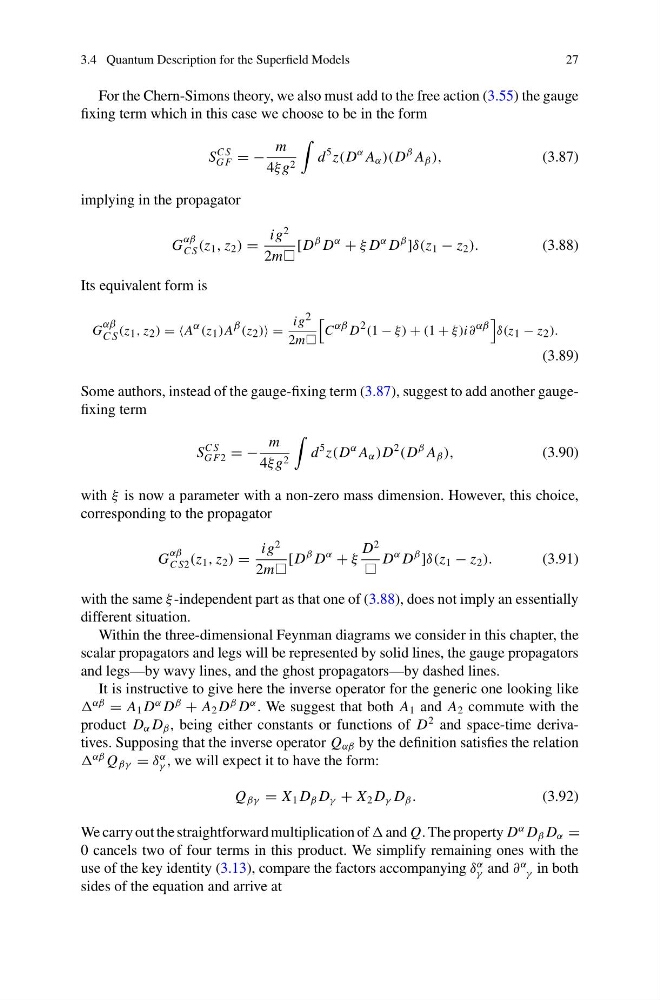
For the Chern-Simons theory, we also must add to the free action (3.55) the gauge
fixing term which in this case we choose to be in the form
S
C S
G F = −
m
4ξ g 2
d
5 z(D
α A α )(D
β A β ),
(3.87)
implying in the propagator
G
αβ
C S (z 1 , z 2 ) =
ig
2
2m
[D
β D
α
+ ξ D
α D
β
]δ(z 1 − z 2 ).
(3.88)
Its equivalent form is
G
αβ
C S (z 1 , z 2 ) = =A α (z 1 )A β (z 2 ) =
ig 2
2m
C αβ D 2 (1 − ξ) + (1 + ξ)i∂ αβ
δ(z 1 − z 2 ).
(3.89)
Some authors, instead of the gauge-fixing term (3.87), suggest to add another gaugefixing term
S
C S
G F2 = −
m
4ξ g 2
d
5 z(D
α A α )D
2
(D
β A β ),
(3.90)
with ξ is now a parameter with a non-zero mass dimension. However, this choice,
corresponding to the propagator
G
αβ
C S2 (z 1 , z 2 ) =
ig
2
2m
[D
β D
α
+ ξ
D
2
D
α D
β
]δ(z 1 − z 2 ).
(3.91)
with the same ξ -independent part as that one of (3.88), does not imply an essentially
different situation.
Within the three-dimensional Feynman diagrams we consider in this chapter, the
scalar propagators and legs will be represented by solid lines, the gauge propagators
and legs—by wavy lines, and the ghost propagators—by dashed lines.
It is instructive to give here the inverse operator for the generic one looking like
αβ
= A 1 D
α D
β
+ A 2 D
β D
α . We suggest that both A 1 and A 2 commute with the
product D α D β , being either constants or functions of D
2 and space-time derivatives. Supposing that the inverse operator Q αβ by the definition satisfies the relation
αβ Q βγ = δ
α
γ , we will expect it to have the form:
Q βγ = X 1 D β D γ + X 2 D γ D β .
(3.92)
We carry out the straightforward multiplication of and Q. The property D
α D β D α =
0 cancels two of four terms in this product. We simplify remaining ones with the
use of the key identity (3.13), compare the factors accompanying δ
α
γ and ∂
α
γ in both
sides of the equation and arrive at
27
For the Chern-Simons theory, we also must add to the free action (3.55) the gauge
fixing term which in this case we choose to be in the form
S
C S
G F = −
m
4ξ g 2
d
5 z(D
α A α )(D
β A β ),
(3.87)
implying in the propagator
G
αβ
C S (z 1 , z 2 ) =
ig
2
2m
[D
β D
α
+ ξ D
α D
β
]δ(z 1 − z 2 ).
(3.88)
Its equivalent form is
G
αβ
C S (z 1 , z 2 ) = =A α (z 1 )A β (z 2 ) =
ig 2
2m
C αβ D 2 (1 − ξ) + (1 + ξ)i∂ αβ
δ(z 1 − z 2 ).
(3.89)
Some authors, instead of the gauge-fixing term (3.87), suggest to add another gaugefixing term
S
C S
G F2 = −
m
4ξ g 2
d
5 z(D
α A α )D
2
(D
β A β ),
(3.90)
with ξ is now a parameter with a non-zero mass dimension. However, this choice,
corresponding to the propagator
G
αβ
C S2 (z 1 , z 2 ) =
ig
2
2m
[D
β D
α
+ ξ
D
2
D
α D
β
]δ(z 1 − z 2 ).
(3.91)
with the same ξ -independent part as that one of (3.88), does not imply an essentially
different situation.
Within the three-dimensional Feynman diagrams we consider in this chapter, the
scalar propagators and legs will be represented by solid lines, the gauge propagators
and legs—by wavy lines, and the ghost propagators—by dashed lines.
It is instructive to give here the inverse operator for the generic one looking like
αβ
= A 1 D
α D
β
+ A 2 D
β D
α . We suggest that both A 1 and A 2 commute with the
product D α D β , being either constants or functions of D
2 and space-time derivatives. Supposing that the inverse operator Q αβ by the definition satisfies the relation
αβ Q βγ = δ
α
γ , we will expect it to have the form:
Q βγ = X 1 D β D γ + X 2 D γ D β .
(3.92)
We carry out the straightforward multiplication of and Q. The property D
α D β D α =
0 cancels two of four terms in this product. We simplify remaining ones with the
use of the key identity (3.13), compare the factors accompanying δ
α
γ and ∂
α
γ in both
sides of the equation and arrive at