

26
3 Superfield Description of Three-Dimensional Supersymmetric Theories
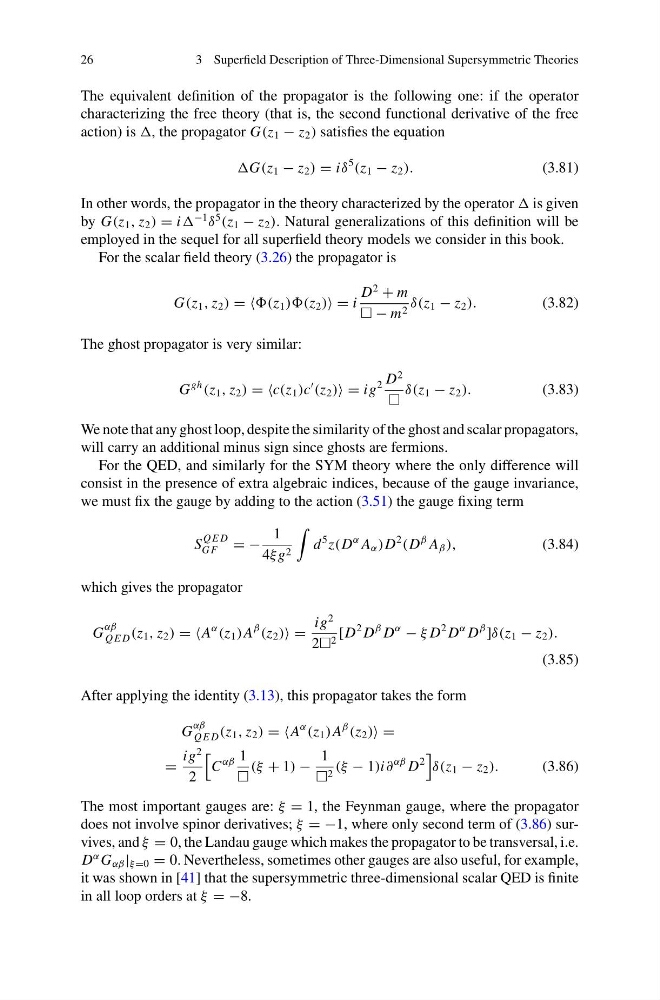
The equivalent definition of the propagator is the following one: if the operator
characterizing the free theory (that is, the second functional derivative of the free
action) is , the propagator G(z 1 − z 2 ) satisfies the equation
G(z 1 − z 2 ) = iδ
5
(z 1 − z 2 ).
(3.81)
In other words, the propagator in the theory characterized by the operator is given
by G(z 1 , z 2 ) = i
−1
δ
5
(z 1 − z 2 ). Natural generalizations of this definition will be
employed in the sequel for all superfield theory models we consider in this book.
For the scalar field theory (3.26) the propagator is
G(z 1 , z 2 ) = =(z 1 ))(z 2 ) = i
D
2
+ m
− m 2 δ(z 1 − z 2 ).
(3.82)
The ghost propagator is very similar:
G
gh
(z 1 , z 2 ) = =c(z 1 )c
(z 2 ) = ig
2 D
2
δ(z 1 − z 2 ).
(3.83)
We note that any ghost loop, despite the similarity of the ghost and scalar propagators,
will carry an additional minus sign since ghosts are fermions.
For the QED, and similarly for the SYM theory where the only difference will
consist in the presence of extra algebraic indices, because of the gauge invariance,
we must fix the gauge by adding to the action (3.51) the gauge fixing term
S
Q E D
G F
= −
1
4ξ g 2
d
5 z(D
α A α )D
2
(D
β A β ),
(3.84)
which gives the propagator
G
αβ
Q E D (z 1 , z 2 ) = =A
α
(z 1 )A
β
(z 2 ) =
ig
2
2 2 [D
2 D
β D
α
− ξ D
2 D
α D
β
]δ(z 1 − z 2 ).
(3.85)
After applying the identity (3.13), this propagator takes the form
G
αβ
Q E D (z 1 , z 2 ) = =A
α
(z 1 )A
β
(z 2 ) =
=
ig
2
2
C
αβ 1
(ξ + 1) −
1
2 (ξ − 1)i∂
αβ D
2
δ(z 1 − z 2 ).
(3.86)
The most important gauges are: ξ = 1, the Feynman gauge, where the propagator
does not involve spinor derivatives; ξ = −1, where only second term of (3.86) survives, and ξ = 0, the Landau gauge which makes the propagator to be transversal, i.e.
D
α G αβ | ξ =0 = 0. Nevertheless, sometimes other gauges are also useful, for example,
it was shown in [41] that the supersymmetric three-dimensional scalar QED is finite
in all loop orders at ξ = −8.
3 Superfield Description of Three-Dimensional Supersymmetric Theories
The equivalent definition of the propagator is the following one: if the operator
characterizing the free theory (that is, the second functional derivative of the free
action) is , the propagator G(z 1 − z 2 ) satisfies the equation
G(z 1 − z 2 ) = iδ
5
(z 1 − z 2 ).
(3.81)
In other words, the propagator in the theory characterized by the operator is given
by G(z 1 , z 2 ) = i
−1
δ
5
(z 1 − z 2 ). Natural generalizations of this definition will be
employed in the sequel for all superfield theory models we consider in this book.
For the scalar field theory (3.26) the propagator is
G(z 1 , z 2 ) = =(z 1 ))(z 2 ) = i
D
2
+ m
− m 2 δ(z 1 − z 2 ).
(3.82)
The ghost propagator is very similar:
G
gh
(z 1 , z 2 ) = =c(z 1 )c
(z 2 ) = ig
2 D
2
δ(z 1 − z 2 ).
(3.83)
We note that any ghost loop, despite the similarity of the ghost and scalar propagators,
will carry an additional minus sign since ghosts are fermions.
For the QED, and similarly for the SYM theory where the only difference will
consist in the presence of extra algebraic indices, because of the gauge invariance,
we must fix the gauge by adding to the action (3.51) the gauge fixing term
S
Q E D
G F
= −
1
4ξ g 2
d
5 z(D
α A α )D
2
(D
β A β ),
(3.84)
which gives the propagator
G
αβ
Q E D (z 1 , z 2 ) = =A
α
(z 1 )A
β
(z 2 ) =
ig
2
2 2 [D
2 D
β D
α
− ξ D
2 D
α D
β
]δ(z 1 − z 2 ).
(3.85)
After applying the identity (3.13), this propagator takes the form
G
αβ
Q E D (z 1 , z 2 ) = =A
α
(z 1 )A
β
(z 2 ) =
=
ig
2
2
C
αβ 1
(ξ + 1) −
1
2 (ξ − 1)i∂
αβ D
2
δ(z 1 − z 2 ).
(3.86)
The most important gauges are: ξ = 1, the Feynman gauge, where the propagator
does not involve spinor derivatives; ξ = −1, where only second term of (3.86) survives, and ξ = 0, the Landau gauge which makes the propagator to be transversal, i.e.
D
α G αβ | ξ =0 = 0. Nevertheless, sometimes other gauges are also useful, for example,
it was shown in [41] that the supersymmetric three-dimensional scalar QED is finite
in all loop orders at ξ = −8.