

3.3 Non-Abelian Gauge Models
25
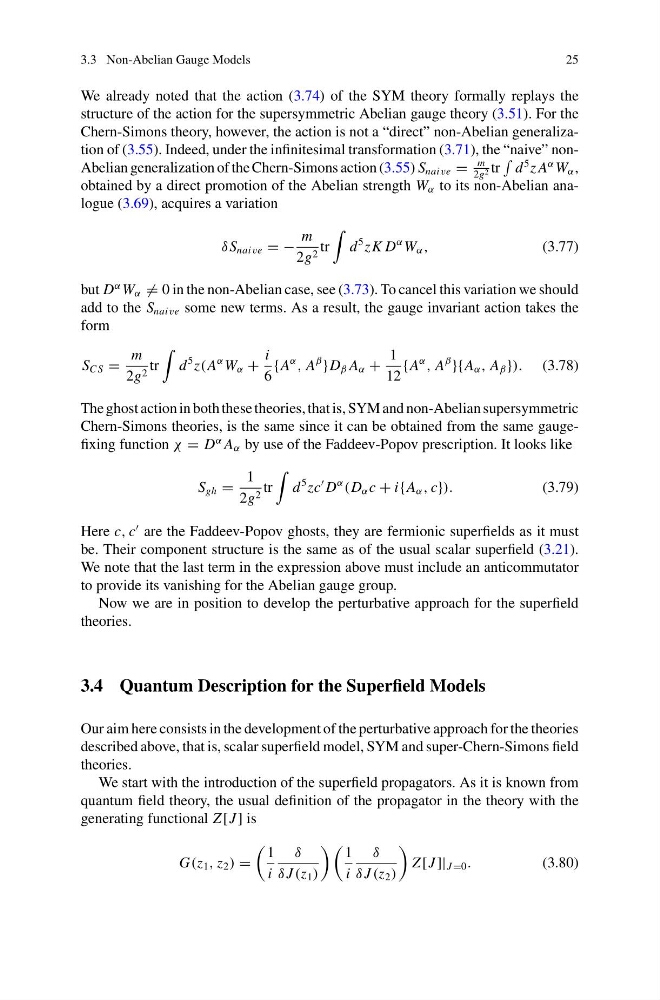
We already noted that the action (3.74) of the SYM theory formally replays the
structure of the action for the supersymmetric Abelian gauge theory (3.51). For the
Chern-Simons theory, however, the action is not a “direct” non-Abelian generalization of (3.55). Indeed, under the infinitesimal transformation (3.71), the “naive” nonAbelian generalization of the Chern-Simons action (3.55) S naive =
m
2g 2 tr
d
5 z A
α W α ,
obtained by a direct promotion of the Abelian strength W α to its non-Abelian analogue (3.69), acquires a variation
δS naive = −
m
2g 2 tr
d
5 zK D
α W α ,
(3.77)
but D
α W α = 0 in the non-Abelian case, see (3.73). To cancel this variation we should
add to the S naive some new terms. As a result, the gauge invariant action takes the
form
S C S =
m
2g 2 tr
d
5 z(A
α W α +
i
6
{A
α
, A
β
}D β A α +
1
12
{A
α
, A
β
}{A α , A β }). (3.78)
The ghost action in both these theories, that is, SYM and non-Abelian supersymmetric
Chern-Simons theories, is the same since it can be obtained from the same gaugefixing function χ = D
α A α by use of the Faddeev-Popov prescription. It looks like
S gh =
1
2g 2 tr
d
5 zc
D
α
(D α c + i{A α , c}).
(3.79)
Here c, c
are the Faddeev-Popov ghosts, they are fermionic superfields as it must
be. Their component structure is the same as of the usual scalar superfield (3.21).
We note that the last term in the expression above must include an anticommutator
to provide its vanishing for the Abelian gauge group.
Now we are in position to develop the perturbative approach for the superfield
theories.
3.4 Quantum Description for the Superfield Models
Our aim here consists in the development of the perturbative approach for the theories
described above, that is, scalar superfield model, SYM and super-Chern-Simons field
theories.
We start with the introduction of the superfield propagators. As it is known from
quantum field theory, the usual definition of the propagator in the theory with the
generating functional Z [J ] is
G(z 1 , z 2 ) =
1
i
δ
δ J (z 1 )
1
i
δ
δ J (z 2 )
Z [J ]| J =0 .
(3.80)
25
We already noted that the action (3.74) of the SYM theory formally replays the
structure of the action for the supersymmetric Abelian gauge theory (3.51). For the
Chern-Simons theory, however, the action is not a “direct” non-Abelian generalization of (3.55). Indeed, under the infinitesimal transformation (3.71), the “naive” nonAbelian generalization of the Chern-Simons action (3.55) S naive =
m
2g 2 tr
d
5 z A
α W α ,
obtained by a direct promotion of the Abelian strength W α to its non-Abelian analogue (3.69), acquires a variation
δS naive = −
m
2g 2 tr
d
5 zK D
α W α ,
(3.77)
but D
α W α = 0 in the non-Abelian case, see (3.73). To cancel this variation we should
add to the S naive some new terms. As a result, the gauge invariant action takes the
form
S C S =
m
2g 2 tr
d
5 z(A
α W α +
i
6
{A
α
, A
β
}D β A α +
1
12
{A
α
, A
β
}{A α , A β }). (3.78)
The ghost action in both these theories, that is, SYM and non-Abelian supersymmetric
Chern-Simons theories, is the same since it can be obtained from the same gaugefixing function χ = D
α A α by use of the Faddeev-Popov prescription. It looks like
S gh =
1
2g 2 tr
d
5 zc
D
α
(D α c + i{A α , c}).
(3.79)
Here c, c
are the Faddeev-Popov ghosts, they are fermionic superfields as it must
be. Their component structure is the same as of the usual scalar superfield (3.21).
We note that the last term in the expression above must include an anticommutator
to provide its vanishing for the Abelian gauge group.
Now we are in position to develop the perturbative approach for the superfield
theories.
3.4 Quantum Description for the Superfield Models
Our aim here consists in the development of the perturbative approach for the theories
described above, that is, scalar superfield model, SYM and super-Chern-Simons field
theories.
We start with the introduction of the superfield propagators. As it is known from
quantum field theory, the usual definition of the propagator in the theory with the
generating functional Z [J ] is
G(z 1 , z 2 ) =
1
i
δ
δ J (z 1 )
1
i
δ
δ J (z 2 )
Z [J ]| J =0 .
(3.80)