

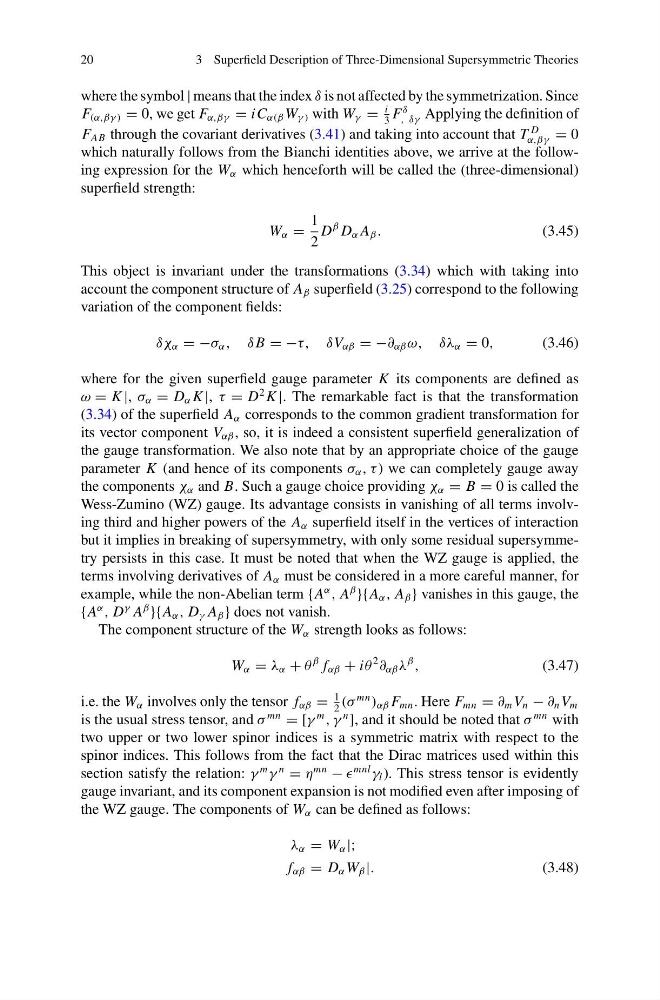
20
3 Superfield Description of Three-Dimensional Supersymmetric Theories
where the symbol | means that the index δ is not affected by the symmetrization. Since
F (α,βγ ) = 0, we get F α,βγ = iC α(β W γ ) with W γ =
i
3
F
δ
, δγ Applying the definition of
F AB through the covariant derivatives (3.41) and taking into account that T
D
α,βγ = 0
which naturally follows from the Bianchi identities above, we arrive at the following expression for the W α which henceforth will be called the (three-dimensional)
superfield strength:
W α =
1
2
D
β D α A β .
(3.45)
This object is invariant under the transformations (3.34) which with taking into
account the component structure of A β superfield (3.25) correspond to the following
variation of the component fields:
δχ α = −σ α , δB = −τ, δV αβ = −∂ αβ ω, δλ α = 0,
(3.46)
where for the given superfield gauge parameter K its components are defined as
ω = K |, σ α = D α K |, τ = D
2 K |. The remarkable fact is that the transformation
(3.34) of the superfield A α corresponds to the common gradient transformation for
its vector component V αβ , so, it is indeed a consistent superfield generalization of
the gauge transformation. We also note that by an appropriate choice of the gauge
parameter K (and hence of its components σ α , τ ) we can completely gauge away
the components χ α and B. Such a gauge choice providing χ α = B = 0 is called the
Wess-Zumino (WZ) gauge. Its advantage consists in vanishing of all terms involving third and higher powers of the A α superfield itself in the vertices of interaction
but it implies in breaking of supersymmetry, with only some residual supersymmetry persists in this case. It must be noted that when the WZ gauge is applied, the
terms involving derivatives of A α must be considered in a more careful manner, for
example, while the non-Abelian term {A
α
, A
β
}{A α , A β } vanishes in this gauge, the
{A
α
, D
γ A
β
}{A α , D γ A β } does not vanish.
The component structure of the W α strength looks as follows:
W α = λ α + θ
β f αβ + iθ
2
∂ αβ λ
β
,
(3.47)
i.e. the W α involves only the tensor f αβ =
1
2
(σ
mn
) αβ F mn . Here F mn = ∂ m V n − ∂ n V m
is the usual stress tensor, and σ
mn
= [γ
m
, γ
n
], and it should be noted that σ
mn with
two upper or two lower spinor indices is a symmetric matrix with respect to the
spinor indices. This follows from the fact that the Dirac matrices used within this
section satisfy the relation: γ
m
γ
n
= η
mn
−
mnl
γ l ). This stress tensor is evidently
gauge invariant, and its component expansion is not modified even after imposing of
the WZ gauge. The components of W α can be defined as follows:
λ α = W α |;
f αβ = D α W β |.
(3.48)
3 Superfield Description of Three-Dimensional Supersymmetric Theories
where the symbol | means that the index δ is not affected by the symmetrization. Since
F (α,βγ ) = 0, we get F α,βγ = iC α(β W γ ) with W γ =
i
3
F
δ
, δγ Applying the definition of
F AB through the covariant derivatives (3.41) and taking into account that T
D
α,βγ = 0
which naturally follows from the Bianchi identities above, we arrive at the following expression for the W α which henceforth will be called the (three-dimensional)
superfield strength:
W α =
1
2
D
β D α A β .
(3.45)
This object is invariant under the transformations (3.34) which with taking into
account the component structure of A β superfield (3.25) correspond to the following
variation of the component fields:
δχ α = −σ α , δB = −τ, δV αβ = −∂ αβ ω, δλ α = 0,
(3.46)
where for the given superfield gauge parameter K its components are defined as
ω = K |, σ α = D α K |, τ = D
2 K |. The remarkable fact is that the transformation
(3.34) of the superfield A α corresponds to the common gradient transformation for
its vector component V αβ , so, it is indeed a consistent superfield generalization of
the gauge transformation. We also note that by an appropriate choice of the gauge
parameter K (and hence of its components σ α , τ ) we can completely gauge away
the components χ α and B. Such a gauge choice providing χ α = B = 0 is called the
Wess-Zumino (WZ) gauge. Its advantage consists in vanishing of all terms involving third and higher powers of the A α superfield itself in the vertices of interaction
but it implies in breaking of supersymmetry, with only some residual supersymmetry persists in this case. It must be noted that when the WZ gauge is applied, the
terms involving derivatives of A α must be considered in a more careful manner, for
example, while the non-Abelian term {A
α
, A
β
}{A α , A β } vanishes in this gauge, the
{A
α
, D
γ A
β
}{A α , D γ A β } does not vanish.
The component structure of the W α strength looks as follows:
W α = λ α + θ
β f αβ + iθ
2
∂ αβ λ
β
,
(3.47)
i.e. the W α involves only the tensor f αβ =
1
2
(σ
mn
) αβ F mn . Here F mn = ∂ m V n − ∂ n V m
is the usual stress tensor, and σ
mn
= [γ
m
, γ
n
], and it should be noted that σ
mn with
two upper or two lower spinor indices is a symmetric matrix with respect to the
spinor indices. This follows from the fact that the Dirac matrices used within this
section satisfy the relation: γ
m
γ
n
= η
mn
−
mnl
γ l ). This stress tensor is evidently
gauge invariant, and its component expansion is not modified even after imposing of
the WZ gauge. The components of W α can be defined as follows:
λ α = W α |;
f αβ = D α W β |.
(3.48)