

3.2 Field Theory Models
19
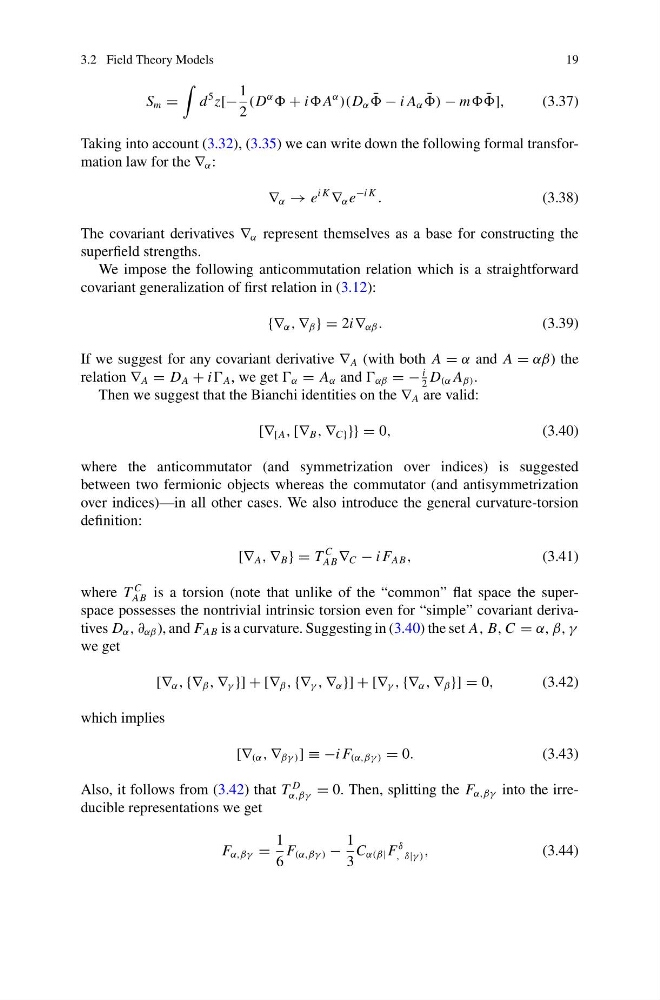
S m =
d
5 z[−
1
2
(D
α
+ iA
α
)(D α ¯
− i A α ¯
) − m ¯
],
(3.37)
Taking into account (3.32), (3.35) we can write down the following formal transformation law for the ∇ α :
∇ α → e
i K
∇ α e
−i K
.
(3.38)
The covariant derivatives ∇ α represent themselves as a base for constructing the
superfield strengths.
We impose the following anticommutation relation which is a straightforward
covariant generalization of first relation in (3.12):
{∇ α , ∇ β } = 2i∇ αβ .
(3.39)
If we suggest for any covariant derivative ∇ A (with both A = α and A = αβ) the
relation ∇ A = D A + i A , we get α = A α and αβ = −
i
2
D (α A β) .
Then we suggest that the Bianchi identities on the ∇ A are valid:
[∇ [A , [∇ B , ∇ C} }} = 0,
(3.40)
where the anticommutator (and symmetrization over indices) is suggested
between two fermionic objects whereas the commutator (and antisymmetrization
over indices)—in all other cases. We also introduce the general curvature-torsion
definition:
[∇ A , ∇ B } = T
C
AB ∇ C − i F AB ,
(3.41)
where T
C
AB is a torsion (note that unlike of the “common” flat space the superspace possesses the nontrivial intrinsic torsion even for “simple” covariant derivatives D α , ∂ αβ ), and F AB is a curvature. Suggesting in (3.40) the set A, B, C = α, β, γ
we get
[∇ α , {∇ β , ∇ γ }] + [∇ β , {∇ γ , ∇ α }] + [∇ γ , {∇ α , ∇ β }] = 0,
(3.42)
which implies
[∇ (α , ∇ βγ ) ] ≡ −i F (α,βγ ) = 0.
(3.43)
Also, it follows from (3.42) that T
D
α,βγ = 0. Then, splitting the F α,βγ into the irreducible representations we get
F α,βγ =
1
6
F (α,βγ ) −
1
3
C α(β| F
δ
, δ|γ ) ,
(3.44)
19
S m =
d
5 z[−
1
2
(D
α
+ iA
α
)(D α ¯
− i A α ¯
) − m ¯
],
(3.37)
Taking into account (3.32), (3.35) we can write down the following formal transformation law for the ∇ α :
∇ α → e
i K
∇ α e
−i K
.
(3.38)
The covariant derivatives ∇ α represent themselves as a base for constructing the
superfield strengths.
We impose the following anticommutation relation which is a straightforward
covariant generalization of first relation in (3.12):
{∇ α , ∇ β } = 2i∇ αβ .
(3.39)
If we suggest for any covariant derivative ∇ A (with both A = α and A = αβ) the
relation ∇ A = D A + i A , we get α = A α and αβ = −
i
2
D (α A β) .
Then we suggest that the Bianchi identities on the ∇ A are valid:
[∇ [A , [∇ B , ∇ C} }} = 0,
(3.40)
where the anticommutator (and symmetrization over indices) is suggested
between two fermionic objects whereas the commutator (and antisymmetrization
over indices)—in all other cases. We also introduce the general curvature-torsion
definition:
[∇ A , ∇ B } = T
C
AB ∇ C − i F AB ,
(3.41)
where T
C
AB is a torsion (note that unlike of the “common” flat space the superspace possesses the nontrivial intrinsic torsion even for “simple” covariant derivatives D α , ∂ αβ ), and F AB is a curvature. Suggesting in (3.40) the set A, B, C = α, β, γ
we get
[∇ α , {∇ β , ∇ γ }] + [∇ β , {∇ γ , ∇ α }] + [∇ γ , {∇ α , ∇ β }] = 0,
(3.42)
which implies
[∇ (α , ∇ βγ ) ] ≡ −i F (α,βγ ) = 0.
(3.43)
Also, it follows from (3.42) that T
D
α,βγ = 0. Then, splitting the F α,βγ into the irreducible representations we get
F α,βγ =
1
6
F (α,βγ ) −
1
3
C α(β| F
δ
, δ|γ ) ,
(3.44)