

18
3 Superfield Description of Three-Dimensional Supersymmetric Theories
which gives
S =
d
3 x
1
2
ϕϕ −
1
2
(mϕ − f
(ϕ))
2
−
1
2
iψ α ∂
αβ
ψ β − (m − f
(ϕ))ψ
2
.
(3.31)
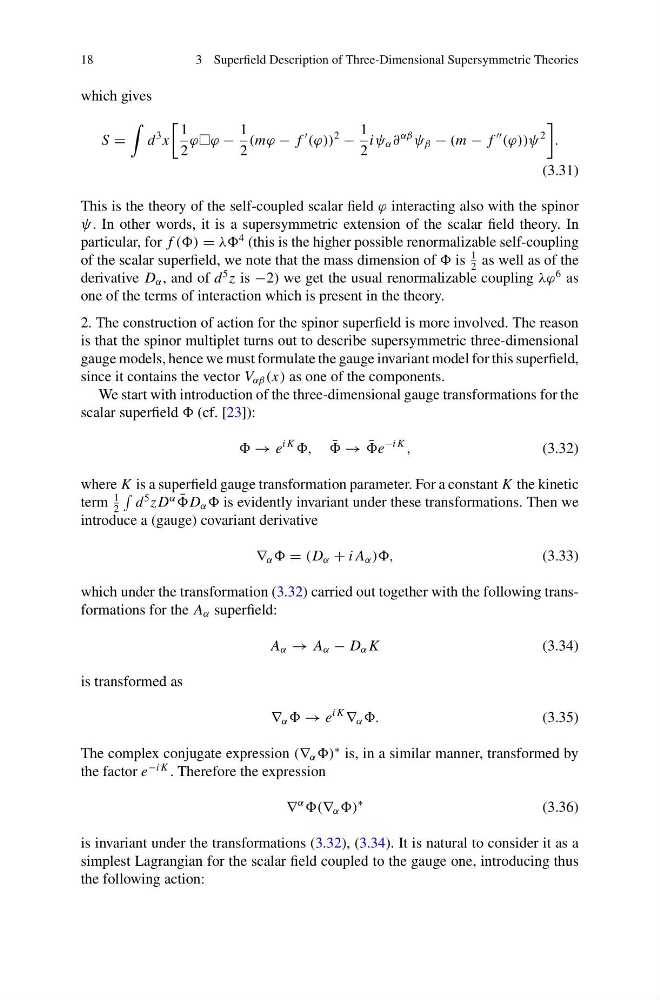
This is the theory of the self-coupled scalar field ϕ interacting also with the spinor
ψ. In other words, it is a supersymmetric extension of the scalar field theory. In
particular, for f (() = λλ
4 (this is the higher possible renormalizable self-coupling
of the scalar superfield, we note that the mass dimension of is
1
2
as well as of the
derivative D α , and of d
5 z is −2) we get the usual renormalizable coupling λϕ
6 as
one of the terms of interaction which is present in the theory.
2. The construction of action for the spinor superfield is more involved. The reason
is that the spinor multiplet turns out to describe supersymmetric three-dimensional
gauge models, hence we must formulate the gauge invariant model for this superfield,
since it contains the vector V αβ (x) as one of the components.
We start with introduction of the three-dimensional gauge transformations for the
scalar superfield (cf. [23]):
→ e
i K
, ¯
→ ¯
e
−i K
,
(3.32)
where K is a superfield gauge transformation parameter. For a constant K the kinetic
term
1
2
d
5 z D
α ¯
D α is evidently invariant under these transformations. Then we
introduce a (gauge) covariant derivative
∇ α = (D α + i A α )),
(3.33)
which under the transformation (3.32) carried out together with the following transformations for the A α superfield:
A α → A α − D α K
(3.34)
is transformed as
∇ α → e
i K
∇ α .
(3.35)
The complex conjugate expression (∇ α )
∗ is, in a similar manner, transformed by
the factor e
−i K . Therefore the expression
∇
α
(∇ α )
∗
(3.36)
is invariant under the transformations (3.32), (3.34). It is natural to consider it as a
simplest Lagrangian for the scalar field coupled to the gauge one, introducing thus
the following action:
3 Superfield Description of Three-Dimensional Supersymmetric Theories
which gives
S =
d
3 x
1
2
ϕϕ −
1
2
(mϕ − f
(ϕ))
2
−
1
2
iψ α ∂
αβ
ψ β − (m − f
(ϕ))ψ
2
.
(3.31)
This is the theory of the self-coupled scalar field ϕ interacting also with the spinor
ψ. In other words, it is a supersymmetric extension of the scalar field theory. In
particular, for f (() = λλ
4 (this is the higher possible renormalizable self-coupling
of the scalar superfield, we note that the mass dimension of is
1
2
as well as of the
derivative D α , and of d
5 z is −2) we get the usual renormalizable coupling λϕ
6 as
one of the terms of interaction which is present in the theory.
2. The construction of action for the spinor superfield is more involved. The reason
is that the spinor multiplet turns out to describe supersymmetric three-dimensional
gauge models, hence we must formulate the gauge invariant model for this superfield,
since it contains the vector V αβ (x) as one of the components.
We start with introduction of the three-dimensional gauge transformations for the
scalar superfield (cf. [23]):
→ e
i K
, ¯
→ ¯
e
−i K
,
(3.32)
where K is a superfield gauge transformation parameter. For a constant K the kinetic
term
1
2
d
5 z D
α ¯
D α is evidently invariant under these transformations. Then we
introduce a (gauge) covariant derivative
∇ α = (D α + i A α )),
(3.33)
which under the transformation (3.32) carried out together with the following transformations for the A α superfield:
A α → A α − D α K
(3.34)
is transformed as
∇ α → e
i K
∇ α .
(3.35)
The complex conjugate expression (∇ α )
∗ is, in a similar manner, transformed by
the factor e
−i K . Therefore the expression
∇
α
(∇ α )
∗
(3.36)
is invariant under the transformations (3.32), (3.34). It is natural to consider it as a
simplest Lagrangian for the scalar field coupled to the gauge one, introducing thus
the following action: