

3.2 Field Theory Models
17
3.2 Field Theory Models
Now, let us introduce the models involving the scalar and spinor superfields. In this
section, we proceed mostly in a manner similar to [23].
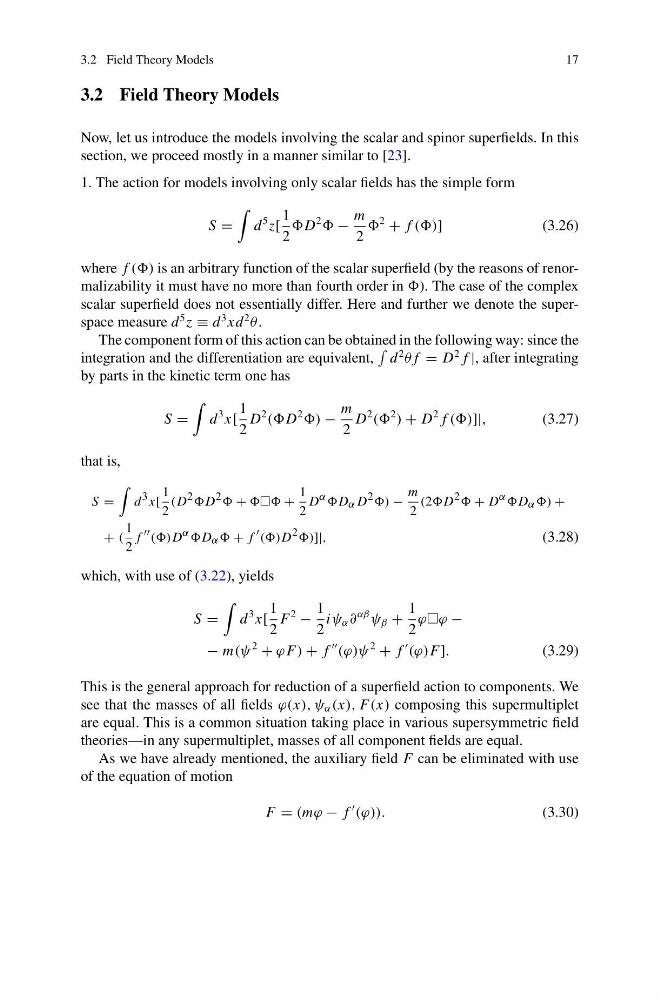
1. The action for models involving only scalar fields has the simple form
S =
d
5 z[
1
2
D
2
−
m
2
2
+ f (()]
(3.26)
where f (() is an arbitrary function of the scalar superfield (by the reasons of renormalizability it must have no more than fourth order in ). The case of the complex
scalar superfield does not essentially differ. Here and further we denote the superspace measure d
5 z ≡ d
3 xd
2
θ .
The component form of this action can be obtained in the following way: since the
integration and the differentiation are equivalent,
d
2
θ f = D
2 f |, after integrating
by parts in the kinetic term one has
S =
d
3 x[
1
2
D
2
((D
2
) −
m
2
D
2
((
2
) + D
2 f (()]|,
(3.27)
that is,
S =
d 3 x[
1
2
(D 2 D 2 + +
1
2
D α D α D 2 ) −
m
2
(2D 2 + D α D α ) +
+ (
1
2
f (()D α D α + f (()D 2 )]|,
(3.28)
which, with use of (3.22), yields
S =
d
3 x[
1
2
F
2
−
1
2
iψ α ∂
αβ
ψ β +
1
2
ϕϕ −
− m(ψ
2
+ ϕ F) + f
(ϕ)ψ
2
+ f
(ϕ)F].
(3.29)
This is the general approach for reduction of a superfield action to components. We
see that the masses of all fields ϕ(x), ψ α (x), F(x) composing this supermultiplet
are equal. This is a common situation taking place in various supersymmetric field
theories—in any supermultiplet, masses of all component fields are equal.
As we have already mentioned, the auxiliary field F can be eliminated with use
of the equation of motion
F = (mϕ − f
(ϕ)).
(3.30)
17
3.2 Field Theory Models
Now, let us introduce the models involving the scalar and spinor superfields. In this
section, we proceed mostly in a manner similar to [23].
1. The action for models involving only scalar fields has the simple form
S =
d
5 z[
1
2
D
2
−
m
2
2
+ f (()]
(3.26)
where f (() is an arbitrary function of the scalar superfield (by the reasons of renormalizability it must have no more than fourth order in ). The case of the complex
scalar superfield does not essentially differ. Here and further we denote the superspace measure d
5 z ≡ d
3 xd
2
θ .
The component form of this action can be obtained in the following way: since the
integration and the differentiation are equivalent,
d
2
θ f = D
2 f |, after integrating
by parts in the kinetic term one has
S =
d
3 x[
1
2
D
2
((D
2
) −
m
2
D
2
((
2
) + D
2 f (()]|,
(3.27)
that is,
S =
d 3 x[
1
2
(D 2 D 2 + +
1
2
D α D α D 2 ) −
m
2
(2D 2 + D α D α ) +
+ (
1
2
f (()D α D α + f (()D 2 )]|,
(3.28)
which, with use of (3.22), yields
S =
d
3 x[
1
2
F
2
−
1
2
iψ α ∂
αβ
ψ β +
1
2
ϕϕ −
− m(ψ
2
+ ϕ F) + f
(ϕ)ψ
2
+ f
(ϕ)F].
(3.29)
This is the general approach for reduction of a superfield action to components. We
see that the masses of all fields ϕ(x), ψ α (x), F(x) composing this supermultiplet
are equal. This is a common situation taking place in various supersymmetric field
theories—in any supermultiplet, masses of all component fields are equal.
As we have already mentioned, the auxiliary field F can be eliminated with use
of the equation of motion
F = (mϕ − f
(ϕ)).
(3.30)