

16
3 Superfield Description of Three-Dimensional Supersymmetric Theories
higher derivatives are just constraints, so, it can be completely eliminated from the
theory on the mass shell. The supersymmetry transformations for the component
fields can be obtained from the projections:
δϕ(x) = δφ(x, θ)| = −i
α Q α φ(x, θ)| =
α D α φ(x, θ)| =
α
ψ α (x);
δψ α (x) = δ D α φ(x, θ)| = −i
β Q β D α φ(x, θ)| = −
β D α D β φ(x, θ)| =
= −
β
(i∂ αβ − C αβ D
2
)φ(x, θ)| = −
β
(i∂ αβ ϕ(x) − C αβ F(x));
δ F(x) = δ D
2
φ(x, θ)| = −i
α Q α D
2
φ(x, θ)| =
α D α D
2
φ(x, θ)| =
= −
1
2
α
{D α , D β }D
β
φ(x, θ)| = −i
α
∂ αβ ψ
β
.
(3.23)
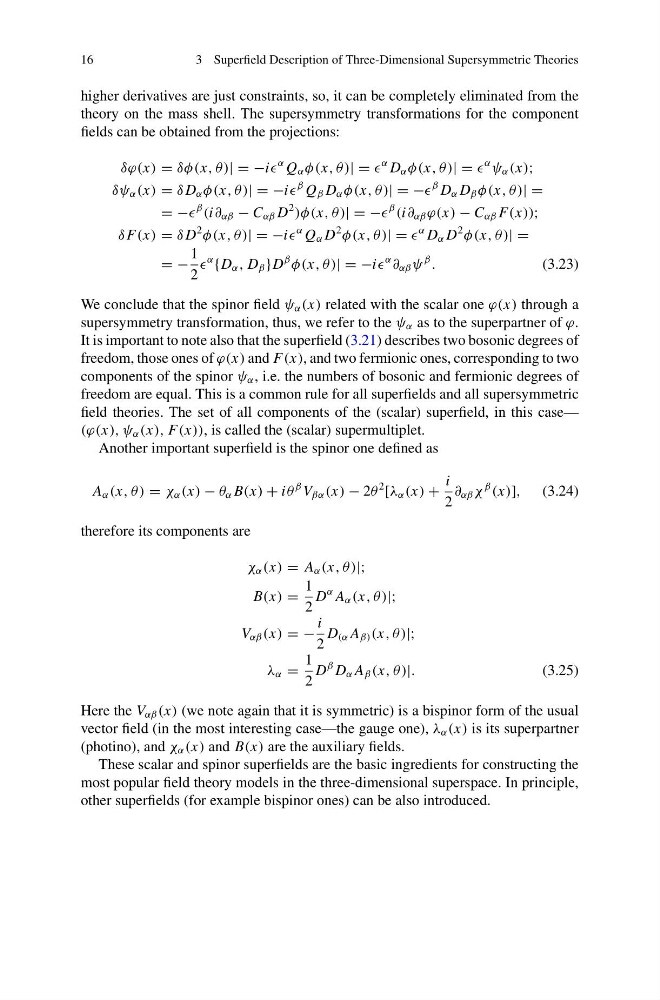
We conclude that the spinor field ψ α (x) related with the scalar one ϕ(x) through a
supersymmetry transformation, thus, we refer to the ψ α as to the superpartner of ϕ.
It is important to note also that the superfield (3.21) describes two bosonic degrees of
freedom, those ones of ϕ(x) and F(x), and two fermionic ones, corresponding to two
components of the spinor ψ α , i.e. the numbers of bosonic and fermionic degrees of
freedom are equal. This is a common rule for all superfields and all supersymmetric
field theories. The set of all components of the (scalar) superfield, in this case—
(ϕ(x), ψ α (x), F(x)), is called the (scalar) supermultiplet.
Another important superfield is the spinor one defined as
A α (x, θ) = χ α (x) − θ α B(x) + iθ
β V βα (x) − 2θ
2
[λ α (x) +
i
2
∂ αβ χ
β
(x)], (3.24)
therefore its components are
χ α (x) = A α (x, θ)|;
B(x) =
1
2
D
α A α (x, θ)|;
V αβ (x) = −
i
2
D (α A β) (x, θ)|;
λ α =
1
2
D
β D α A β (x, θ)|.
(3.25)
Here the V αβ (x) (we note again that it is symmetric) is a bispinor form of the usual
vector field (in the most interesting case—the gauge one), λ α (x) is its superpartner
(photino), and χ α (x) and B(x) are the auxiliary fields.
These scalar and spinor superfields are the basic ingredients for constructing the
most popular field theory models in the three-dimensional superspace. In principle,
other superfields (for example bispinor ones) can be also introduced.
3 Superfield Description of Three-Dimensional Supersymmetric Theories
higher derivatives are just constraints, so, it can be completely eliminated from the
theory on the mass shell. The supersymmetry transformations for the component
fields can be obtained from the projections:
δϕ(x) = δφ(x, θ)| = −i
α Q α φ(x, θ)| =
α D α φ(x, θ)| =
α
ψ α (x);
δψ α (x) = δ D α φ(x, θ)| = −i
β Q β D α φ(x, θ)| = −
β D α D β φ(x, θ)| =
= −
β
(i∂ αβ − C αβ D
2
)φ(x, θ)| = −
β
(i∂ αβ ϕ(x) − C αβ F(x));
δ F(x) = δ D
2
φ(x, θ)| = −i
α Q α D
2
φ(x, θ)| =
α D α D
2
φ(x, θ)| =
= −
1
2
α
{D α , D β }D
β
φ(x, θ)| = −i
α
∂ αβ ψ
β
.
(3.23)
We conclude that the spinor field ψ α (x) related with the scalar one ϕ(x) through a
supersymmetry transformation, thus, we refer to the ψ α as to the superpartner of ϕ.
It is important to note also that the superfield (3.21) describes two bosonic degrees of
freedom, those ones of ϕ(x) and F(x), and two fermionic ones, corresponding to two
components of the spinor ψ α , i.e. the numbers of bosonic and fermionic degrees of
freedom are equal. This is a common rule for all superfields and all supersymmetric
field theories. The set of all components of the (scalar) superfield, in this case—
(ϕ(x), ψ α (x), F(x)), is called the (scalar) supermultiplet.
Another important superfield is the spinor one defined as
A α (x, θ) = χ α (x) − θ α B(x) + iθ
β V βα (x) − 2θ
2
[λ α (x) +
i
2
∂ αβ χ
β
(x)], (3.24)
therefore its components are
χ α (x) = A α (x, θ)|;
B(x) =
1
2
D
α A α (x, θ)|;
V αβ (x) = −
i
2
D (α A β) (x, θ)|;
λ α =
1
2
D
β D α A β (x, θ)|.
(3.25)
Here the V αβ (x) (we note again that it is symmetric) is a bispinor form of the usual
vector field (in the most interesting case—the gauge one), λ α (x) is its superpartner
(photino), and χ α (x) and B(x) are the auxiliary fields.
These scalar and spinor superfields are the basic ingredients for constructing the
most popular field theory models in the three-dimensional superspace. In principle,
other superfields (for example bispinor ones) can be also introduced.