

3.2 Field Theory Models
21
We note the transversality of the W
α following from (3.45):
D
α W α = 0,
(3.49)
which is a superfield analogue of the known property of the dual vector F
m
=
1
2
mnl F nl :
∂ m F
m
= 0.
(3.50)
The most natural, gauge invariant kinetic term for the action of the spinor superfield is hence
S g =
1
2g 2
d
5 zW
α W α ,
(3.51)
which, because of (3.47), can be easily shown to give in components
S g = −
1
g 2
d
3 x(
1
2
f
αβ f αβ + λ
α i∂ αβ λ
β
).
(3.52)
Coupling of the gauge superfield to matter is given by the term
S m = −
1
2
d
5 z∇
α
(∇ α )
∗
= −
1
2
d
5 z(D
α
+ i A
α
))(D α − i A α ))
∗
, (3.53)
whose component content is
S m =
d
3 x
(F ¯
F − i ¯
ψ α ∂
αβ
ψ β + ¯
ϕϕ +
+ i V
αβ
ϕ
↔
∂ αβ ¯
ϕ −
1
2
ϕV
αβ V αβ ¯
ϕ − V
αβ
(ψ α ¯
ψ β + ¯
ψ α ψ β ) + λ
α
(ϕ ¯
ψ α + ¯
ϕψ α ) −
− (ψ
α ¯
F − ¯
ψ
α F)χ α − (∂ αβ ψ
α
¯
ϕ − ∂ αβ ¯
ψ
α
ϕ + ∂ αβ ¯
ϕψ
α
+ ∂ αβ ϕ ¯
ψ
α
)χ
β
−
−
1
2
(ϕ B
2
¯
ϕ − ϕ ¯
ϕχ
α
λ α + χ
α
χ α (F ¯
ϕ + ϕ ¯
F))
.
(3.54)
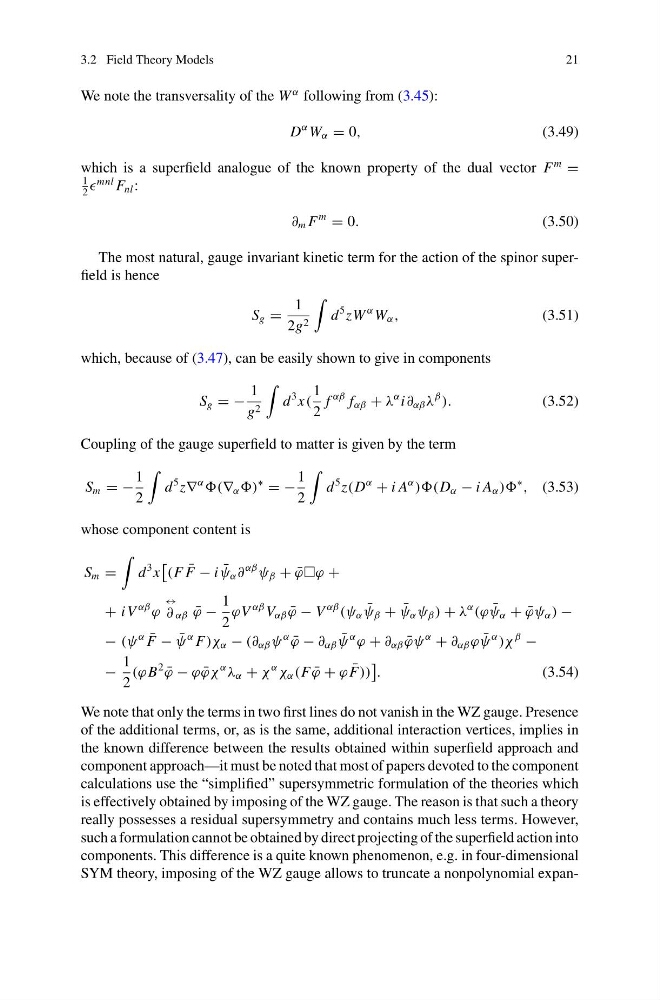
We note that only the terms in two first lines do not vanish in the WZ gauge. Presence
of the additional terms, or, as is the same, additional interaction vertices, implies in
the known difference between the results obtained within superfield approach and
component approach—it must be noted that most of papers devoted to the component
calculations use the “simplified” supersymmetric formulation of the theories which
is effectively obtained by imposing of the WZ gauge. The reason is that such a theory
really possesses a residual supersymmetry and contains much less terms. However,
such a formulation cannot be obtained by direct projecting of the superfield action into
components. This difference is a quite known phenomenon, e.g. in four-dimensional
SYM theory, imposing of the WZ gauge allows to truncate a nonpolynomial expan-
21
We note the transversality of the W
α following from (3.45):
D
α W α = 0,
(3.49)
which is a superfield analogue of the known property of the dual vector F
m
=
1
2
mnl F nl :
∂ m F
m
= 0.
(3.50)
The most natural, gauge invariant kinetic term for the action of the spinor superfield is hence
S g =
1
2g 2
d
5 zW
α W α ,
(3.51)
which, because of (3.47), can be easily shown to give in components
S g = −
1
g 2
d
3 x(
1
2
f
αβ f αβ + λ
α i∂ αβ λ
β
).
(3.52)
Coupling of the gauge superfield to matter is given by the term
S m = −
1
2
d
5 z∇
α
(∇ α )
∗
= −
1
2
d
5 z(D
α
+ i A
α
))(D α − i A α ))
∗
, (3.53)
whose component content is
S m =
d
3 x
(F ¯
F − i ¯
ψ α ∂
αβ
ψ β + ¯
ϕϕ +
+ i V
αβ
ϕ
↔
∂ αβ ¯
ϕ −
1
2
ϕV
αβ V αβ ¯
ϕ − V
αβ
(ψ α ¯
ψ β + ¯
ψ α ψ β ) + λ
α
(ϕ ¯
ψ α + ¯
ϕψ α ) −
− (ψ
α ¯
F − ¯
ψ
α F)χ α − (∂ αβ ψ
α
¯
ϕ − ∂ αβ ¯
ψ
α
ϕ + ∂ αβ ¯
ϕψ
α
+ ∂ αβ ϕ ¯
ψ
α
)χ
β
−
−
1
2
(ϕ B
2
¯
ϕ − ϕ ¯
ϕχ
α
λ α + χ
α
χ α (F ¯
ϕ + ϕ ¯
F))
.
(3.54)
We note that only the terms in two first lines do not vanish in the WZ gauge. Presence
of the additional terms, or, as is the same, additional interaction vertices, implies in
the known difference between the results obtained within superfield approach and
component approach—it must be noted that most of papers devoted to the component
calculations use the “simplified” supersymmetric formulation of the theories which
is effectively obtained by imposing of the WZ gauge. The reason is that such a theory
really possesses a residual supersymmetry and contains much less terms. However,
such a formulation cannot be obtained by direct projecting of the superfield action into
components. This difference is a quite known phenomenon, e.g. in four-dimensional
SYM theory, imposing of the WZ gauge allows to truncate a nonpolynomial expan-