

5.1 Explicit Supersymmetry Breaking
145
We close this section with a mentioning that the soft supersymmetry breaking has
wide phenomenological and cosmological applications, for example, in the context
of the dark matter problem, see e.g. [116].
5.2 Spontaneous Supersymmetry Breaking
Now, let us suggest that the classical action of the theory is supersymmetric and
formulated in terms of superfields. At the same time, we suppose that the vacuum is
not supersymmetric, so, the supersymmetry is broken in a spontaneous manner. This
way of supersymmetry breaking seems to be more delicate being a principal subject
of many studies.
The key observation which gave rise to many discussions of the spontaneous
supersymmetry breaking is the following one (it is explained, e.g., in [23, 32] and
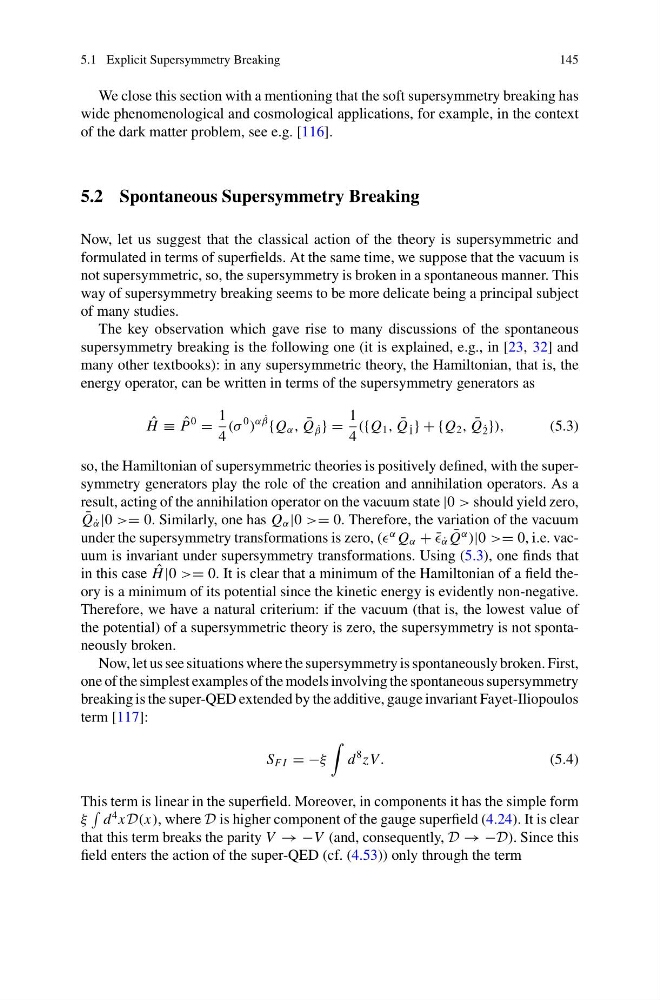
many other textbooks): in any supersymmetric theory, the Hamiltonian, that is, the
energy operator, can be written in terms of the supersymmetry generators as
ˆ
H ≡ ˆ
P
0
=
1
4
(σ
0
)
α ˙
β
{Q α , ¯
Q ˙
β } =
1
4
({Q 1 , ¯
Q ˙
1 } + {Q 2 , ¯
Q ˙
2 }),
(5.3)
so, the Hamiltonian of supersymmetric theories is positively defined, with the supersymmetry generators play the role of the creation and annihilation operators. As a
result, acting of the annihilation operator on the vacuum state |0 > should yield zero,
¯
Q ˙
α |0 >= 0. Similarly, one has Q α |0 >= 0. Therefore, the variation of the vacuum
under the supersymmetry transformations is zero, ((
α Q α + ¯
˙
α
¯
Q
α
)|0 >= 0, i.e. vacuum is invariant under supersymmetry transformations. Using (5.3), one finds that
in this case ˆ
H |0 >= 0. It is clear that a minimum of the Hamiltonian of a field theory is a minimum of its potential since the kinetic energy is evidently non-negative.
Therefore, we have a natural criterium: if the vacuum (that is, the lowest value of
the potential) of a supersymmetric theory is zero, the supersymmetry is not spontaneously broken.
Now, let us see situations where the supersymmetry is spontaneously broken. First,
one of the simplest examples of the models involving the spontaneous supersymmetry
breaking is the super-QED extended by the additive, gauge invariant Fayet-Iliopoulos
term [117]:
S F I = −ξ
d
8 zV.
(5.4)
This term is linear in the superfield. Moreover, in components it has the simple form
ξ
d
4 xD(x), where D is higher component of the gauge superfield (4.24). It is clear
that this term breaks the parity V → −V (and, consequently, D → −D). Since this
field enters the action of the super-QED (cf. (4.53)) only through the term
145
We close this section with a mentioning that the soft supersymmetry breaking has
wide phenomenological and cosmological applications, for example, in the context
of the dark matter problem, see e.g. [116].
5.2 Spontaneous Supersymmetry Breaking
Now, let us suggest that the classical action of the theory is supersymmetric and
formulated in terms of superfields. At the same time, we suppose that the vacuum is
not supersymmetric, so, the supersymmetry is broken in a spontaneous manner. This
way of supersymmetry breaking seems to be more delicate being a principal subject
of many studies.
The key observation which gave rise to many discussions of the spontaneous
supersymmetry breaking is the following one (it is explained, e.g., in [23, 32] and
many other textbooks): in any supersymmetric theory, the Hamiltonian, that is, the
energy operator, can be written in terms of the supersymmetry generators as
ˆ
H ≡ ˆ
P
0
=
1
4
(σ
0
)
α ˙
β
{Q α , ¯
Q ˙
β } =
1
4
({Q 1 , ¯
Q ˙
1 } + {Q 2 , ¯
Q ˙
2 }),
(5.3)
so, the Hamiltonian of supersymmetric theories is positively defined, with the supersymmetry generators play the role of the creation and annihilation operators. As a
result, acting of the annihilation operator on the vacuum state |0 > should yield zero,
¯
Q ˙
α |0 >= 0. Similarly, one has Q α |0 >= 0. Therefore, the variation of the vacuum
under the supersymmetry transformations is zero, ((
α Q α + ¯
˙
α
¯
Q
α
)|0 >= 0, i.e. vacuum is invariant under supersymmetry transformations. Using (5.3), one finds that
in this case ˆ
H |0 >= 0. It is clear that a minimum of the Hamiltonian of a field theory is a minimum of its potential since the kinetic energy is evidently non-negative.
Therefore, we have a natural criterium: if the vacuum (that is, the lowest value of
the potential) of a supersymmetric theory is zero, the supersymmetry is not spontaneously broken.
Now, let us see situations where the supersymmetry is spontaneously broken. First,
one of the simplest examples of the models involving the spontaneous supersymmetry
breaking is the super-QED extended by the additive, gauge invariant Fayet-Iliopoulos
term [117]:
S F I = −ξ
d
8 zV.
(5.4)
This term is linear in the superfield. Moreover, in components it has the simple form
ξ
d
4 xD(x), where D is higher component of the gauge superfield (4.24). It is clear
that this term breaks the parity V → −V (and, consequently, D → −D). Since this
field enters the action of the super-QED (cf. (4.53)) only through the term