

144
5 Supersymmetry Breaking
directly from the study of the superficial degree of divergence, for the SYM theory
the higher-order divergences can be shown to be forbidden by the gauge symmetry.
Therefore, we suppose the spurion terms to be in the form which does not introduce
quadratic divergences. In particular, it is necessary to require the constant defining
the spurion to have a non-negative mass dimension.
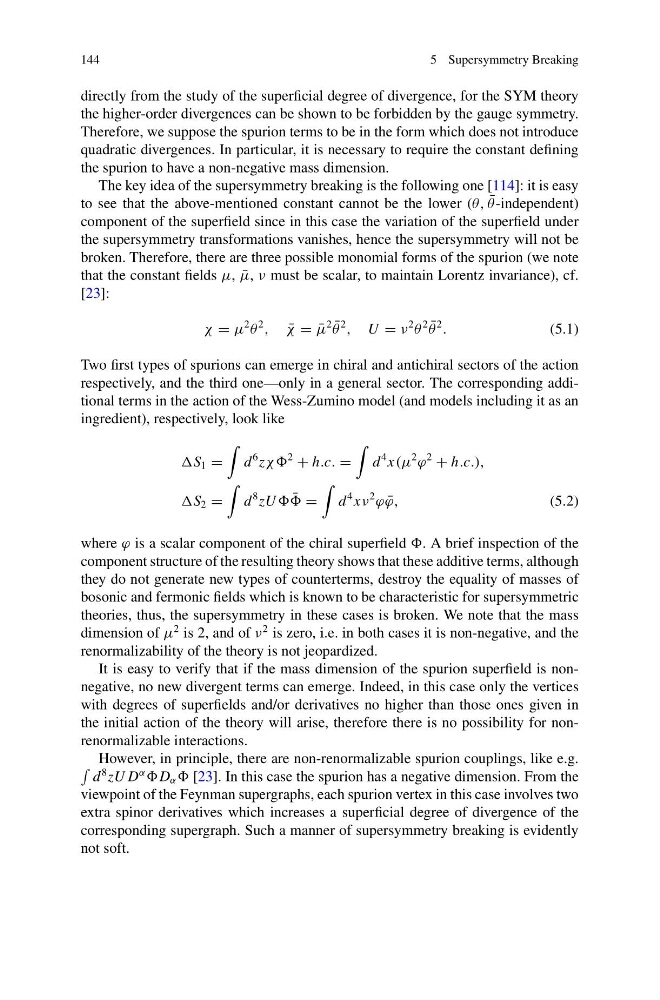
The key idea of the supersymmetry breaking is the following one [114]: it is easy
to see that the above-mentioned constant cannot be the lower (θ, ¯
θ -independent)
component of the superfield since in this case the variation of the superfield under
the supersymmetry transformations vanishes, hence the supersymmetry will not be
broken. Therefore, there are three possible monomial forms of the spurion (we note
that the constant fields μ, ¯
μ, ν must be scalar, to maintain Lorentz invariance), cf.
[23]:
χ = μ
2
θ
2
, ¯
χ = ¯
μ
2 ¯
θ
2
, U = ν
2
θ
2 ¯
θ
2
.
(5.1)
Two first types of spurions can emerge in chiral and antichiral sectors of the action
respectively, and the third one—only in a general sector. The corresponding additional terms in the action of the Wess-Zumino model (and models including it as an
ingredient), respectively, look like
S 1 =
d
6 zχχ
2
+ h.c. =
d
4 x(μ
2
ϕ
2
+ h.c.),
S 2 =
d
8 zU ¯
=
d
4 xν
2
ϕ ¯
ϕ,
(5.2)
where ϕ is a scalar component of the chiral superfield . A brief inspection of the
component structure of the resulting theory shows that these additive terms, although
they do not generate new types of counterterms, destroy the equality of masses of
bosonic and fermonic fields which is known to be characteristic for supersymmetric
theories, thus, the supersymmetry in these cases is broken. We note that the mass
dimension of μ
2 is 2, and of ν
2 is zero, i.e. in both cases it is non-negative, and the
renormalizability of the theory is not jeopardized.
It is easy to verify that if the mass dimension of the spurion superfield is nonnegative, no new divergent terms can emerge. Indeed, in this case only the vertices
with degrees of superfields and/or derivatives no higher than those ones given in
the initial action of the theory will arise, therefore there is no possibility for nonrenormalizable interactions.
However, in principle, there are non-renormalizable spurion couplings, like e.g.
d
8 zU D
α
D α [23]. In this case the spurion has a negative dimension. From the
viewpoint of the Feynman supergraphs, each spurion vertex in this case involves two
extra spinor derivatives which increases a superficial degree of divergence of the
corresponding supergraph. Such a manner of supersymmetry breaking is evidently
not soft.
5 Supersymmetry Breaking
directly from the study of the superficial degree of divergence, for the SYM theory
the higher-order divergences can be shown to be forbidden by the gauge symmetry.
Therefore, we suppose the spurion terms to be in the form which does not introduce
quadratic divergences. In particular, it is necessary to require the constant defining
the spurion to have a non-negative mass dimension.
The key idea of the supersymmetry breaking is the following one [114]: it is easy
to see that the above-mentioned constant cannot be the lower (θ, ¯
θ -independent)
component of the superfield since in this case the variation of the superfield under
the supersymmetry transformations vanishes, hence the supersymmetry will not be
broken. Therefore, there are three possible monomial forms of the spurion (we note
that the constant fields μ, ¯
μ, ν must be scalar, to maintain Lorentz invariance), cf.
[23]:
χ = μ
2
θ
2
, ¯
χ = ¯
μ
2 ¯
θ
2
, U = ν
2
θ
2 ¯
θ
2
.
(5.1)
Two first types of spurions can emerge in chiral and antichiral sectors of the action
respectively, and the third one—only in a general sector. The corresponding additional terms in the action of the Wess-Zumino model (and models including it as an
ingredient), respectively, look like
S 1 =
d
6 zχχ
2
+ h.c. =
d
4 x(μ
2
ϕ
2
+ h.c.),
S 2 =
d
8 zU ¯
=
d
4 xν
2
ϕ ¯
ϕ,
(5.2)
where ϕ is a scalar component of the chiral superfield . A brief inspection of the
component structure of the resulting theory shows that these additive terms, although
they do not generate new types of counterterms, destroy the equality of masses of
bosonic and fermonic fields which is known to be characteristic for supersymmetric
theories, thus, the supersymmetry in these cases is broken. We note that the mass
dimension of μ
2 is 2, and of ν
2 is zero, i.e. in both cases it is non-negative, and the
renormalizability of the theory is not jeopardized.
It is easy to verify that if the mass dimension of the spurion superfield is nonnegative, no new divergent terms can emerge. Indeed, in this case only the vertices
with degrees of superfields and/or derivatives no higher than those ones given in
the initial action of the theory will arise, therefore there is no possibility for nonrenormalizable interactions.
However, in principle, there are non-renormalizable spurion couplings, like e.g.
d
8 zU D
α
D α [23]. In this case the spurion has a negative dimension. From the
viewpoint of the Feynman supergraphs, each spurion vertex in this case involves two
extra spinor derivatives which increases a superficial degree of divergence of the
corresponding supergraph. Such a manner of supersymmetry breaking is evidently
not soft.