

146
5 Supersymmetry Breaking
S D =
d
4 x(
1
2
D
2
− ξ D),
(5.5)
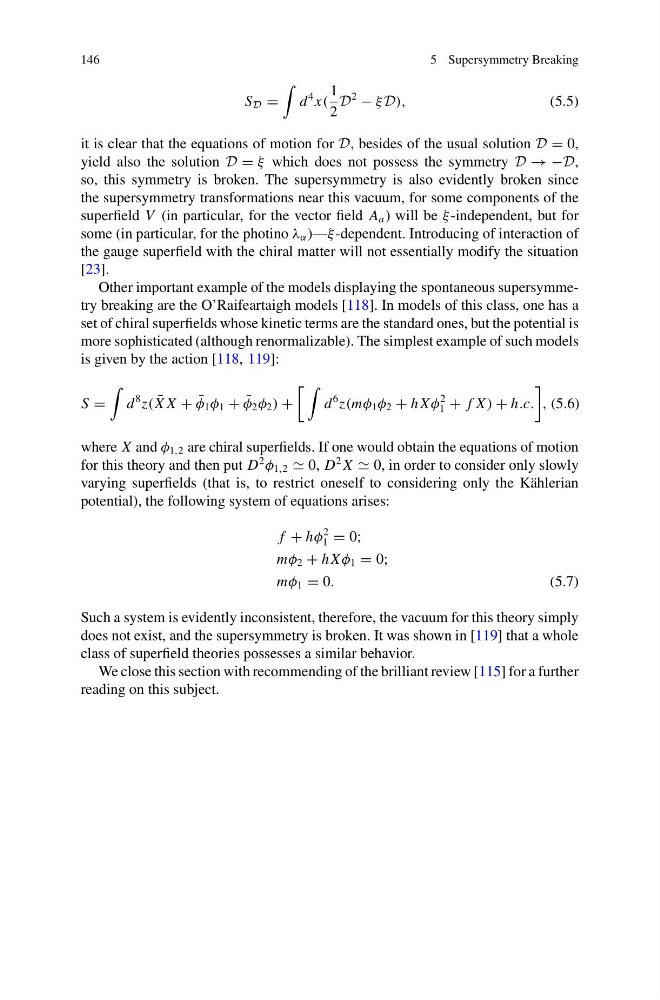
it is clear that the equations of motion for D, besides of the usual solution D = 0,
yield also the solution D = ξ which does not possess the symmetry D → −D,
so, this symmetry is broken. The supersymmetry is also evidently broken since
the supersymmetry transformations near this vacuum, for some components of the
superfield V (in particular, for the vector field A a ) will be ξ -independent, but for
some (in particular, for the photino λ α )—ξ -dependent. Introducing of interaction of
the gauge superfield with the chiral matter will not essentially modify the situation
[23].
Other important example of the models displaying the spontaneous supersymmetry breaking are the O’Raifeartaigh models [118]. In models of this class, one has a
set of chiral superfields whose kinetic terms are the standard ones, but the potential is
more sophisticated (although renormalizable). The simplest example of such models
is given by the action [118, 119]:
S =
d
8 z( ¯
X X + ¯
φ 1 φ 1 + ¯
φ 2 φ 2 ) +
d
6 z(mφ 1 φ 2 + h Xφ
2
1 + f X) + h.c.
, (5.6)
where X and φ 1,2 are chiral superfields. If one would obtain the equations of motion
for this theory and then put D
2
φ 1,2 0, D
2 X 0, in order to consider only slowly
varying superfields (that is, to restrict oneself to considering only the Kählerian
potential), the following system of equations arises:
f + hφ
2
1 = 0;
mφ 2 + h Xφ 1 = 0;
mφ 1 = 0.
(5.7)
Such a system is evidently inconsistent, therefore, the vacuum for this theory simply
does not exist, and the supersymmetry is broken. It was shown in [119] that a whole
class of superfield theories possesses a similar behavior.
We close this section with recommending of the brilliant review [115] for a further
reading on this subject.
5 Supersymmetry Breaking
S D =
d
4 x(
1
2
D
2
− ξ D),
(5.5)
it is clear that the equations of motion for D, besides of the usual solution D = 0,
yield also the solution D = ξ which does not possess the symmetry D → −D,
so, this symmetry is broken. The supersymmetry is also evidently broken since
the supersymmetry transformations near this vacuum, for some components of the
superfield V (in particular, for the vector field A a ) will be ξ -independent, but for
some (in particular, for the photino λ α )—ξ -dependent. Introducing of interaction of
the gauge superfield with the chiral matter will not essentially modify the situation
[23].
Other important example of the models displaying the spontaneous supersymmetry breaking are the O’Raifeartaigh models [118]. In models of this class, one has a
set of chiral superfields whose kinetic terms are the standard ones, but the potential is
more sophisticated (although renormalizable). The simplest example of such models
is given by the action [118, 119]:
S =
d
8 z( ¯
X X + ¯
φ 1 φ 1 + ¯
φ 2 φ 2 ) +
d
6 z(mφ 1 φ 2 + h Xφ
2
1 + f X) + h.c.
, (5.6)
where X and φ 1,2 are chiral superfields. If one would obtain the equations of motion
for this theory and then put D
2
φ 1,2 0, D
2 X 0, in order to consider only slowly
varying superfields (that is, to restrict oneself to considering only the Kählerian
potential), the following system of equations arises:
f + hφ
2
1 = 0;
mφ 2 + h Xφ 1 = 0;
mφ 1 = 0.
(5.7)
Such a system is evidently inconsistent, therefore, the vacuum for this theory simply
does not exist, and the supersymmetry is broken. It was shown in [119] that a whole
class of superfield theories possesses a similar behavior.
We close this section with recommending of the brilliant review [115] for a further
reading on this subject.