

116
4 Four-Dimensional Superfield Supersymmetry
F
(1)
= C 1
¯
D
2 ¯
D
2
¯
+ C 2 [ ¯
¯
D
2 ¯
D
α
D α + h.c.]
1
(( ¯
) 2 +
+ C 3 D
α
D α ¯
D ˙
α ¯
¯
D
˙
α ¯
1
(( ¯
) 2 ,
(4.244)
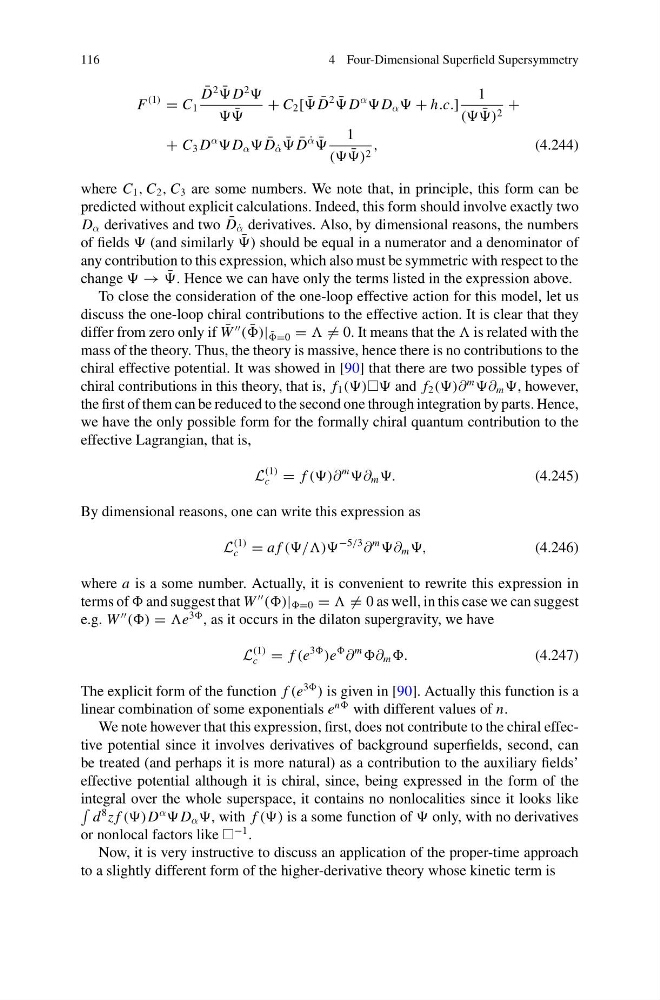
where C 1 , C 2 , C 3 are some numbers. We note that, in principle, this form can be
predicted without explicit calculations. Indeed, this form should involve exactly two
D α derivatives and two ¯
D ˙
α derivatives. Also, by dimensional reasons, the numbers
of fields (and similarly ¯
) should be equal in a numerator and a denominator of
any contribution to this expression, which also must be symmetric with respect to the
change → ¯
. Hence we can have only the terms listed in the expression above.
To close the consideration of the one-loop effective action for this model, let us
discuss the one-loop chiral contributions to the effective action. It is clear that they
differ from zero only if ¯
W
( ¯
)| ¯
=0 = = 0. It means that the is related with the
mass of the theory. Thus, the theory is massive, hence there is no contributions to the
chiral effective potential. It was showed in [90] that there are two possible types of
chiral contributions in this theory, that is, f 1 (() and f 2 (()∂
m
∂ m , however,
the first of them can be reduced to the second one through integration by parts. Hence,
we have the only possible form for the formally chiral quantum contribution to the
effective Lagrangian, that is,
L
(1)
c = f (()∂
m
∂ m .
(4.245)
By dimensional reasons, one can write this expression as
L
(1)
c = a f ((//))
−5/3
∂
m
∂ m ,
(4.246)
where a is a some number. Actually, it is convenient to rewrite this expression in
terms of and suggest that W
(()| =0 = = 0 as well, in this case we can suggest
e.g. W
(() = e
3 , as it occurs in the dilaton supergravity, we have
L
(1)
c = f (e
3
)e
∂
m
∂ m .
(4.247)
The explicit form of the function f (e
3
) is given in [90]. Actually this function is a
linear combination of some exponentials e
n with different values of n.
We note however that this expression, first, does not contribute to the chiral effective potential since it involves derivatives of background superfields, second, can
be treated (and perhaps it is more natural) as a contribution to the auxiliary fields’
effective potential although it is chiral, since, being expressed in the form of the
integral over the whole superspace, it contains no nonlocalities since it looks like
d
8 z f (()D
α
D α , with f (() is a some function of only, with no derivatives
or nonlocal factors like
−1 .
Now, it is very instructive to discuss an application of the proper-time approach
to a slightly different form of the higher-derivative theory whose kinetic term is
4 Four-Dimensional Superfield Supersymmetry
F
(1)
= C 1
¯
D
2 ¯
D
2
¯
+ C 2 [ ¯
¯
D
2 ¯
D
α
D α + h.c.]
1
(( ¯
) 2 +
+ C 3 D
α
D α ¯
D ˙
α ¯
¯
D
˙
α ¯
1
(( ¯
) 2 ,
(4.244)
where C 1 , C 2 , C 3 are some numbers. We note that, in principle, this form can be
predicted without explicit calculations. Indeed, this form should involve exactly two
D α derivatives and two ¯
D ˙
α derivatives. Also, by dimensional reasons, the numbers
of fields (and similarly ¯
) should be equal in a numerator and a denominator of
any contribution to this expression, which also must be symmetric with respect to the
change → ¯
. Hence we can have only the terms listed in the expression above.
To close the consideration of the one-loop effective action for this model, let us
discuss the one-loop chiral contributions to the effective action. It is clear that they
differ from zero only if ¯
W
( ¯
)| ¯
=0 = = 0. It means that the is related with the
mass of the theory. Thus, the theory is massive, hence there is no contributions to the
chiral effective potential. It was showed in [90] that there are two possible types of
chiral contributions in this theory, that is, f 1 (() and f 2 (()∂
m
∂ m , however,
the first of them can be reduced to the second one through integration by parts. Hence,
we have the only possible form for the formally chiral quantum contribution to the
effective Lagrangian, that is,
L
(1)
c = f (()∂
m
∂ m .
(4.245)
By dimensional reasons, one can write this expression as
L
(1)
c = a f ((//))
−5/3
∂
m
∂ m ,
(4.246)
where a is a some number. Actually, it is convenient to rewrite this expression in
terms of and suggest that W
(()| =0 = = 0 as well, in this case we can suggest
e.g. W
(() = e
3 , as it occurs in the dilaton supergravity, we have
L
(1)
c = f (e
3
)e
∂
m
∂ m .
(4.247)
The explicit form of the function f (e
3
) is given in [90]. Actually this function is a
linear combination of some exponentials e
n with different values of n.
We note however that this expression, first, does not contribute to the chiral effective potential since it involves derivatives of background superfields, second, can
be treated (and perhaps it is more natural) as a contribution to the auxiliary fields’
effective potential although it is chiral, since, being expressed in the form of the
integral over the whole superspace, it contains no nonlocalities since it looks like
d
8 z f (()D
α
D α , with f (() is a some function of only, with no derivatives
or nonlocal factors like
−1 .
Now, it is very instructive to discuss an application of the proper-time approach
to a slightly different form of the higher-derivative theory whose kinetic term is