

4.10 The Higher-Derivative Chiral Superfield Models
115
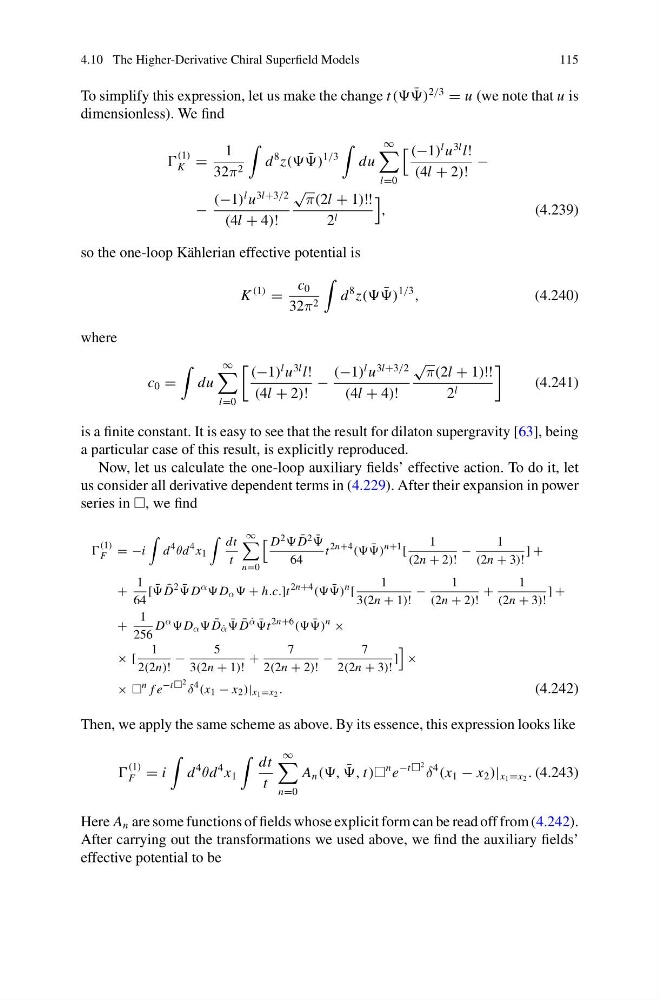
To simplify this expression, let us make the change t (( ¯
)
2/3
= u (we note that u is
dimensionless). We find
(1)
K =
1
32π 2
d
8 z(( ¯
)
1/3
du
∞
l=0
(−1)
l u
3l l!
(4l + 2)!
−
−
(−1)
l u
3l+3/2
(4l + 4)!
√
π(2l + 1)!!
2 l
,
(4.239)
so the one-loop Kählerian effective potential is
K
(1)
=
c 0
32π 2
d
8 z(( ¯
)
1/3
,
(4.240)
where
c 0 =
du
∞
l=0
(−1)
l u
3l l!
(4l + 2)!
−
(−1)
l u
3l+3/2
(4l + 4)!
√ π(2l + 1)!!
2 l
(4.241)
is a finite constant. It is easy to see that the result for dilaton supergravity [63], being
a particular case of this result, is explicitly reproduced.
Now, let us calculate the one-loop auxiliary fields’ effective action. To do it, let
us consider all derivative dependent terms in (4.229). After their expansion in power
series in , we find
(1)
F = −i
d
4 θd
4 x 1
dt
t
∞
n=0
D 2 ¯
D 2 ¯
64
t
2n+4 (( ¯
)
n+1 [
1
(2n + 2)!
−
1
(2n + 3)!
] +
+
1
64
[ ¯
¯
D
2 ¯
D
α D α + h.c.]t
2n+4 (( ¯
)
n [
1
3(2n + 1)!
−
1
(2n + 2)!
+
1
(2n + 3)!
] +
+
1
256
D
α D α ¯
D ˙
α ¯
¯
D
˙
α ¯
t
2n+6 (( ¯
)
n ×
× [
1
2(2n)!
−
5
3(2n + 1)!
+
7
2(2n + 2)!
−
7
2(2n + 3)!
]
×
×
n f e
−t 2 δ
4 (x 1 − x 2 )| x1=x2 .
(4.242)
Then, we apply the same scheme as above. By its essence, this expression looks like
(1)
F = i
d
4
θd
4 x 1
dt
t
∞
n=0
A n ((, ¯
, t)
n e
−t
2 δ
4
(x 1 − x 2 )| x 1 =x 2 . (4.243)
Here A n are some functions of fields whose explicit form can be read off from (4.242).
After carrying out the transformations we used above, we find the auxiliary fields’
effective potential to be
115
To simplify this expression, let us make the change t (( ¯
)
2/3
= u (we note that u is
dimensionless). We find
(1)
K =
1
32π 2
d
8 z(( ¯
)
1/3
du
∞
l=0
(−1)
l u
3l l!
(4l + 2)!
−
−
(−1)
l u
3l+3/2
(4l + 4)!
√
π(2l + 1)!!
2 l
,
(4.239)
so the one-loop Kählerian effective potential is
K
(1)
=
c 0
32π 2
d
8 z(( ¯
)
1/3
,
(4.240)
where
c 0 =
du
∞
l=0
(−1)
l u
3l l!
(4l + 2)!
−
(−1)
l u
3l+3/2
(4l + 4)!
√ π(2l + 1)!!
2 l
(4.241)
is a finite constant. It is easy to see that the result for dilaton supergravity [63], being
a particular case of this result, is explicitly reproduced.
Now, let us calculate the one-loop auxiliary fields’ effective action. To do it, let
us consider all derivative dependent terms in (4.229). After their expansion in power
series in , we find
(1)
F = −i
d
4 θd
4 x 1
dt
t
∞
n=0
D 2 ¯
D 2 ¯
64
t
2n+4 (( ¯
)
n+1 [
1
(2n + 2)!
−
1
(2n + 3)!
] +
+
1
64
[ ¯
¯
D
2 ¯
D
α D α + h.c.]t
2n+4 (( ¯
)
n [
1
3(2n + 1)!
−
1
(2n + 2)!
+
1
(2n + 3)!
] +
+
1
256
D
α D α ¯
D ˙
α ¯
¯
D
˙
α ¯
t
2n+6 (( ¯
)
n ×
× [
1
2(2n)!
−
5
3(2n + 1)!
+
7
2(2n + 2)!
−
7
2(2n + 3)!
]
×
×
n f e
−t 2 δ
4 (x 1 − x 2 )| x1=x2 .
(4.242)
Then, we apply the same scheme as above. By its essence, this expression looks like
(1)
F = i
d
4
θd
4 x 1
dt
t
∞
n=0
A n ((, ¯
, t)
n e
−t
2 δ
4
(x 1 − x 2 )| x 1 =x 2 . (4.243)
Here A n are some functions of fields whose explicit form can be read off from (4.242).
After carrying out the transformations we used above, we find the auxiliary fields’
effective potential to be