

4.10 The Higher-Derivative Chiral Superfield Models
117
S K =
d
8 z( − M
2
) ¯
.
(4.248)
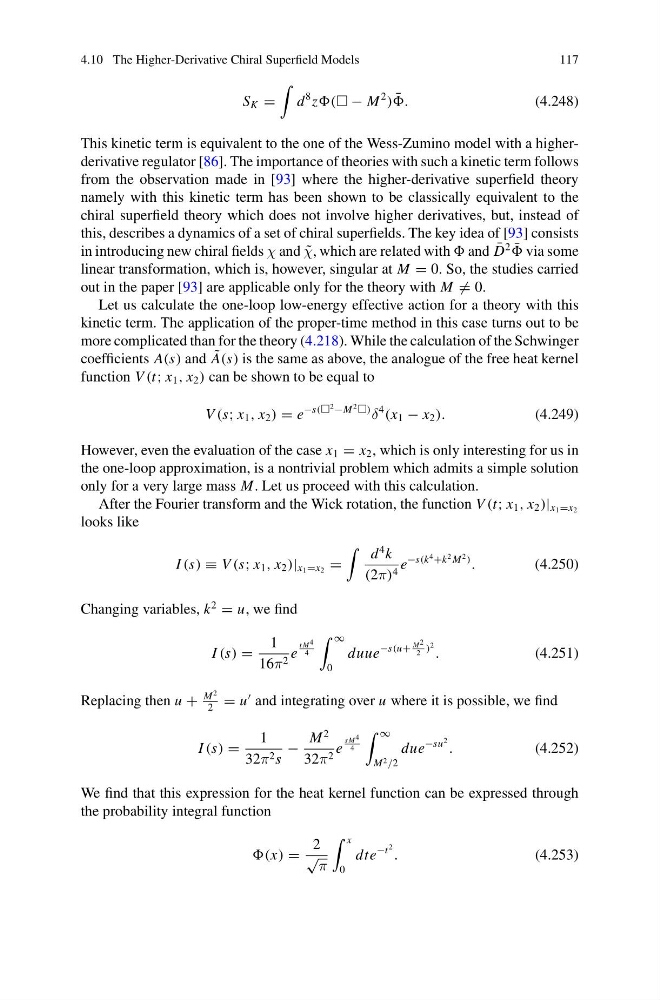
This kinetic term is equivalent to the one of the Wess-Zumino model with a higherderivative regulator [86]. The importance of theories with such a kinetic term follows
from the observation made in [93] where the higher-derivative superfield theory
namely with this kinetic term has been shown to be classically equivalent to the
chiral superfield theory which does not involve higher derivatives, but, instead of
this, describes a dynamics of a set of chiral superfields. The key idea of [93] consists
in introducing new chiral fields χ and ˜
χ, which are related with and ¯
D
2 ¯
via some
linear transformation, which is, however, singular at M = 0. So, the studies carried
out in the paper [93] are applicable only for the theory with M = 0.
Let us calculate the one-loop low-energy effective action for a theory with this
kinetic term. The application of the proper-time method in this case turns out to be
more complicated than for the theory (4.218). While the calculation of the Schwinger
coefficients A(s) and ˜
A(s) is the same as above, the analogue of the free heat kernel
function V (t; x 1 , x 2 ) can be shown to be equal to
V (s; x 1 , x 2 ) = e
−s(
2 −M
2 )
δ
4
(x 1 − x 2 ).
(4.249)
However, even the evaluation of the case x 1 = x 2 , which is only interesting for us in
the one-loop approximation, is a nontrivial problem which admits a simple solution
only for a very large mass M. Let us proceed with this calculation.
After the Fourier transform and the Wick rotation, the function V (t; x 1 , x 2 )| x 1 =x 2
looks like
I (s) ≡ V (s; x 1 , x 2 )| x 1 =x 2 =
d
4 k
(2π) 4 e
−s(k
4 +k
2 M
2 )
.
(4.250)
Changing variables, k
2
= u, we find
I (s) =
1
16π 2 e
t M 4
4
∞
0
duue
−s(u+
M 2
2 )
2 .
(4.251)
Replacing then u +
M
2
2
= u
and integrating over u where it is possible, we find
I (s) =
1
32π 2 s
−
M
2
32π 2 e
s M 4
4
∞
M 2 /2
due
−su
2 .
(4.252)
We find that this expression for the heat kernel function can be expressed through
the probability integral function
(x) =
2
√
π
x
0
dte
−t
2 .
(4.253)
117
S K =
d
8 z( − M
2
) ¯
.
(4.248)
This kinetic term is equivalent to the one of the Wess-Zumino model with a higherderivative regulator [86]. The importance of theories with such a kinetic term follows
from the observation made in [93] where the higher-derivative superfield theory
namely with this kinetic term has been shown to be classically equivalent to the
chiral superfield theory which does not involve higher derivatives, but, instead of
this, describes a dynamics of a set of chiral superfields. The key idea of [93] consists
in introducing new chiral fields χ and ˜
χ, which are related with and ¯
D
2 ¯
via some
linear transformation, which is, however, singular at M = 0. So, the studies carried
out in the paper [93] are applicable only for the theory with M = 0.
Let us calculate the one-loop low-energy effective action for a theory with this
kinetic term. The application of the proper-time method in this case turns out to be
more complicated than for the theory (4.218). While the calculation of the Schwinger
coefficients A(s) and ˜
A(s) is the same as above, the analogue of the free heat kernel
function V (t; x 1 , x 2 ) can be shown to be equal to
V (s; x 1 , x 2 ) = e
−s(
2 −M
2 )
δ
4
(x 1 − x 2 ).
(4.249)
However, even the evaluation of the case x 1 = x 2 , which is only interesting for us in
the one-loop approximation, is a nontrivial problem which admits a simple solution
only for a very large mass M. Let us proceed with this calculation.
After the Fourier transform and the Wick rotation, the function V (t; x 1 , x 2 )| x 1 =x 2
looks like
I (s) ≡ V (s; x 1 , x 2 )| x 1 =x 2 =
d
4 k
(2π) 4 e
−s(k
4 +k
2 M
2 )
.
(4.250)
Changing variables, k
2
= u, we find
I (s) =
1
16π 2 e
t M 4
4
∞
0
duue
−s(u+
M 2
2 )
2 .
(4.251)
Replacing then u +
M
2
2
= u
and integrating over u where it is possible, we find
I (s) =
1
32π 2 s
−
M
2
32π 2 e
s M 4
4
∞
M 2 /2
due
−su
2 .
(4.252)
We find that this expression for the heat kernel function can be expressed through
the probability integral function
(x) =
2
√
π
x
0
dte
−t
2 .
(4.253)