

112
4 Four-Dimensional Superfield Supersymmetry
e
i W v =
Dv exp(−
i
16
d
8 zv D
α ¯
D
2 D α v)δ(
1
4
D
2 v − ¯
φ)δ(
1
4
¯
D
2 v − φ)) F P ,
(4.223)
where the
1
4
D
2 v − ¯
φ,
1
4
¯
D
2 v − φ play the role of the gauge fixing functions, the φ, ¯
φ
are the same as in (4.220), and the F P is the Faddeev-Popov determinant. One
should notice that the W v is a constant.
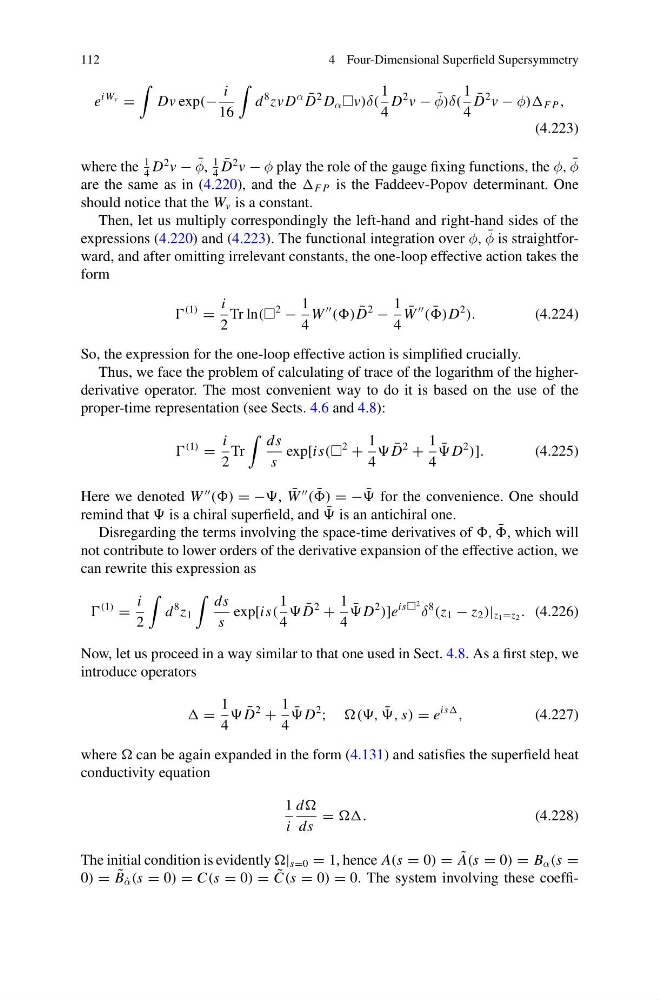
Then, let us multiply correspondingly the left-hand and right-hand sides of the
expressions (4.220) and (4.223). The functional integration over φ, ¯
φ is straightforward, and after omitting irrelevant constants, the one-loop effective action takes the
form
(1)
=
i
2
Tr ln(
2
−
1
4
W
(() ¯
D
2
−
1
4
¯
W
( ¯
)D
2
).
(4.224)
So, the expression for the one-loop effective action is simplified crucially.
Thus, we face the problem of calculating of trace of the logarithm of the higherderivative operator. The most convenient way to do it is based on the use of the
proper-time representation (see Sects. 4.6 and 4.8):
(1)
=
i
2
Tr
ds
s
exp[is(
2
+
1
4
¯
D
2
+
1
4
¯
D
2
)].
(4.225)
Here we denoted W
(() = −, ¯
W
( ¯
) = − ¯
for the convenience. One should
remind that is a chiral superfield, and ¯
is an antichiral one.
Disregarding the terms involving the space-time derivatives of , ¯
, which will
not contribute to lower orders of the derivative expansion of the effective action, we
can rewrite this expression as
(1)
=
i
2
d
8 z 1
ds
s
exp[is(
1
4
¯
D
2
+
1
4
¯
D
2
)]e
is
2 δ
8
(z 1 − z 2 )| z 1 =z 2 . (4.226)
Now, let us proceed in a way similar to that one used in Sect. 4.8. As a first step, we
introduce operators
=
1
4
¯
D
2
+
1
4
¯
D
2
; ((, ¯
, s) = e
is
,
(4.227)
where can be again expanded in the form (4.131) and satisfies the superfield heat
conductivity equation
1
i
d
ds
=
(4.228)
The initial condition is evidently | s=0 = 1, hence A(s = 0) = ˜
A(s = 0) = B α (s =
0) = ˜
B ˙
α (s = 0) = C(s = 0) = ˜
C(s = 0) = 0. The system involving these coeffi-
4 Four-Dimensional Superfield Supersymmetry
e
i W v =
Dv exp(−
i
16
d
8 zv D
α ¯
D
2 D α v)δ(
1
4
D
2 v − ¯
φ)δ(
1
4
¯
D
2 v − φ)) F P ,
(4.223)
where the
1
4
D
2 v − ¯
φ,
1
4
¯
D
2 v − φ play the role of the gauge fixing functions, the φ, ¯
φ
are the same as in (4.220), and the F P is the Faddeev-Popov determinant. One
should notice that the W v is a constant.
Then, let us multiply correspondingly the left-hand and right-hand sides of the
expressions (4.220) and (4.223). The functional integration over φ, ¯
φ is straightforward, and after omitting irrelevant constants, the one-loop effective action takes the
form
(1)
=
i
2
Tr ln(
2
−
1
4
W
(() ¯
D
2
−
1
4
¯
W
( ¯
)D
2
).
(4.224)
So, the expression for the one-loop effective action is simplified crucially.
Thus, we face the problem of calculating of trace of the logarithm of the higherderivative operator. The most convenient way to do it is based on the use of the
proper-time representation (see Sects. 4.6 and 4.8):
(1)
=
i
2
Tr
ds
s
exp[is(
2
+
1
4
¯
D
2
+
1
4
¯
D
2
)].
(4.225)
Here we denoted W
(() = −, ¯
W
( ¯
) = − ¯
for the convenience. One should
remind that is a chiral superfield, and ¯
is an antichiral one.
Disregarding the terms involving the space-time derivatives of , ¯
, which will
not contribute to lower orders of the derivative expansion of the effective action, we
can rewrite this expression as
(1)
=
i
2
d
8 z 1
ds
s
exp[is(
1
4
¯
D
2
+
1
4
¯
D
2
)]e
is
2 δ
8
(z 1 − z 2 )| z 1 =z 2 . (4.226)
Now, let us proceed in a way similar to that one used in Sect. 4.8. As a first step, we
introduce operators
=
1
4
¯
D
2
+
1
4
¯
D
2
; ((, ¯
, s) = e
is
,
(4.227)
where can be again expanded in the form (4.131) and satisfies the superfield heat
conductivity equation
1
i
d
ds
=
(4.228)
The initial condition is evidently | s=0 = 1, hence A(s = 0) = ˜
A(s = 0) = B α (s =
0) = ˜
B ˙
α (s = 0) = C(s = 0) = ˜
C(s = 0) = 0. The system involving these coeffi-