

4.10 The Higher-Derivative Chiral Superfield Models
113
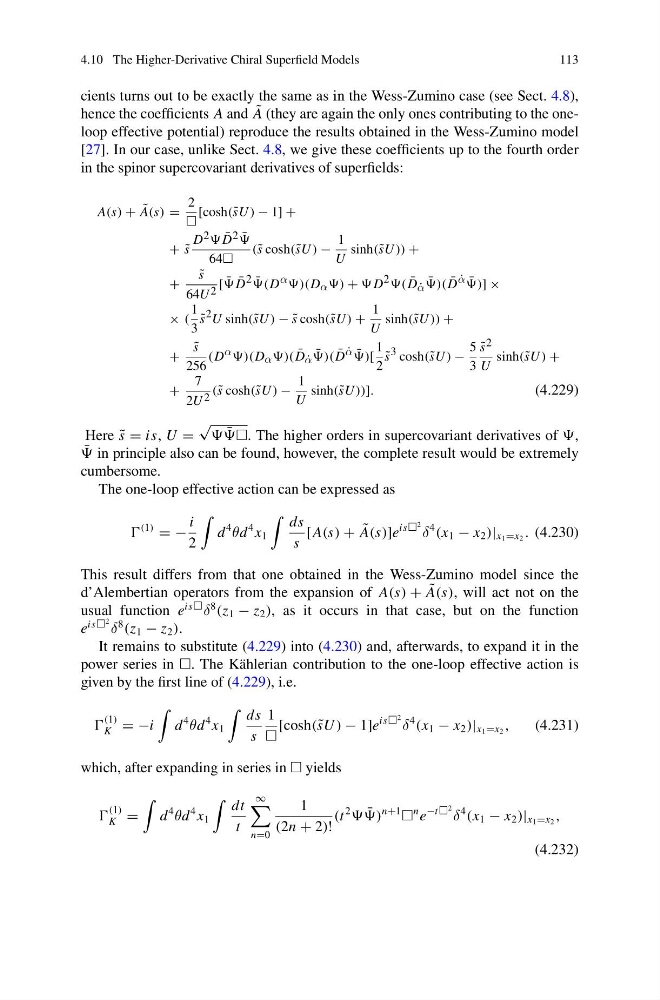
cients turns out to be exactly the same as in the Wess-Zumino case (see Sect. 4.8),
hence the coefficients A and ˜
A (they are again the only ones contributing to the oneloop effective potential) reproduce the results obtained in the Wess-Zumino model
[27]. In our case, unlike Sect. 4.8, we give these coefficients up to the fourth order
in the spinor supercovariant derivatives of superfields:
A(s) + ˜
A(s) =
2
[cosh(˜ sU ) − 1] +
+ ˜
s
D 2 ¯
D 2 ¯
64
(˜ s cosh(˜ sU ) −
1
U
sinh(˜ sU )) +
+
˜
s
64U 2 [ ¯
¯
D 2 ¯
(D α )(D α ) + D 2 ( ¯
D ˙
α ¯
)( ¯
D ˙
α ¯
)] ×
× (
1
3
˜
s 2 U sinh(˜ sU ) − ˜
s cosh(˜ sU ) +
1
U
sinh(˜ sU )) +
+
˜
s
256
(D α )(D α )( ¯
D ˙
α ¯
)( ¯
D ˙
α ¯
)[
1
2
˜
s 3 cosh(˜ sU ) −
5
3
˜
s 2
U
sinh(˜ sU ) +
+
7
2U 2 (˜ s cosh(˜ sU ) −
1
U
sinh(˜ sU ))].
(4.229)
Here ˜
s = is, U =
√
¯
. The higher orders in supercovariant derivatives of ,
¯
in principle also can be found, however, the complete result would be extremely
cumbersome.
The one-loop effective action can be expressed as
(1)
= −
i
2
d
4
θd
4 x 1
ds
s
[A(s) + ˜
A(s)]e
is
2 δ
4
(x 1 − x 2 )| x 1 =x 2 . (4.230)
This result differs from that one obtained in the Wess-Zumino model since the
d’Alembertian operators from the expansion of A(s) + ˜
A(s), will act not on the
usual function e
is
δ
8
(z 1 − z 2 ), as it occurs in that case, but on the function
e
is
2 δ
8
(z 1 − z 2 ).
It remains to substitute (4.229) into (4.230) and, afterwards, to expand it in the
power series in . The Kählerian contribution to the one-loop effective action is
given by the first line of (4.229), i.e.
(1)
K = −i
d
4
θd
4 x 1
ds
s
1
[cosh(˜ sU ) − 1]e
is
2 δ
4
(x 1 − x 2 )| x 1 =x 2 ,
(4.231)
which, after expanding in series in yields
(1)
K =
d
4
θd
4 x 1
dt
t
∞
n=0
1
(2n + 2)!
(t
2
¯
)
n+1
n e
−t
2 δ
4
(x 1 − x 2 )| x 1 =x 2 ,
(4.232)
113
cients turns out to be exactly the same as in the Wess-Zumino case (see Sect. 4.8),
hence the coefficients A and ˜
A (they are again the only ones contributing to the oneloop effective potential) reproduce the results obtained in the Wess-Zumino model
[27]. In our case, unlike Sect. 4.8, we give these coefficients up to the fourth order
in the spinor supercovariant derivatives of superfields:
A(s) + ˜
A(s) =
2
[cosh(˜ sU ) − 1] +
+ ˜
s
D 2 ¯
D 2 ¯
64
(˜ s cosh(˜ sU ) −
1
U
sinh(˜ sU )) +
+
˜
s
64U 2 [ ¯
¯
D 2 ¯
(D α )(D α ) + D 2 ( ¯
D ˙
α ¯
)( ¯
D ˙
α ¯
)] ×
× (
1
3
˜
s 2 U sinh(˜ sU ) − ˜
s cosh(˜ sU ) +
1
U
sinh(˜ sU )) +
+
˜
s
256
(D α )(D α )( ¯
D ˙
α ¯
)( ¯
D ˙
α ¯
)[
1
2
˜
s 3 cosh(˜ sU ) −
5
3
˜
s 2
U
sinh(˜ sU ) +
+
7
2U 2 (˜ s cosh(˜ sU ) −
1
U
sinh(˜ sU ))].
(4.229)
Here ˜
s = is, U =
√
¯
. The higher orders in supercovariant derivatives of ,
¯
in principle also can be found, however, the complete result would be extremely
cumbersome.
The one-loop effective action can be expressed as
(1)
= −
i
2
d
4
θd
4 x 1
ds
s
[A(s) + ˜
A(s)]e
is
2 δ
4
(x 1 − x 2 )| x 1 =x 2 . (4.230)
This result differs from that one obtained in the Wess-Zumino model since the
d’Alembertian operators from the expansion of A(s) + ˜
A(s), will act not on the
usual function e
is
δ
8
(z 1 − z 2 ), as it occurs in that case, but on the function
e
is
2 δ
8
(z 1 − z 2 ).
It remains to substitute (4.229) into (4.230) and, afterwards, to expand it in the
power series in . The Kählerian contribution to the one-loop effective action is
given by the first line of (4.229), i.e.
(1)
K = −i
d
4
θd
4 x 1
ds
s
1
[cosh(˜ sU ) − 1]e
is
2 δ
4
(x 1 − x 2 )| x 1 =x 2 ,
(4.231)
which, after expanding in series in yields
(1)
K =
d
4
θd
4 x 1
dt
t
∞
n=0
1
(2n + 2)!
(t
2
¯
)
n+1
n e
−t
2 δ
4
(x 1 − x 2 )| x 1 =x 2 ,
(4.232)