

4.10 The Higher-Derivative Chiral Superfield Models
111
Here is a chiral superfield, and W (() is an arbitrary function. A particular form
of this action was studied in [85], for the case W (() = e
3 , it corresponds to
the four-dimensional anomaly-modified dilaton supergravity in the infrared limit,
where, in particular, all derivative-dependent coupling terms of the classical action
simply vanish. This action, being reduced to the components, contains terms of the
fourth order in space-time derivatives. We will refer to this theory as to the minimal
higher-derivative theory.
The effective action [, ¯
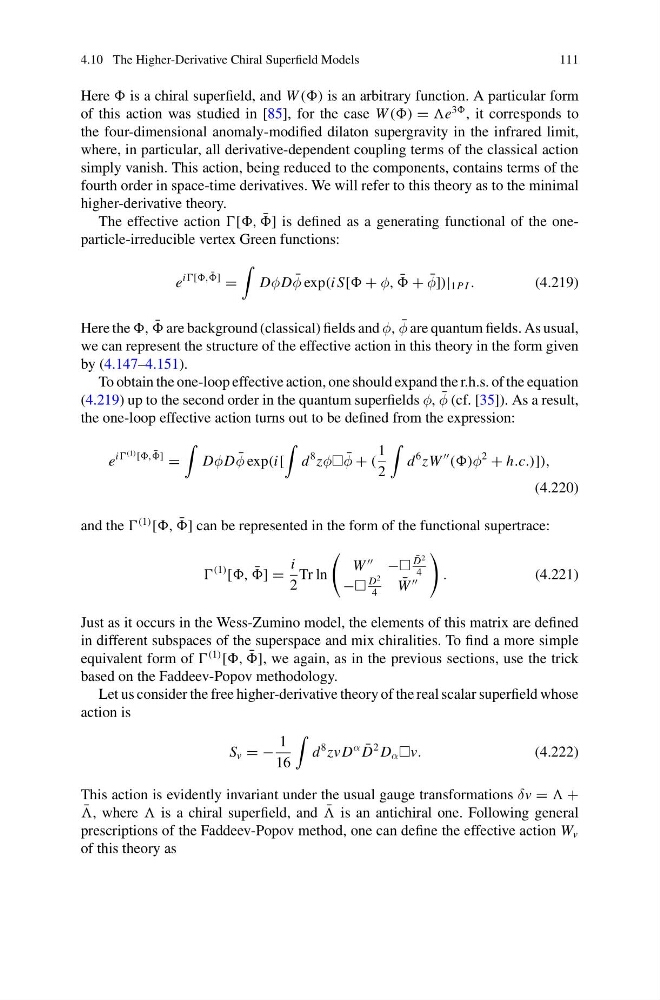
] is defined as a generating functional of the oneparticle-irreducible vertex Green functions:
e
i[, ¯
]
=
DφD ¯
φ exp(i S[ + φ, ¯
+ ¯
φ])| 1P I .
(4.219)
Here the , ¯
are background (classical) fields and φ, ¯
φ are quantum fields. As usual,
we can represent the structure of the effective action in this theory in the form given
by (4.147–4.151).
To obtain the one-loop effective action, one should expand the r.h.s. of the equation
(4.219) up to the second order in the quantum superfields φ, ¯
φ (cf. [35]). As a result,
the one-loop effective action turns out to be defined from the expression:
e
i
(1) [, ¯
]
=
DφD ¯
φ exp(i[
d
8 zφ ¯
φ + (
1
2
d
6 zW
(()φ
2
+ h.c.)]),
(4.220)
and the
(1)
[, ¯
] can be represented in the form of the functional supertrace:
(1)
[, ¯
] =
i
2
Tr ln
W
−
¯
D
2
4
−
D
2
4
¯
W
.
(4.221)
Just as it occurs in the Wess-Zumino model, the elements of this matrix are defined
in different subspaces of the superspace and mix chiralities. To find a more simple
equivalent form of
(1)
[, ¯
], we again, as in the previous sections, use the trick
based on the Faddeev-Popov methodology.
Let us consider the free higher-derivative theory of the real scalar superfield whose
action is
S v = −
1
16
d
8 zv D
α ¯
D
2 D α v.
(4.222)
This action is evidently invariant under the usual gauge transformations δv = +
¯
, where is a chiral superfield, and ¯
is an antichiral one. Following general
prescriptions of the Faddeev-Popov method, one can define the effective action W v
of this theory as
111
Here is a chiral superfield, and W (() is an arbitrary function. A particular form
of this action was studied in [85], for the case W (() = e
3 , it corresponds to
the four-dimensional anomaly-modified dilaton supergravity in the infrared limit,
where, in particular, all derivative-dependent coupling terms of the classical action
simply vanish. This action, being reduced to the components, contains terms of the
fourth order in space-time derivatives. We will refer to this theory as to the minimal
higher-derivative theory.
The effective action [, ¯
] is defined as a generating functional of the oneparticle-irreducible vertex Green functions:
e
i[, ¯
]
=
DφD ¯
φ exp(i S[ + φ, ¯
+ ¯
φ])| 1P I .
(4.219)
Here the , ¯
are background (classical) fields and φ, ¯
φ are quantum fields. As usual,
we can represent the structure of the effective action in this theory in the form given
by (4.147–4.151).
To obtain the one-loop effective action, one should expand the r.h.s. of the equation
(4.219) up to the second order in the quantum superfields φ, ¯
φ (cf. [35]). As a result,
the one-loop effective action turns out to be defined from the expression:
e
i
(1) [, ¯
]
=
DφD ¯
φ exp(i[
d
8 zφ ¯
φ + (
1
2
d
6 zW
(()φ
2
+ h.c.)]),
(4.220)
and the
(1)
[, ¯
] can be represented in the form of the functional supertrace:
(1)
[, ¯
] =
i
2
Tr ln
W
−
¯
D
2
4
−
D
2
4
¯
W
.
(4.221)
Just as it occurs in the Wess-Zumino model, the elements of this matrix are defined
in different subspaces of the superspace and mix chiralities. To find a more simple
equivalent form of
(1)
[, ¯
], we again, as in the previous sections, use the trick
based on the Faddeev-Popov methodology.
Let us consider the free higher-derivative theory of the real scalar superfield whose
action is
S v = −
1
16
d
8 zv D
α ¯
D
2 D α v.
(4.222)
This action is evidently invariant under the usual gauge transformations δv = +
¯
, where is a chiral superfield, and ¯
is an antichiral one. Following general
prescriptions of the Faddeev-Popov method, one can define the effective action W v
of this theory as