

72
2 The Discrete Spectrum and the Continuum
harmonic oscillator |n rel rel and |N CM L CM states, which are eigenstates of
the relative and center of mass parts of Eq. (2.209), respectively. The respective
eigenenergies of |n rel rel and |N CM L CM indeed verify e rel + E CM = E.
Consequently, for a given energy E, an eigenstate of the Hamiltonian of Eq. (2.26)
defined with laboratory coordinates is then a finite linear combination of those
defined with relative/center-of-mass coordinates of the same energy using
Eq. (2.25). This proves the existence of Eq. (2.20), as the sum therein is necessarily
finite.
Exercise IV. Coulomb wave functions are in general not analytic on the negative
real axis and there is a cut therein. F ,η (z) is clearly not analytic for non-integer,
while it is entire when is an integer (see Eq. (2.37)). Conversely, H ω
,η always has
a cut on the negative real axis for η = 0 (see Sect. 2.3.2). Thus, Coulomb wave
functions present a discontinuity when crossing the negative real axis. Evidently, if
Coulomb wave functions vary by several orders of magnitude for slowly varying z,
the magnitude of the discontinuity on the negative real axis can be expected to be
large as well.
Exercise V. Determine inequalities from Eqs. (2.73) and (2.74) replacing y by 1 in
their Λ dependent term and conclude using the fact that y ∈ [0 : 1].
Exercise VI. To derive Eq. (2.85), use the Taylor expansions of arctan and arctanh
in Eqs. (2.73) and (2.74) for r → 0.
As y → 1 when r → +∞, Eqs. (2.86) and (2.87) are directly obtained from
Eqs. (2.73), (2.74), (2.81), and (2.84).
Exercise VII. The fact that V PTG (r) + + 1)/r 2 ∼ + 1)/r 2 for r → 0 and
V PTG (r) → 0 tend to zero exponentially for r → +∞ is a direct implication of the
results of Exercises V and VI. As V PTG (r) + + 1)/r 2 is negligibly small in the
asymptotic region, the effective orbital angular momentum in the asymptotic region
is equal to zero, so that all bound and resonance states behave like neutron s-states.
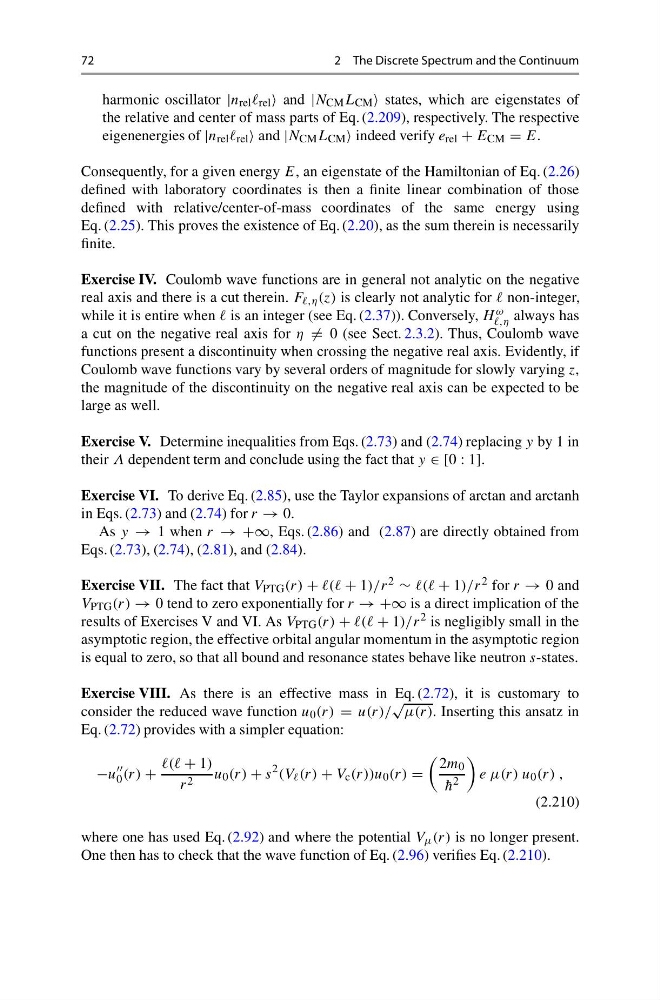
Exercise VIII. As there is an effective mass in Eq. (2.72), it is customary to
consider the reduced wave function u 0 (r) = u(r)/
√
μ(r). Inserting this ansatz in
Eq. (2.72) provides with a simpler equation:
−u
0 (r) +
+ 1)
r 2 u 0 (r) + s
2 (V (r) + V c (r))u 0 (r) =
2m 0
¯
h
2
e μ(r) u 0 (r) ,
(2.210)
where one has used Eq. (2.92) and where the potential V μ (r) is no longer present.
One then has to check that the wave function of Eq. (2.96) verifies Eq. (2.210).
2 The Discrete Spectrum and the Continuum
harmonic oscillator |n rel rel and |N CM L CM states, which are eigenstates of
the relative and center of mass parts of Eq. (2.209), respectively. The respective
eigenenergies of |n rel rel and |N CM L CM indeed verify e rel + E CM = E.
Consequently, for a given energy E, an eigenstate of the Hamiltonian of Eq. (2.26)
defined with laboratory coordinates is then a finite linear combination of those
defined with relative/center-of-mass coordinates of the same energy using
Eq. (2.25). This proves the existence of Eq. (2.20), as the sum therein is necessarily
finite.
Exercise IV. Coulomb wave functions are in general not analytic on the negative
real axis and there is a cut therein. F ,η (z) is clearly not analytic for non-integer,
while it is entire when is an integer (see Eq. (2.37)). Conversely, H ω
,η always has
a cut on the negative real axis for η = 0 (see Sect. 2.3.2). Thus, Coulomb wave
functions present a discontinuity when crossing the negative real axis. Evidently, if
Coulomb wave functions vary by several orders of magnitude for slowly varying z,
the magnitude of the discontinuity on the negative real axis can be expected to be
large as well.
Exercise V. Determine inequalities from Eqs. (2.73) and (2.74) replacing y by 1 in
their Λ dependent term and conclude using the fact that y ∈ [0 : 1].
Exercise VI. To derive Eq. (2.85), use the Taylor expansions of arctan and arctanh
in Eqs. (2.73) and (2.74) for r → 0.
As y → 1 when r → +∞, Eqs. (2.86) and (2.87) are directly obtained from
Eqs. (2.73), (2.74), (2.81), and (2.84).
Exercise VII. The fact that V PTG (r) + + 1)/r 2 ∼ + 1)/r 2 for r → 0 and
V PTG (r) → 0 tend to zero exponentially for r → +∞ is a direct implication of the
results of Exercises V and VI. As V PTG (r) + + 1)/r 2 is negligibly small in the
asymptotic region, the effective orbital angular momentum in the asymptotic region
is equal to zero, so that all bound and resonance states behave like neutron s-states.
Exercise VIII. As there is an effective mass in Eq. (2.72), it is customary to
consider the reduced wave function u 0 (r) = u(r)/
√
μ(r). Inserting this ansatz in
Eq. (2.72) provides with a simpler equation:
−u
0 (r) +
+ 1)
r 2 u 0 (r) + s
2 (V (r) + V c (r))u 0 (r) =
2m 0
¯
h
2
e μ(r) u 0 (r) ,
(2.210)
where one has used Eq. (2.92) and where the potential V μ (r) is no longer present.
One then has to check that the wave function of Eq. (2.96) verifies Eq. (2.210).