

Solutions to Exercises
73
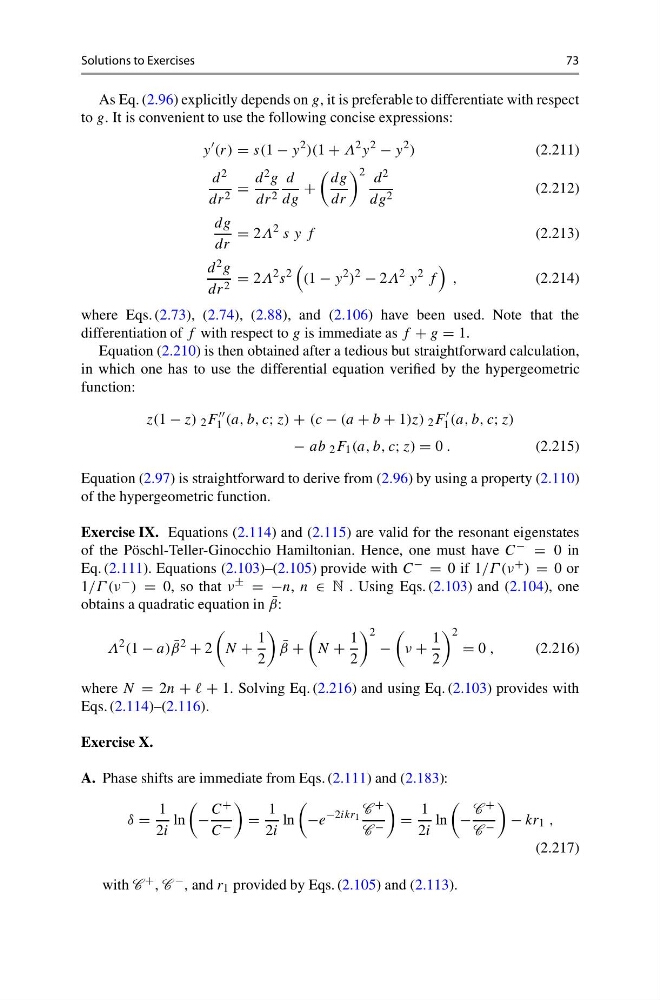
As Eq. (2.96) explicitly depends on g, it is preferable to differentiate with respect
to g. It is convenient to use the following concise expressions:
y
(r) = s(1 − y
2 )(1 + Λ
2 y
2
− y
2 )
(2.211)
d 2
dr 2 =
d 2 g
dr 2
d
dg
+
dg
dr
2 d 2
dg 2
(2.212)
dg
dr
= 2Λ
2 s y f
(2.213)
d 2 g
dr 2 = 2Λ
2 s
2
(1 − y
2 )
2
− 2Λ
2 y
2 f
,
(2.214)
where Eqs. (2.73), (2.74), (2.88), and (2.106) have been used. Note that the
differentiation of f with respect to g is immediate as f + g = 1.
Equation (2.210) is then obtained after a tedious but straightforward calculation,
in which one has to use the differential equation verified by the hypergeometric
function:
z(1 − z) 2 F
1 (a, b, c; z) + (c − (a + b + 1)z) 2 F
1 (a, b, c; z)
− ab 2 F 1 (a, b, c; z) = 0 .
(2.215)
Equation (2.97) is straightforward to derive from (2.96) by using a property (2.110)
of the hypergeometric function.
Exercise IX. Equations (2.114) and (2.115) are valid for the resonant eigenstates
of the Pöschl-Teller-Ginocchio Hamiltonian. Hence, one must have C − = 0 in
Eq. (2.111). Equations (2.103)–(2.105) provide with C − = 0 if 1/Γ (ν + ) = 0 or
1/Γ (ν − ) = 0, so that ν ± = −n, n ∈ N . Using Eqs. (2.103) and (2.104), one
obtains a quadratic equation in ¯
β:
Λ
2 (1 − a) ¯
β
2
+ 2
N +
1
2
¯
β +
N +
1
2
2
−
ν +
1
2
2
= 0 ,
(2.216)
where N = 2n + + 1. Solving Eq. (2.216) and using Eq. (2.103) provides with
Eqs. (2.114)–(2.116).
Exercise X.
A. Phase shifts are immediate from Eqs. (2.111) and (2.183):
δ =
1
2i
ln
−
C +
C −
=
1
2i
ln
−e
−2ikr 1
C +
C −
=
1
2i
ln
−
C +
C −
− kr 1 ,
(2.217)
with C + , C − , and r 1 provided by Eqs. (2.105) and (2.113).
73
As Eq. (2.96) explicitly depends on g, it is preferable to differentiate with respect
to g. It is convenient to use the following concise expressions:
y
(r) = s(1 − y
2 )(1 + Λ
2 y
2
− y
2 )
(2.211)
d 2
dr 2 =
d 2 g
dr 2
d
dg
+
dg
dr
2 d 2
dg 2
(2.212)
dg
dr
= 2Λ
2 s y f
(2.213)
d 2 g
dr 2 = 2Λ
2 s
2
(1 − y
2 )
2
− 2Λ
2 y
2 f
,
(2.214)
where Eqs. (2.73), (2.74), (2.88), and (2.106) have been used. Note that the
differentiation of f with respect to g is immediate as f + g = 1.
Equation (2.210) is then obtained after a tedious but straightforward calculation,
in which one has to use the differential equation verified by the hypergeometric
function:
z(1 − z) 2 F
1 (a, b, c; z) + (c − (a + b + 1)z) 2 F
1 (a, b, c; z)
− ab 2 F 1 (a, b, c; z) = 0 .
(2.215)
Equation (2.97) is straightforward to derive from (2.96) by using a property (2.110)
of the hypergeometric function.
Exercise IX. Equations (2.114) and (2.115) are valid for the resonant eigenstates
of the Pöschl-Teller-Ginocchio Hamiltonian. Hence, one must have C − = 0 in
Eq. (2.111). Equations (2.103)–(2.105) provide with C − = 0 if 1/Γ (ν + ) = 0 or
1/Γ (ν − ) = 0, so that ν ± = −n, n ∈ N . Using Eqs. (2.103) and (2.104), one
obtains a quadratic equation in ¯
β:
Λ
2 (1 − a) ¯
β
2
+ 2
N +
1
2
¯
β +
N +
1
2
2
−
ν +
1
2
2
= 0 ,
(2.216)
where N = 2n + + 1. Solving Eq. (2.216) and using Eq. (2.103) provides with
Eqs. (2.114)–(2.116).
Exercise X.
A. Phase shifts are immediate from Eqs. (2.111) and (2.183):
δ =
1
2i
ln
−
C +
C −
=
1
2i
ln
−e
−2ikr 1
C +
C −
=
1
2i
ln
−
C +
C −
− kr 1 ,
(2.217)
with C + , C − , and r 1 provided by Eqs. (2.105) and (2.113).