

62
2 The Discrete Spectrum and the Continuum
where a is the scattering length and r 0 is the effective range, as it is related to the
distance up to which the nuclear interaction can act. This definition arises from the
equation u(k, r) = 0, solved for k → 0 and moderate r, using the asymptotic wave
function of Eq. (2.7). Following the results of Sect. 2.5.1, there will be a zero of
u(k, r) for small k > 0 at large distance if there is a bound state of energy close to
zero. Consequently, the scattering length is large and positive therein. Conversely,
a negative scattering length implies that there is no bound state at low energy. This
typically indicates the presence of a low energy antibound state for neutron s states,
as no resonance state can exist therein. As the scattering length can be measured
experimentally, it can give insights to the position of its bound, resonance, and
antibound states close to the particle emission threshold.
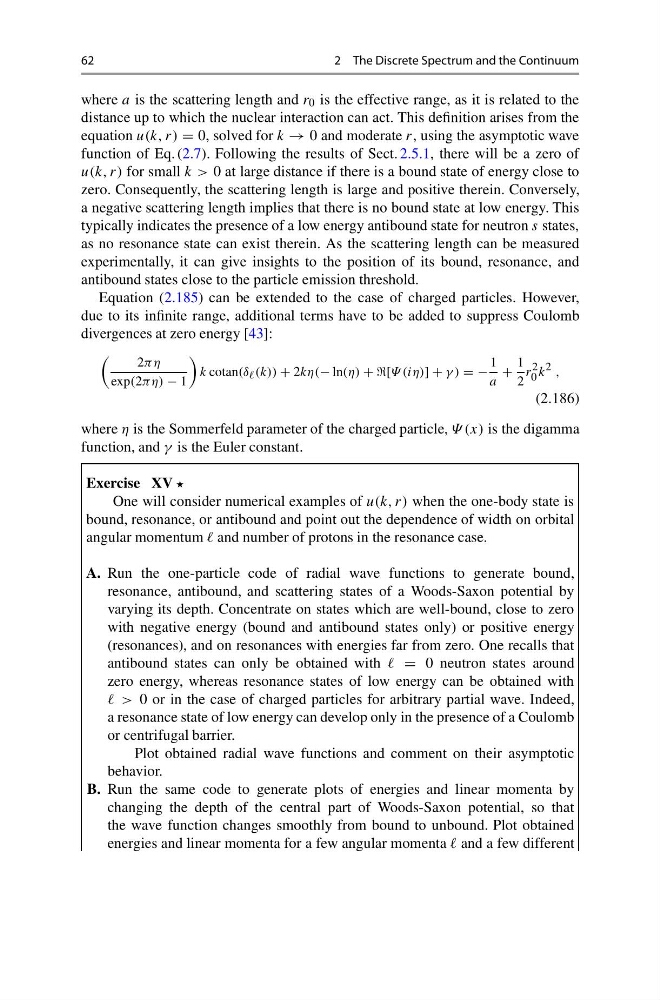
Equation (2.185) can be extended to the case of charged particles. However,
due to its infinite range, additional terms have to be added to suppress Coulomb
divergences at zero energy [43]:
2πη
exp(2πη) − 1
k cotan(δ (k)) + 2kη(− ln(η) + +[Ψ (iη)] + γ ) = −
1
a
+
1
2
r 2
0 k 2 ,
(2.186)
where η is the Sommerfeld parameter of the charged particle, Ψ (x) is the digamma
function, and γ is the Euler constant.
Exercise XV
One will consider numerical examples of u(k, r) when the one-body state is
bound, resonance, or antibound and point out the dependence of width on orbital
angular momentum and number of protons in the resonance case.
A. Run the one-particle code of radial wave functions to generate bound,
resonance, antibound, and scattering states of a Woods-Saxon potential by
varying its depth. Concentrate on states which are well-bound, close to zero
with negative energy (bound and antibound states only) or positive energy
(resonances), and on resonances with energies far from zero. One recalls that
antibound states can only be obtained with = 0 neutron states around
zero energy, whereas resonance states of low energy can be obtained with
> 0 or in the case of charged particles for arbitrary partial wave. Indeed,
a resonance state of low energy can develop only in the presence of a Coulomb
or centrifugal barrier.
Plot obtained radial wave functions and comment on their asymptotic
behavior.
B. Run the same code to generate plots of energies and linear momenta by
changing the depth of the central part of Woods-Saxon potential, so that
the wave function changes smoothly from bound to unbound. Plot obtained
energies and linear momenta for a few angular momenta and a few different
2 The Discrete Spectrum and the Continuum
where a is the scattering length and r 0 is the effective range, as it is related to the
distance up to which the nuclear interaction can act. This definition arises from the
equation u(k, r) = 0, solved for k → 0 and moderate r, using the asymptotic wave
function of Eq. (2.7). Following the results of Sect. 2.5.1, there will be a zero of
u(k, r) for small k > 0 at large distance if there is a bound state of energy close to
zero. Consequently, the scattering length is large and positive therein. Conversely,
a negative scattering length implies that there is no bound state at low energy. This
typically indicates the presence of a low energy antibound state for neutron s states,
as no resonance state can exist therein. As the scattering length can be measured
experimentally, it can give insights to the position of its bound, resonance, and
antibound states close to the particle emission threshold.
Equation (2.185) can be extended to the case of charged particles. However,
due to its infinite range, additional terms have to be added to suppress Coulomb
divergences at zero energy [43]:
2πη
exp(2πη) − 1
k cotan(δ (k)) + 2kη(− ln(η) + +[Ψ (iη)] + γ ) = −
1
a
+
1
2
r 2
0 k 2 ,
(2.186)
where η is the Sommerfeld parameter of the charged particle, Ψ (x) is the digamma
function, and γ is the Euler constant.
Exercise XV
One will consider numerical examples of u(k, r) when the one-body state is
bound, resonance, or antibound and point out the dependence of width on orbital
angular momentum and number of protons in the resonance case.
A. Run the one-particle code of radial wave functions to generate bound,
resonance, antibound, and scattering states of a Woods-Saxon potential by
varying its depth. Concentrate on states which are well-bound, close to zero
with negative energy (bound and antibound states only) or positive energy
(resonances), and on resonances with energies far from zero. One recalls that
antibound states can only be obtained with = 0 neutron states around
zero energy, whereas resonance states of low energy can be obtained with
> 0 or in the case of charged particles for arbitrary partial wave. Indeed,
a resonance state of low energy can develop only in the presence of a Coulomb
or centrifugal barrier.
Plot obtained radial wave functions and comment on their asymptotic
behavior.
B. Run the same code to generate plots of energies and linear momenta by
changing the depth of the central part of Woods-Saxon potential, so that
the wave function changes smoothly from bound to unbound. Plot obtained
energies and linear momenta for a few angular momenta and a few different