

2.6 Analytical Properties of the Wave Functions
63
numbers of protons defining the Coulomb part of the Woods-Saxon potential
and comment on obtained results.
Check that wave functions become resonance states above particleemission threshold and explain the value of width as a function of and
number of protons.
An important relation borne by the S-matrix is the dispersion relation [37] which
provides the relation between (S (k)) and (S (k)). In particular, the dispersion
relation allows to determine univocally phase shift in Eq. (2.183), because its
experimental value is known only up to a k-dependent phase. It would be convenient
to have a dispersion relation for both cases of charged and uncharged particles.
However, as one has to integrate S (k) in k = 0, therefore having a Coulomb
potential in the one-body Hamiltonian is precluded because S (k) possesses an
essential singularity in k = 0 in this situation. Consequently, one will consider
that the potential vanishes for r > R, that is, one considers only the neutron case.
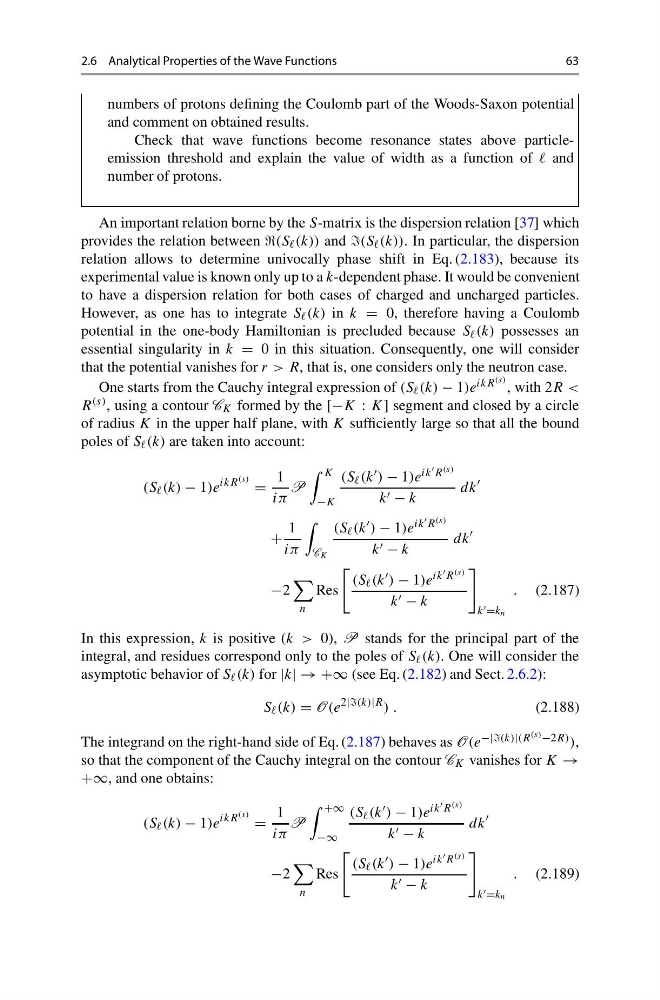
One starts from the Cauchy integral expression of (S (k) − 1)e ikR (s) , with 2R <
R (s) , using a contour C K formed by the [−K : K] segment and closed by a circle
of radius K in the upper half plane, with K sufficiently large so that all the bound
poles of S (k) are taken into account:
(S (k) − 1)e
ikR (s) =
1
iπ
P
K
−K
(S (k ) − 1)e ik R (s)
k − k
dk
+
1
iπ
C K
(S (k ) − 1)e ik R (s)
k − k
dk
−2
n
Res
(S (k ) − 1)e ik R (s)
k − k
k =k n
. (2.187)
In this expression, k is positive (k > 0), P stands for the principal part of the
integral, and residues correspond only to the poles of S (k). One will consider the
asymptotic behavior of S (k) for |k| → +∞ (see Eq. (2.182) and Sect. 2.6.2):
S (k) = O(e
2||(k)|R ) .
(2.188)
The integrand on the right-hand side of Eq. (2.187) behaves as O(e −||(k)|(R (s) −2R) ),
so that the component of the Cauchy integral on the contour C K vanishes for K →
+∞, and one obtains:
(S (k) − 1)e
ikR (s) =
1
iπ
P
+∞
−∞
(S (k ) − 1)e ik R (s)
k − k
dk
−2
n
Res
(S (k ) − 1)e ik R (s)
k − k
k =k n
. (2.189)
63
numbers of protons defining the Coulomb part of the Woods-Saxon potential
and comment on obtained results.
Check that wave functions become resonance states above particleemission threshold and explain the value of width as a function of and
number of protons.
An important relation borne by the S-matrix is the dispersion relation [37] which
provides the relation between (S (k)) and (S (k)). In particular, the dispersion
relation allows to determine univocally phase shift in Eq. (2.183), because its
experimental value is known only up to a k-dependent phase. It would be convenient
to have a dispersion relation for both cases of charged and uncharged particles.
However, as one has to integrate S (k) in k = 0, therefore having a Coulomb
potential in the one-body Hamiltonian is precluded because S (k) possesses an
essential singularity in k = 0 in this situation. Consequently, one will consider
that the potential vanishes for r > R, that is, one considers only the neutron case.
One starts from the Cauchy integral expression of (S (k) − 1)e ikR (s) , with 2R <
R (s) , using a contour C K formed by the [−K : K] segment and closed by a circle
of radius K in the upper half plane, with K sufficiently large so that all the bound
poles of S (k) are taken into account:
(S (k) − 1)e
ikR (s) =
1
iπ
P
K
−K
(S (k ) − 1)e ik R (s)
k − k
dk
+
1
iπ
C K
(S (k ) − 1)e ik R (s)
k − k
dk
−2
n
Res
(S (k ) − 1)e ik R (s)
k − k
k =k n
. (2.187)
In this expression, k is positive (k > 0), P stands for the principal part of the
integral, and residues correspond only to the poles of S (k). One will consider the
asymptotic behavior of S (k) for |k| → +∞ (see Eq. (2.182) and Sect. 2.6.2):
S (k) = O(e
2||(k)|R ) .
(2.188)
The integrand on the right-hand side of Eq. (2.187) behaves as O(e −||(k)|(R (s) −2R) ),
so that the component of the Cauchy integral on the contour C K vanishes for K →
+∞, and one obtains:
(S (k) − 1)e
ikR (s) =
1
iπ
P
+∞
−∞
(S (k ) − 1)e ik R (s)
k − k
dk
−2
n
Res
(S (k ) − 1)e ik R (s)
k − k
k =k n
. (2.189)