

2.6 Analytical Properties of the Wave Functions
47
determine the properties of wave functions in a potential screened of its Coulomb
part at finite distance. The scattering wave functions generated by an infinite-range
potential are singular in the complex k-plane, so that the use of a screened potential
simplifies their theoretical study in the complex k-plane.
Mathematical tools of fundamental importance for scattering theory are the Jost
function and the scattering matrix (S-matrix). They are defined from the incoming
and outgoing components of scattering states, so that they are directly related to
the probability to form a composite system in a nuclear reaction. The dependence of
nuclear cross sections on nuclear structure is in fact present only in the S-matrix. The
S-matrix enters the dispersion relations [37], which are of fundamental importance
as they allow to connect real and imaginary parts of S-matrix and, hence, calculate
the complex S-matrix from the knowledge of its real part. The S-matrix dispersion
relation formulas will then be also derived in this section.
As said earlier, narrow resonance states play a special role in the complex kplane. Moreover, the numerical calculation of resonances is more difficult than the
calculation of bound states. To calculate bound states, one can either diagonalize
Eq. (2.3) in a basis of bound states, for example, in a basis of harmonic oscillator
states, or use a bisection method, as bound states belong to a finite segment of the
negative real energy axis (see Sect. 2.5). On the other hand, the resonance energy
is complex, which precludes the use of the bisection method. Moreover, resonances
diverge on the real axis, so that they cannot be expanded with the basis of bound
states. Thus, the numerical method to calculate resonances, based on the use of the
Jost function, will be stated in this section.
An additional problem arises when the width of a narrow resonance is much
smaller than its energy, hence when one deals with very long-lived resonance. In
this case, it is impossible to precisely calculate both the real and imaginary parts
of the resonance energy simultaneously. In order to solve this problem, one recurs
to the flux equation which provides the width of a narrow resonance from the real
part of its energy and the wave function. This equation and its ability to describe
widths which are several orders of magnitude smaller than associated energies will
be demonstrated in this section.
2.6.1 Decomposition in Incoming and Outgoing Wave Functions
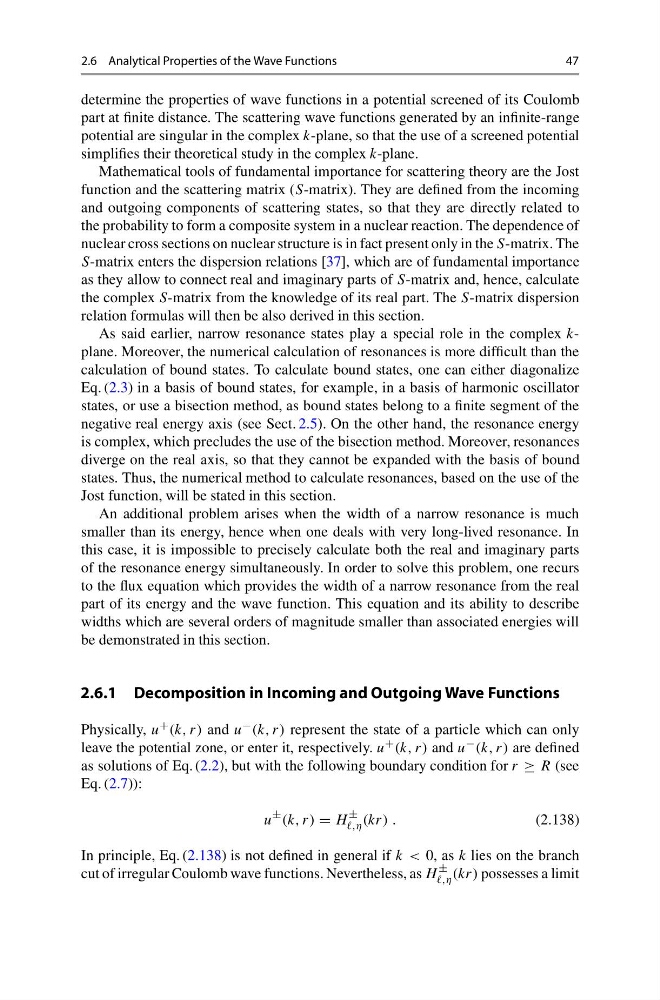
Physically, u + (k, r) and u − (k, r) represent the state of a particle which can only
leave the potential zone, or enter it, respectively. u + (k, r) and u − (k, r) are defined
as solutions of Eq. (2.2), but with the following boundary condition for r ≥ R (see
Eq. (2.7)):
u
± (k, r) = H
±
,η (kr) .
(2.138)
In principle, Eq. (2.138) is not defined in general if k < 0, as k lies on the branch
cut of irregular Coulomb wave functions. Nevertheless, as H
±
,η (kr) possesses a limit
47
determine the properties of wave functions in a potential screened of its Coulomb
part at finite distance. The scattering wave functions generated by an infinite-range
potential are singular in the complex k-plane, so that the use of a screened potential
simplifies their theoretical study in the complex k-plane.
Mathematical tools of fundamental importance for scattering theory are the Jost
function and the scattering matrix (S-matrix). They are defined from the incoming
and outgoing components of scattering states, so that they are directly related to
the probability to form a composite system in a nuclear reaction. The dependence of
nuclear cross sections on nuclear structure is in fact present only in the S-matrix. The
S-matrix enters the dispersion relations [37], which are of fundamental importance
as they allow to connect real and imaginary parts of S-matrix and, hence, calculate
the complex S-matrix from the knowledge of its real part. The S-matrix dispersion
relation formulas will then be also derived in this section.
As said earlier, narrow resonance states play a special role in the complex kplane. Moreover, the numerical calculation of resonances is more difficult than the
calculation of bound states. To calculate bound states, one can either diagonalize
Eq. (2.3) in a basis of bound states, for example, in a basis of harmonic oscillator
states, or use a bisection method, as bound states belong to a finite segment of the
negative real energy axis (see Sect. 2.5). On the other hand, the resonance energy
is complex, which precludes the use of the bisection method. Moreover, resonances
diverge on the real axis, so that they cannot be expanded with the basis of bound
states. Thus, the numerical method to calculate resonances, based on the use of the
Jost function, will be stated in this section.
An additional problem arises when the width of a narrow resonance is much
smaller than its energy, hence when one deals with very long-lived resonance. In
this case, it is impossible to precisely calculate both the real and imaginary parts
of the resonance energy simultaneously. In order to solve this problem, one recurs
to the flux equation which provides the width of a narrow resonance from the real
part of its energy and the wave function. This equation and its ability to describe
widths which are several orders of magnitude smaller than associated energies will
be demonstrated in this section.
2.6.1 Decomposition in Incoming and Outgoing Wave Functions
Physically, u + (k, r) and u − (k, r) represent the state of a particle which can only
leave the potential zone, or enter it, respectively. u + (k, r) and u − (k, r) are defined
as solutions of Eq. (2.2), but with the following boundary condition for r ≥ R (see
Eq. (2.7)):
u
± (k, r) = H
±
,η (kr) .
(2.138)
In principle, Eq. (2.138) is not defined in general if k < 0, as k lies on the branch
cut of irregular Coulomb wave functions. Nevertheless, as H
±
,η (kr) possesses a limit