

46
2 The Discrete Spectrum and the Continuum
space averages, and if one considers that Eq. (2.134) is used with conservative forces
which always derive from a potential.
Equation (2.136) is physically important as it shows that quantum particle in
an attractive Coulomb potential, for example, an electron in an atom, cannot fall
into the center of atom despite the infinitely attractive character of the potential in
r = 0. Indeed, the integral involving v(r) in Eq. (2.136) would become infinite if
the electron would collapse to r = 0. Consequently, one would obtain an infinite
kinetic energy from Eq. (2.136), which is forbidden by energy conservation.
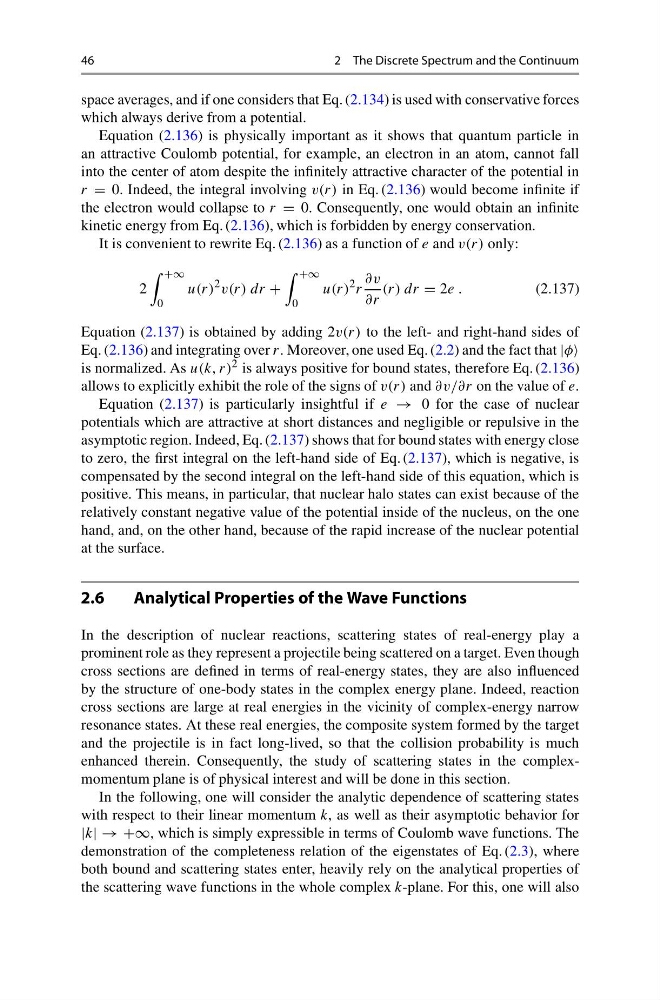
It is convenient to rewrite Eq. (2.136) as a function of e and v(r) only:
2
+∞
0
u(r)
2 v(r) dr +
+∞
0
u(r)
2 r
∂v
∂r
(r) dr = 2e .
(2.137)
Equation (2.137) is obtained by adding 2v(r) to the left- and right-hand sides of
Eq. (2.136) and integrating over r. Moreover, one used Eq. (2.2) and the fact that |φ
is normalized. As u(k, r) 2 is always positive for bound states, therefore Eq. (2.136)
allows to explicitly exhibit the role of the signs of v(r) and ∂v/∂r on the value of e.
Equation (2.137) is particularly insightful if e → 0 for the case of nuclear
potentials which are attractive at short distances and negligible or repulsive in the
asymptotic region. Indeed, Eq. (2.137) shows that for bound states with energy close
to zero, the first integral on the left-hand side of Eq. (2.137), which is negative, is
compensated by the second integral on the left-hand side of this equation, which is
positive. This means, in particular, that nuclear halo states can exist because of the
relatively constant negative value of the potential inside of the nucleus, on the one
hand, and, on the other hand, because of the rapid increase of the nuclear potential
at the surface.
2.6
Analytical Properties of the Wave Functions
In the description of nuclear reactions, scattering states of real-energy play a
prominent role as they represent a projectile being scattered on a target. Even though
cross sections are defined in terms of real-energy states, they are also influenced
by the structure of one-body states in the complex energy plane. Indeed, reaction
cross sections are large at real energies in the vicinity of complex-energy narrow
resonance states. At these real energies, the composite system formed by the target
and the projectile is in fact long-lived, so that the collision probability is much
enhanced therein. Consequently, the study of scattering states in the complexmomentum plane is of physical interest and will be done in this section.
In the following, one will consider the analytic dependence of scattering states
with respect to their linear momentum k, as well as their asymptotic behavior for
|k| → +∞, which is simply expressible in terms of Coulomb wave functions. The
demonstration of the completeness relation of the eigenstates of Eq. (2.3), where
both bound and scattering states enter, heavily rely on the analytical properties of
the scattering wave functions in the whole complex k-plane. For this, one will also
2 The Discrete Spectrum and the Continuum
space averages, and if one considers that Eq. (2.134) is used with conservative forces
which always derive from a potential.
Equation (2.136) is physically important as it shows that quantum particle in
an attractive Coulomb potential, for example, an electron in an atom, cannot fall
into the center of atom despite the infinitely attractive character of the potential in
r = 0. Indeed, the integral involving v(r) in Eq. (2.136) would become infinite if
the electron would collapse to r = 0. Consequently, one would obtain an infinite
kinetic energy from Eq. (2.136), which is forbidden by energy conservation.
It is convenient to rewrite Eq. (2.136) as a function of e and v(r) only:
2
+∞
0
u(r)
2 v(r) dr +
+∞
0
u(r)
2 r
∂v
∂r
(r) dr = 2e .
(2.137)
Equation (2.137) is obtained by adding 2v(r) to the left- and right-hand sides of
Eq. (2.136) and integrating over r. Moreover, one used Eq. (2.2) and the fact that |φ
is normalized. As u(k, r) 2 is always positive for bound states, therefore Eq. (2.136)
allows to explicitly exhibit the role of the signs of v(r) and ∂v/∂r on the value of e.
Equation (2.137) is particularly insightful if e → 0 for the case of nuclear
potentials which are attractive at short distances and negligible or repulsive in the
asymptotic region. Indeed, Eq. (2.137) shows that for bound states with energy close
to zero, the first integral on the left-hand side of Eq. (2.137), which is negative, is
compensated by the second integral on the left-hand side of this equation, which is
positive. This means, in particular, that nuclear halo states can exist because of the
relatively constant negative value of the potential inside of the nucleus, on the one
hand, and, on the other hand, because of the rapid increase of the nuclear potential
at the surface.
2.6
Analytical Properties of the Wave Functions
In the description of nuclear reactions, scattering states of real-energy play a
prominent role as they represent a projectile being scattered on a target. Even though
cross sections are defined in terms of real-energy states, they are also influenced
by the structure of one-body states in the complex energy plane. Indeed, reaction
cross sections are large at real energies in the vicinity of complex-energy narrow
resonance states. At these real energies, the composite system formed by the target
and the projectile is in fact long-lived, so that the collision probability is much
enhanced therein. Consequently, the study of scattering states in the complexmomentum plane is of physical interest and will be done in this section.
In the following, one will consider the analytic dependence of scattering states
with respect to their linear momentum k, as well as their asymptotic behavior for
|k| → +∞, which is simply expressible in terms of Coulomb wave functions. The
demonstration of the completeness relation of the eigenstates of Eq. (2.3), where
both bound and scattering states enter, heavily rely on the analytical properties of
the scattering wave functions in the whole complex k-plane. For this, one will also