

36
2 The Discrete Spectrum and the Continuum
Indeed, in order to transform the initial Schrödinger equation of Eq. (2.72) into
a hypergeometric equation, all parts of the Pöschl-Teller-Ginocchio potential in
Eq. (2.92) must be rational functions of y. This prevents the existence of both a
centrifugal potential in 1/r 2 and a Coulomb potential in 1/r in the Pöschl-TellerGinocchio potential (see Exercise VII).
This is the fundamental deficiency of the Pöschl-Teller-Ginocchio potential,
which otherwise would be as general as the Woods-Saxon potential. In fact, the
only known analytical wave functions, which are able to accommodate an exact
centrifugal potential, are the harmonic oscillator wave functions, the modified
Bessel functions, and the Coulomb wave functions. One will nevertheless see
at the end of this chapter that adding a proper centrifugal+Coulomb part to the
Pöschl-Teller-Ginocchio potential leads to a quasi-analytical potential whose bound,
resonance, and scattering states bear physical asymptotes.
2.4.3 Wave Functions of the Pöschl-Teller-Ginocchio Potential
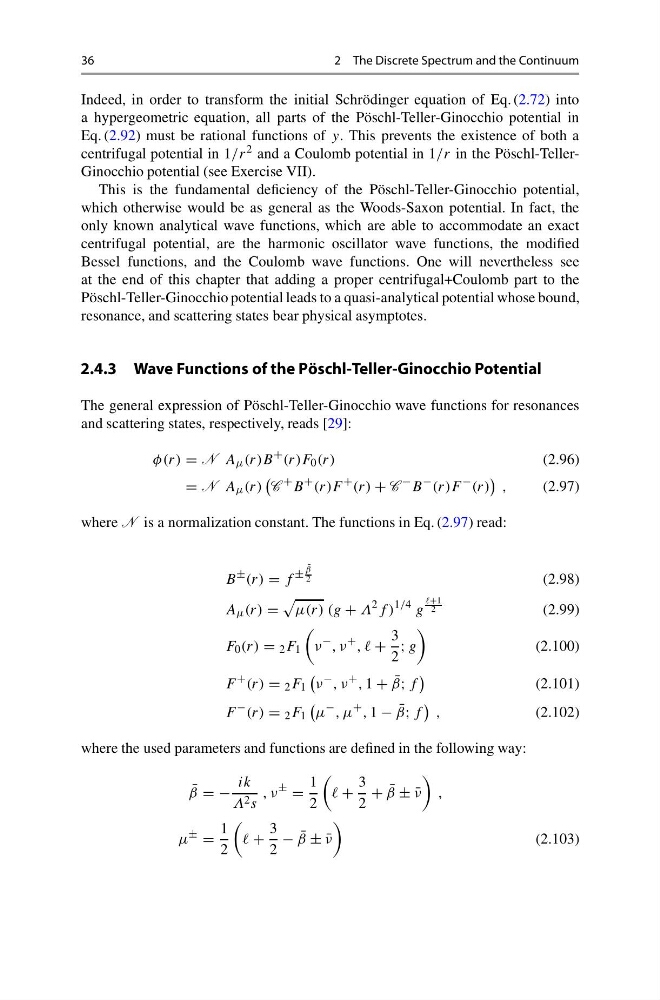
The general expression of Pöschl-Teller-Ginocchio wave functions for resonances
and scattering states, respectively, reads [29]:
φ(r) = N A μ (r)B
+ (r)F 0 (r)
(2.96)
= N A μ (r)
C
+ B
+ (r)F
+ (r) + C
− B
− (r)F
− (r)
,
(2.97)
where N is a normalization constant. The functions in Eq. (2.97) read:
B
± (r) = f
±
¯
β
2
(2.98)
A μ (r) =
μ(r) (g + Λ
2 f )
1/4 g
+1
2
(2.99)
F 0 (r) = 2 F 1
ν
− , ν
+ , , +
3
2
; g
(2.100)
F
+ (r) = 2 F 1
ν
− , ν
+ , 1 + ¯
β; f
(2.101)
F
− (r) = 2 F 1
μ
− , μ
+ , 1 − ¯
β; f
,
(2.102)
where the used parameters and functions are defined in the following way:
¯
β = −
ik
Λ 2 s
, ν
±
=
1
2
+
3
2
+ ¯
β ± ¯
ν
,
μ
±
=
1
2
+
3
2
− ¯
β ± ¯
ν
(2.103)
2 The Discrete Spectrum and the Continuum
Indeed, in order to transform the initial Schrödinger equation of Eq. (2.72) into
a hypergeometric equation, all parts of the Pöschl-Teller-Ginocchio potential in
Eq. (2.92) must be rational functions of y. This prevents the existence of both a
centrifugal potential in 1/r 2 and a Coulomb potential in 1/r in the Pöschl-TellerGinocchio potential (see Exercise VII).
This is the fundamental deficiency of the Pöschl-Teller-Ginocchio potential,
which otherwise would be as general as the Woods-Saxon potential. In fact, the
only known analytical wave functions, which are able to accommodate an exact
centrifugal potential, are the harmonic oscillator wave functions, the modified
Bessel functions, and the Coulomb wave functions. One will nevertheless see
at the end of this chapter that adding a proper centrifugal+Coulomb part to the
Pöschl-Teller-Ginocchio potential leads to a quasi-analytical potential whose bound,
resonance, and scattering states bear physical asymptotes.
2.4.3 Wave Functions of the Pöschl-Teller-Ginocchio Potential
The general expression of Pöschl-Teller-Ginocchio wave functions for resonances
and scattering states, respectively, reads [29]:
φ(r) = N A μ (r)B
+ (r)F 0 (r)
(2.96)
= N A μ (r)
C
+ B
+ (r)F
+ (r) + C
− B
− (r)F
− (r)
,
(2.97)
where N is a normalization constant. The functions in Eq. (2.97) read:
B
± (r) = f
±
¯
β
2
(2.98)
A μ (r) =
μ(r) (g + Λ
2 f )
1/4 g
+1
2
(2.99)
F 0 (r) = 2 F 1
ν
− , ν
+ , , +
3
2
; g
(2.100)
F
+ (r) = 2 F 1
ν
− , ν
+ , 1 + ¯
β; f
(2.101)
F
− (r) = 2 F 1
μ
− , μ
+ , 1 − ¯
β; f
,
(2.102)
where the used parameters and functions are defined in the following way:
¯
β = −
ik
Λ 2 s
, ν
±
=
1
2
+
3
2
+ ¯
β ± ¯
ν
,
μ
±
=
1
2
+
3
2
− ¯
β ± ¯
ν
(2.103)