

2.4 Pöschl-Teller-Ginocchio Potential
35
V (r) = + 1)
(1 − y 2 )(1 + (Λ 2 − 1)y 2 )
y 2
−
1
s 2 r 2
, r > 0
(2.90)
V c (r) = (1 − y 2 )
−Λ 2 ν(ν + 1) −
Λ 2 − 1
4
2 − (7 − Λ 2 )y 2 − 5(Λ 2 − 1)y 4
(2.91)
V PTG (r) =
¯
h 2 s 2
2m 0 μ(r)
V μ (r) + V (r) + V c (r)
(2.92)
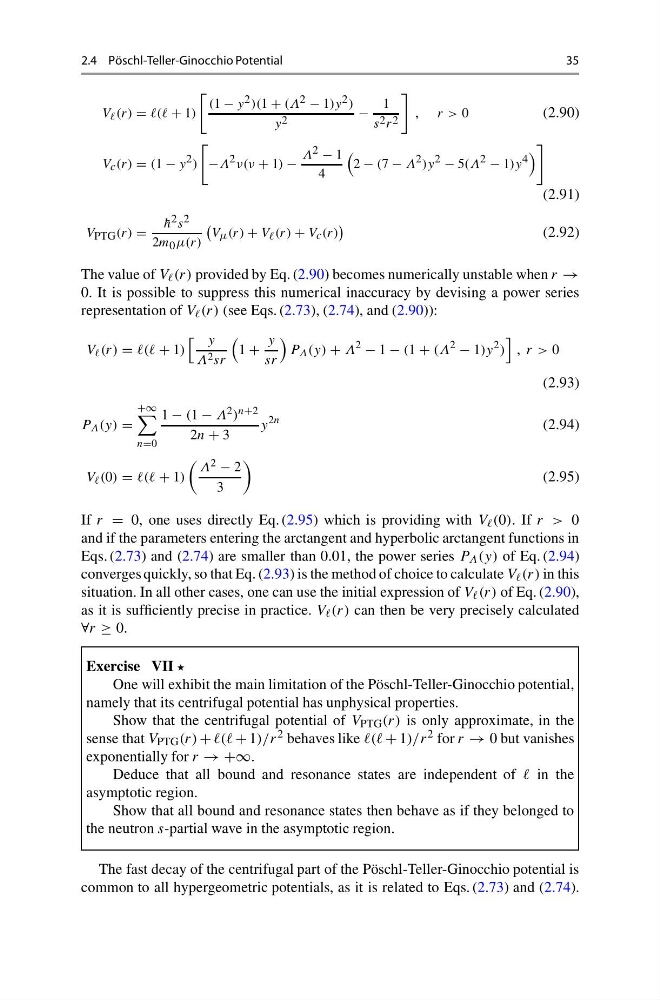
The value of V (r) provided by Eq. (2.90) becomes numerically unstable when r →
0. It is possible to suppress this numerical inaccuracy by devising a power series
representation of V (r) (see Eqs. (2.73), (2.74), and (2.90)):
V (r) = + 1)
y
Λ 2 sr
1 +
y
sr
P Λ (y) + Λ
2
− 1 − (1 + (Λ
2
− 1)y
2 )
, r > 0
(2.93)
P Λ (y) =
+∞
n=0
1 − (1 − Λ 2 ) n+2
2n + 3
y
2n
(2.94)
V (0) = + 1)
Λ 2 − 2
3
(2.95)
If r = 0, one uses directly Eq. (2.95) which is providing with V (0). If r > 0
and if the parameters entering the arctangent and hyperbolic arctangent functions in
Eqs. (2.73) and (2.74) are smaller than 0.01, the power series P Λ (y) of Eq. (2.94)
converges quickly, so that Eq. (2.93) is the method of choice to calculate V (r) in this
situation. In all other cases, one can use the initial expression of V (r) of Eq. (2.90),
as it is sufficiently precise in practice. V (r) can then be very precisely calculated
∀r ≥ 0.
Exercise VII
One will exhibit the main limitation of the Pöschl-Teller-Ginocchio potential,
namely that its centrifugal potential has unphysical properties.
Show that the centrifugal potential of V PTG (r) is only approximate, in the
sense that V PTG (r) + + 1)/r 2 behaves like + 1)/r 2 for r → 0 but vanishes
exponentially for r → +∞.
Deduce that all bound and resonance states are independent of in the
asymptotic region.
Show that all bound and resonance states then behave as if they belonged to
the neutron s-partial wave in the asymptotic region.
The fast decay of the centrifugal part of the Pöschl-Teller-Ginocchio potential is
common to all hypergeometric potentials, as it is related to Eqs. (2.73) and (2.74).
35
V (r) = + 1)
(1 − y 2 )(1 + (Λ 2 − 1)y 2 )
y 2
−
1
s 2 r 2
, r > 0
(2.90)
V c (r) = (1 − y 2 )
−Λ 2 ν(ν + 1) −
Λ 2 − 1
4
2 − (7 − Λ 2 )y 2 − 5(Λ 2 − 1)y 4
(2.91)
V PTG (r) =
¯
h 2 s 2
2m 0 μ(r)
V μ (r) + V (r) + V c (r)
(2.92)
The value of V (r) provided by Eq. (2.90) becomes numerically unstable when r →
0. It is possible to suppress this numerical inaccuracy by devising a power series
representation of V (r) (see Eqs. (2.73), (2.74), and (2.90)):
V (r) = + 1)
y
Λ 2 sr
1 +
y
sr
P Λ (y) + Λ
2
− 1 − (1 + (Λ
2
− 1)y
2 )
, r > 0
(2.93)
P Λ (y) =
+∞
n=0
1 − (1 − Λ 2 ) n+2
2n + 3
y
2n
(2.94)
V (0) = + 1)
Λ 2 − 2
3
(2.95)
If r = 0, one uses directly Eq. (2.95) which is providing with V (0). If r > 0
and if the parameters entering the arctangent and hyperbolic arctangent functions in
Eqs. (2.73) and (2.74) are smaller than 0.01, the power series P Λ (y) of Eq. (2.94)
converges quickly, so that Eq. (2.93) is the method of choice to calculate V (r) in this
situation. In all other cases, one can use the initial expression of V (r) of Eq. (2.90),
as it is sufficiently precise in practice. V (r) can then be very precisely calculated
∀r ≥ 0.
Exercise VII
One will exhibit the main limitation of the Pöschl-Teller-Ginocchio potential,
namely that its centrifugal potential has unphysical properties.
Show that the centrifugal potential of V PTG (r) is only approximate, in the
sense that V PTG (r) + + 1)/r 2 behaves like + 1)/r 2 for r → 0 but vanishes
exponentially for r → +∞.
Deduce that all bound and resonance states are independent of in the
asymptotic region.
Show that all bound and resonance states then behave as if they belonged to
the neutron s-partial wave in the asymptotic region.
The fast decay of the centrifugal part of the Pöschl-Teller-Ginocchio potential is
common to all hypergeometric potentials, as it is related to Eqs. (2.73) and (2.74).