

9.4 Calculation of Spectra and Reaction Cross Sections in the Coupled-. . .
473
-8
-6
-4
-2
0
2
4
6
-8
-6
-4
-2
0
2
4
6
1
+
1
3
+
1
2
+
1
1
+
2
GSM-CC (E) GSM-CC (ANC)
Exp
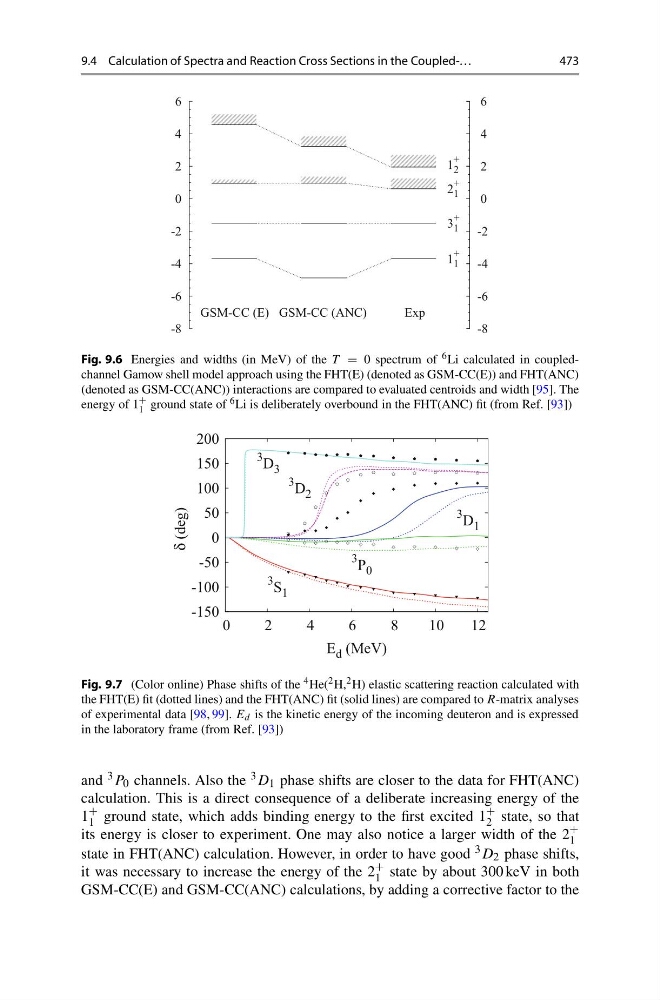
Fig. 9.6 Energies and widths (in MeV) of the T = 0 spectrum of 6 Li calculated in coupledchannel Gamow shell model approach using the FHT(E) (denoted as GSM-CC(E)) and FHT(ANC)
(denoted as GSM-CC(ANC)) interactions are compared to evaluated centroids and width [95]. The
energy of 1
+
1 ground state of 6 Li is deliberately overbound in the FHT(ANC) fit (from Ref. [93])
-150
-100
-50
0
50
100
150
200
0
2
4
6
8
10
12
δ (deg)
E d (MeV)
3 S 1
3
P 0
3 D 1
3 D 2
3
D 3
Fig. 9.7 (Color online) Phase shifts of the 4 He( 2 H, 2 H) elastic scattering reaction calculated with
the FHT(E) fit (dotted lines) and the FHT(ANC) fit (solid lines) are compared to R-matrix analyses
of experimental data [98, 99]. E d is the kinetic energy of the incoming deuteron and is expressed
in the laboratory frame (from Ref. [93])
and 3 P 0 channels. Also the 3 D 1 phase shifts are closer to the data for FHT(ANC)
calculation. This is a direct consequence of a deliberate increasing energy of the
1
+
1 ground state, which adds binding energy to the first excited 1
+
2 state, so that
its energy is closer to experiment. One may also notice a larger width of the 2
+
1
state in FHT(ANC) calculation. However, in order to have good 3 D 2 phase shifts,
it was necessary to increase the energy of the 2
+
1 state by about 300 keV in both
GSM-CC(E) and GSM-CC(ANC) calculations, by adding a corrective factor to the
473
-8
-6
-4
-2
0
2
4
6
-8
-6
-4
-2
0
2
4
6
1
+
1
3
+
1
2
+
1
1
+
2
GSM-CC (E) GSM-CC (ANC)
Exp
Fig. 9.6 Energies and widths (in MeV) of the T = 0 spectrum of 6 Li calculated in coupledchannel Gamow shell model approach using the FHT(E) (denoted as GSM-CC(E)) and FHT(ANC)
(denoted as GSM-CC(ANC)) interactions are compared to evaluated centroids and width [95]. The
energy of 1
+
1 ground state of 6 Li is deliberately overbound in the FHT(ANC) fit (from Ref. [93])
-150
-100
-50
0
50
100
150
200
0
2
4
6
8
10
12
δ (deg)
E d (MeV)
3 S 1
3
P 0
3 D 1
3 D 2
3
D 3
Fig. 9.7 (Color online) Phase shifts of the 4 He( 2 H, 2 H) elastic scattering reaction calculated with
the FHT(E) fit (dotted lines) and the FHT(ANC) fit (solid lines) are compared to R-matrix analyses
of experimental data [98, 99]. E d is the kinetic energy of the incoming deuteron and is expressed
in the laboratory frame (from Ref. [93])
and 3 P 0 channels. Also the 3 D 1 phase shifts are closer to the data for FHT(ANC)
calculation. This is a direct consequence of a deliberate increasing energy of the
1
+
1 ground state, which adds binding energy to the first excited 1
+
2 state, so that
its energy is closer to experiment. One may also notice a larger width of the 2
+
1
state in FHT(ANC) calculation. However, in order to have good 3 D 2 phase shifts,
it was necessary to increase the energy of the 2
+
1 state by about 300 keV in both
GSM-CC(E) and GSM-CC(ANC) calculations, by adding a corrective factor to the