

474
9 The Unification of Structure and Reaction Frameworks
2 + coupled-channel Hamiltonian (see Sect. 9.4.2.1). This is directly related to the
large width of the 2
+
1 state, implying that the many-body S-matrix poles provided
by Gamow shell model within the resonating group method calculation and the
resonance structures seen in reaction observables are not equivalent. Consequently,
reproducing resonant states energies in structure calculation does not necessarily
guarantee a good reproduction of experimental cross sections.
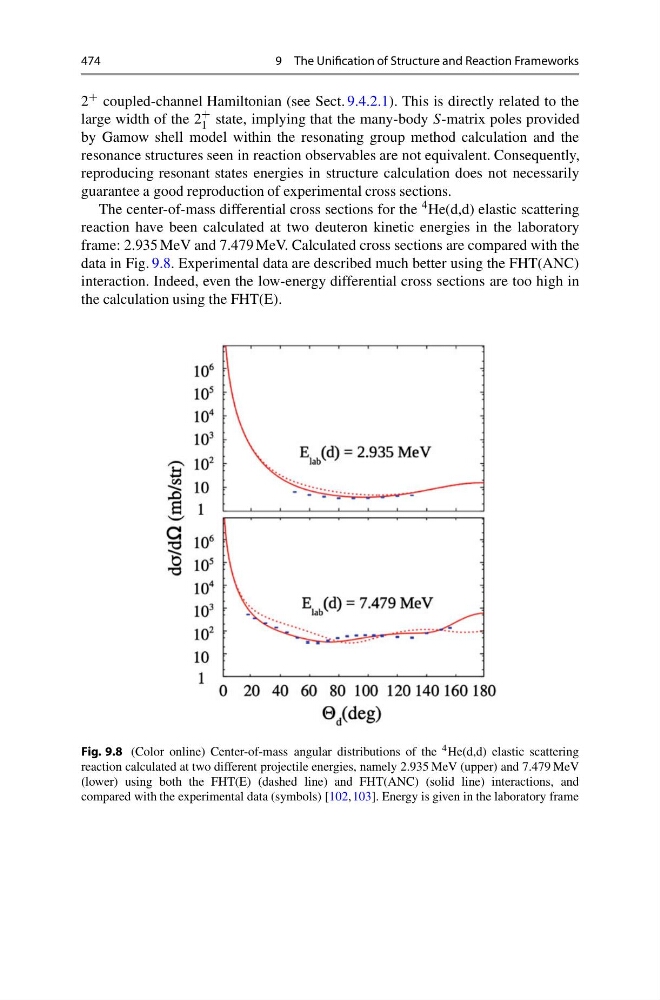
The center-of-mass differential cross sections for the 4 He(d,d) elastic scattering
reaction have been calculated at two deuteron kinetic energies in the laboratory
frame: 2.935 MeV and 7.479 MeV. Calculated cross sections are compared with the
data in Fig. 9.8. Experimental data are described much better using the FHT(ANC)
interaction. Indeed, even the low-energy differential cross sections are too high in
the calculation using the FHT(E).
Fig. 9.8 (Color online) Center-of-mass angular distributions of the 4 He(d,d) elastic scattering
reaction calculated at two different projectile energies, namely 2.935 MeV (upper) and 7.479 MeV
(lower) using both the FHT(E) (dashed line) and FHT(ANC) (solid line) interactions, and
compared with the experimental data (symbols) [102,103]. Energy is given in the laboratory frame
9 The Unification of Structure and Reaction Frameworks
2 + coupled-channel Hamiltonian (see Sect. 9.4.2.1). This is directly related to the
large width of the 2
+
1 state, implying that the many-body S-matrix poles provided
by Gamow shell model within the resonating group method calculation and the
resonance structures seen in reaction observables are not equivalent. Consequently,
reproducing resonant states energies in structure calculation does not necessarily
guarantee a good reproduction of experimental cross sections.
The center-of-mass differential cross sections for the 4 He(d,d) elastic scattering
reaction have been calculated at two deuteron kinetic energies in the laboratory
frame: 2.935 MeV and 7.479 MeV. Calculated cross sections are compared with the
data in Fig. 9.8. Experimental data are described much better using the FHT(ANC)
interaction. Indeed, even the low-energy differential cross sections are too high in
the calculation using the FHT(E).
Fig. 9.8 (Color online) Center-of-mass angular distributions of the 4 He(d,d) elastic scattering
reaction calculated at two different projectile energies, namely 2.935 MeV (upper) and 7.479 MeV
(lower) using both the FHT(E) (dashed line) and FHT(ANC) (solid line) interactions, and
compared with the experimental data (symbols) [102,103]. Energy is given in the laboratory frame