

472
9 The Unification of Structure and Reaction Frameworks
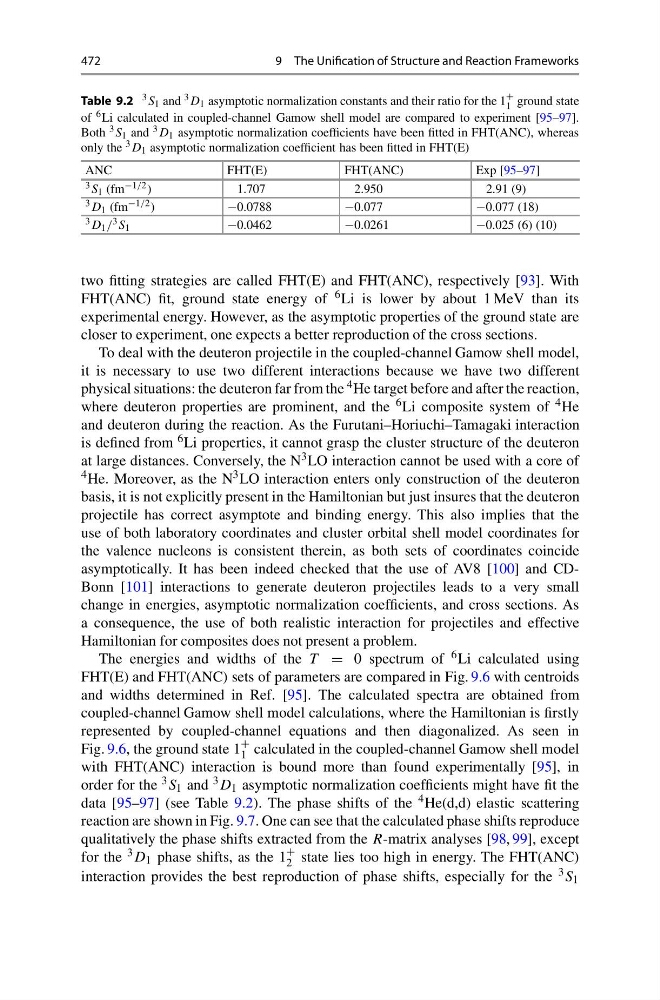
Table 9.2 3 S 1 and 3 D 1 asymptotic normalization constants and their ratio for the 1
+
1 ground state
of 6 Li calculated in coupled-channel Gamow shell model are compared to experiment [95–97].
Both 3 S 1 and 3 D 1 asymptotic normalization coefficients have been fitted in FHT(ANC), whereas
only the 3 D 1 asymptotic normalization coefficient has been fitted in FHT(E)
ANC
FHT(E)
FHT(ANC)
Exp [95–97]
3 S 1 (fm −1/2 )
1.707
2.950
2.91 (9)
3 D 1 (fm −1/2 )
−0.0788
−0.077
−0.077 (18)
3 D 1 / 3 S 1
−0.0462
−0.0261
−0.025 (6) (10)
two fitting strategies are called FHT(E) and FHT(ANC), respectively [93]. With
FHT(ANC) fit, ground state energy of 6 Li is lower by about 1 MeV than its
experimental energy. However, as the asymptotic properties of the ground state are
closer to experiment, one expects a better reproduction of the cross sections.
To deal with the deuteron projectile in the coupled-channel Gamow shell model,
it is necessary to use two different interactions because we have two different
physical situations: the deuteron far from the 4 He target before and after the reaction,
where deuteron properties are prominent, and the 6 Li composite system of 4 He
and deuteron during the reaction. As the Furutani–Horiuchi–Tamagaki interaction
is defined from 6 Li properties, it cannot grasp the cluster structure of the deuteron
at large distances. Conversely, the N 3 LO interaction cannot be used with a core of
4 He. Moreover, as the N 3 LO interaction enters only construction of the deuteron
basis, it is not explicitly present in the Hamiltonian but just insures that the deuteron
projectile has correct asymptote and binding energy. This also implies that the
use of both laboratory coordinates and cluster orbital shell model coordinates for
the valence nucleons is consistent therein, as both sets of coordinates coincide
asymptotically. It has been indeed checked that the use of AV8 [100] and CDBonn [101] interactions to generate deuteron projectiles leads to a very small
change in energies, asymptotic normalization coefficients, and cross sections. As
a consequence, the use of both realistic interaction for projectiles and effective
Hamiltonian for composites does not present a problem.
The energies and widths of the T = 0 spectrum of 6 Li calculated using
FHT(E) and FHT(ANC) sets of parameters are compared in Fig. 9.6 with centroids
and widths determined in Ref. [95]. The calculated spectra are obtained from
coupled-channel Gamow shell model calculations, where the Hamiltonian is firstly
represented by coupled-channel equations and then diagonalized. As seen in
Fig. 9.6, the ground state 1
+
1 calculated in the coupled-channel Gamow shell model
with FHT(ANC) interaction is bound more than found experimentally [95], in
order for the 3 S 1 and 3 D 1 asymptotic normalization coefficients might have fit the
data [95–97] (see Table 9.2). The phase shifts of the 4 He(d,d) elastic scattering
reaction are shown in Fig. 9.7. One can see that the calculated phase shifts reproduce
qualitatively the phase shifts extracted from the R-matrix analyses [98, 99], except
for the 3 D 1 phase shifts, as the 1
+
2 state lies too high in energy. The FHT(ANC)
interaction provides the best reproduction of phase shifts, especially for the 3 S 1
9 The Unification of Structure and Reaction Frameworks
Table 9.2 3 S 1 and 3 D 1 asymptotic normalization constants and their ratio for the 1
+
1 ground state
of 6 Li calculated in coupled-channel Gamow shell model are compared to experiment [95–97].
Both 3 S 1 and 3 D 1 asymptotic normalization coefficients have been fitted in FHT(ANC), whereas
only the 3 D 1 asymptotic normalization coefficient has been fitted in FHT(E)
ANC
FHT(E)
FHT(ANC)
Exp [95–97]
3 S 1 (fm −1/2 )
1.707
2.950
2.91 (9)
3 D 1 (fm −1/2 )
−0.0788
−0.077
−0.077 (18)
3 D 1 / 3 S 1
−0.0462
−0.0261
−0.025 (6) (10)
two fitting strategies are called FHT(E) and FHT(ANC), respectively [93]. With
FHT(ANC) fit, ground state energy of 6 Li is lower by about 1 MeV than its
experimental energy. However, as the asymptotic properties of the ground state are
closer to experiment, one expects a better reproduction of the cross sections.
To deal with the deuteron projectile in the coupled-channel Gamow shell model,
it is necessary to use two different interactions because we have two different
physical situations: the deuteron far from the 4 He target before and after the reaction,
where deuteron properties are prominent, and the 6 Li composite system of 4 He
and deuteron during the reaction. As the Furutani–Horiuchi–Tamagaki interaction
is defined from 6 Li properties, it cannot grasp the cluster structure of the deuteron
at large distances. Conversely, the N 3 LO interaction cannot be used with a core of
4 He. Moreover, as the N 3 LO interaction enters only construction of the deuteron
basis, it is not explicitly present in the Hamiltonian but just insures that the deuteron
projectile has correct asymptote and binding energy. This also implies that the
use of both laboratory coordinates and cluster orbital shell model coordinates for
the valence nucleons is consistent therein, as both sets of coordinates coincide
asymptotically. It has been indeed checked that the use of AV8 [100] and CDBonn [101] interactions to generate deuteron projectiles leads to a very small
change in energies, asymptotic normalization coefficients, and cross sections. As
a consequence, the use of both realistic interaction for projectiles and effective
Hamiltonian for composites does not present a problem.
The energies and widths of the T = 0 spectrum of 6 Li calculated using
FHT(E) and FHT(ANC) sets of parameters are compared in Fig. 9.6 with centroids
and widths determined in Ref. [95]. The calculated spectra are obtained from
coupled-channel Gamow shell model calculations, where the Hamiltonian is firstly
represented by coupled-channel equations and then diagonalized. As seen in
Fig. 9.6, the ground state 1
+
1 calculated in the coupled-channel Gamow shell model
with FHT(ANC) interaction is bound more than found experimentally [95], in
order for the 3 S 1 and 3 D 1 asymptotic normalization coefficients might have fit the
data [95–97] (see Table 9.2). The phase shifts of the 4 He(d,d) elastic scattering
reaction are shown in Fig. 9.7. One can see that the calculated phase shifts reproduce
qualitatively the phase shifts extracted from the R-matrix analyses [98, 99], except
for the 3 D 1 phase shifts, as the 1
+
2 state lies too high in energy. The FHT(ANC)
interaction provides the best reproduction of phase shifts, especially for the 3 S 1