

454
9 The Unification of Structure and Reaction Frameworks
where a c = (2m/ ¯
h
2 )V
(eq)
cc (0) − k 2 and a c = (2m/ ¯
h
2 )V
(eq)
cc (0), with V
(eq)
cc (r) the
equivalent potential associated to w c (r) (see Sect. 9.3.2.2).
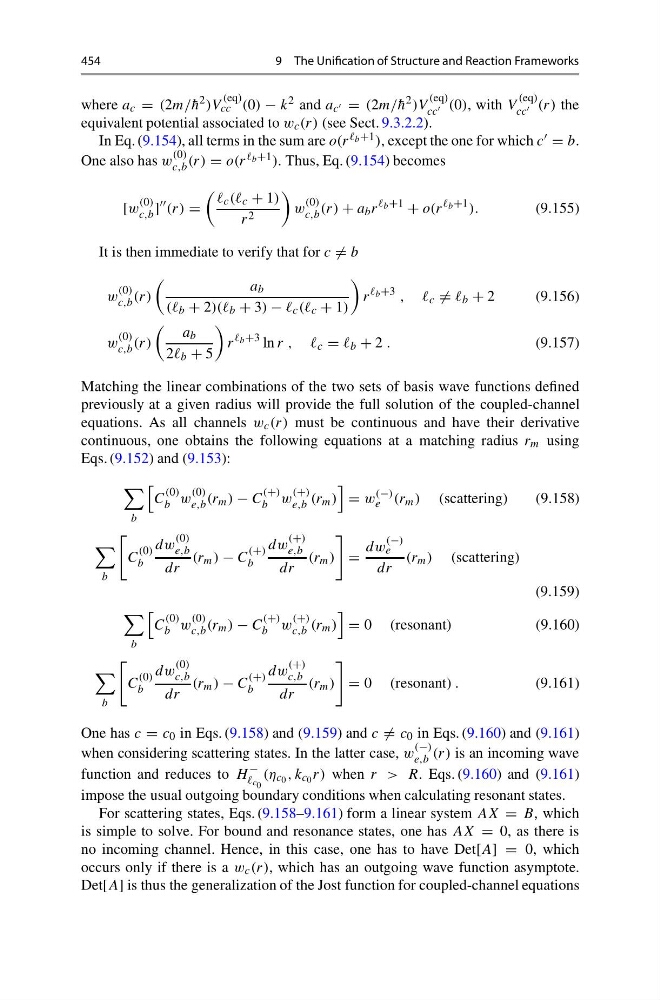
In Eq. (9.154), all terms in the sum are o(r b +1 ), except the one for which c = b.
One also has w
(0)
c,b (r) = o(r b +1 ). Thus, Eq. (9.154) becomes
[w
(0)
c,b ]
(r) =
c (( c + 1)
r 2
w
(0)
c,b (r) + a b r
b +1
+ o(r
b +1 ).
(9.155)
It is then immediate to verify that for c = b
w
(0)
c,b (r)
a b
(( b + 2)(( b + 3) − c (( c + 1)
r
b +3 , , c = b + 2
(9.156)
w
(0)
c,b (r)
a b
2 b + 5
r
b +3 ln r , , c = b + 2 .
(9.157)
Matching the linear combinations of the two sets of basis wave functions defined
previously at a given radius will provide the full solution of the coupled-channel
equations. As all channels w c (r) must be continuous and have their derivative
continuous, one obtains the following equations at a matching radius r m using
Eqs. (9.152) and (9.153):
b
C
(0)
b w
(0)
e,b (r m ) − C
(+)
b w
(+)
e,b (r m )
= w
(−)
e (r m ) (scattering)
(9.158)
b
C
(0)
b
dw
(0)
e,b
dr
(r m ) − C
(+)
b
dw
(+)
e,b
dr
(r m )
=
dw
(−)
e
dr
(r m ) (scattering)
(9.159)
b
C
(0)
b w
(0)
c,b (r m ) − C
(+)
b w
(+)
c,b (r m )
= 0 (resonant)
(9.160)
b
C
(0)
b
dw
(0)
c,b
dr
(r m ) − C
(+)
b
dw
(+)
c,b
dr
(r m )
= 0 (resonant) .
(9.161)
One has c = c 0 in Eqs. (9.158) and (9.159) and c = c 0 in Eqs. (9.160) and (9.161)
when considering scattering states. In the latter case, w
(−)
e,b (r) is an incoming wave
function and reduces to H
−
c 0
(η c 0 , k c 0 r) when r > R. Eqs. (9.160) and (9.161)
impose the usual outgoing boundary conditions when calculating resonant states.
For scattering states, Eqs. (9.158–9.161) form a linear system AX = B, which
is simple to solve. For bound and resonance states, one has AX = 0, as there is
no incoming channel. Hence, in this case, one has to have Det[A] = 0, which
occurs only if there is a w c (r), which has an outgoing wave function asymptote.
Det[A] is thus the generalization of the Jost function for coupled-channel equations
9 The Unification of Structure and Reaction Frameworks
where a c = (2m/ ¯
h
2 )V
(eq)
cc (0) − k 2 and a c = (2m/ ¯
h
2 )V
(eq)
cc (0), with V
(eq)
cc (r) the
equivalent potential associated to w c (r) (see Sect. 9.3.2.2).
In Eq. (9.154), all terms in the sum are o(r b +1 ), except the one for which c = b.
One also has w
(0)
c,b (r) = o(r b +1 ). Thus, Eq. (9.154) becomes
[w
(0)
c,b ]
(r) =
c (( c + 1)
r 2
w
(0)
c,b (r) + a b r
b +1
+ o(r
b +1 ).
(9.155)
It is then immediate to verify that for c = b
w
(0)
c,b (r)
a b
(( b + 2)(( b + 3) − c (( c + 1)
r
b +3 , , c = b + 2
(9.156)
w
(0)
c,b (r)
a b
2 b + 5
r
b +3 ln r , , c = b + 2 .
(9.157)
Matching the linear combinations of the two sets of basis wave functions defined
previously at a given radius will provide the full solution of the coupled-channel
equations. As all channels w c (r) must be continuous and have their derivative
continuous, one obtains the following equations at a matching radius r m using
Eqs. (9.152) and (9.153):
b
C
(0)
b w
(0)
e,b (r m ) − C
(+)
b w
(+)
e,b (r m )
= w
(−)
e (r m ) (scattering)
(9.158)
b
C
(0)
b
dw
(0)
e,b
dr
(r m ) − C
(+)
b
dw
(+)
e,b
dr
(r m )
=
dw
(−)
e
dr
(r m ) (scattering)
(9.159)
b
C
(0)
b w
(0)
c,b (r m ) − C
(+)
b w
(+)
c,b (r m )
= 0 (resonant)
(9.160)
b
C
(0)
b
dw
(0)
c,b
dr
(r m ) − C
(+)
b
dw
(+)
c,b
dr
(r m )
= 0 (resonant) .
(9.161)
One has c = c 0 in Eqs. (9.158) and (9.159) and c = c 0 in Eqs. (9.160) and (9.161)
when considering scattering states. In the latter case, w
(−)
e,b (r) is an incoming wave
function and reduces to H
−
c 0
(η c 0 , k c 0 r) when r > R. Eqs. (9.160) and (9.161)
impose the usual outgoing boundary conditions when calculating resonant states.
For scattering states, Eqs. (9.158–9.161) form a linear system AX = B, which
is simple to solve. For bound and resonance states, one has AX = 0, as there is
no incoming channel. Hence, in this case, one has to have Det[A] = 0, which
occurs only if there is a w c (r), which has an outgoing wave function asymptote.
Det[A] is thus the generalization of the Jost function for coupled-channel equations