

9.3 Computational Methods for Solving the Coupled-Channel Gamow Shell. . .
453
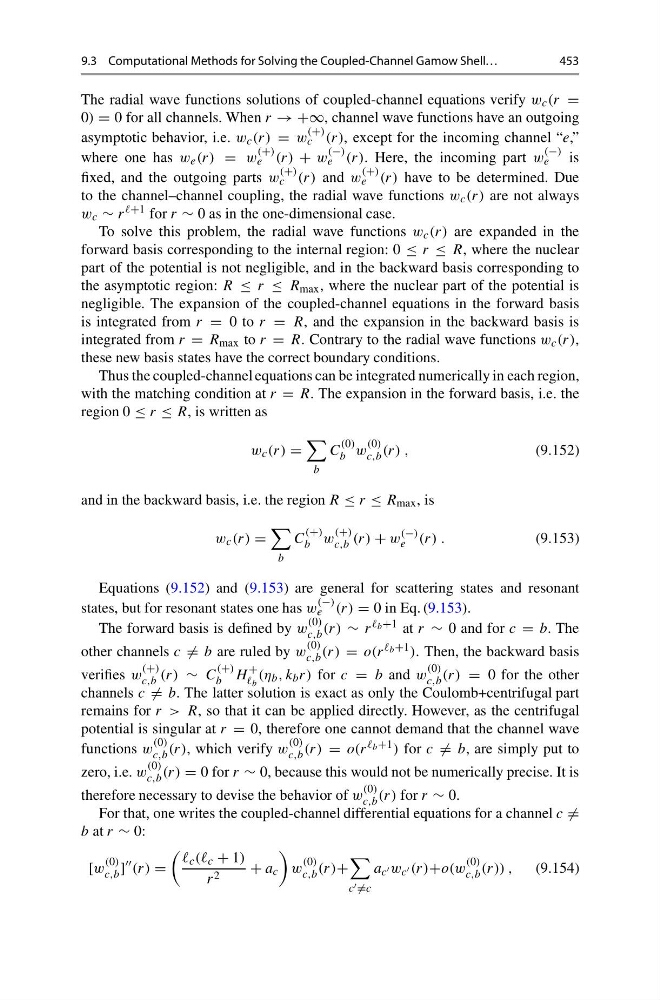
The radial wave functions solutions of coupled-channel equations verify w c (r =
0) = 0 for all channels. When r → +∞, channel wave functions have an outgoing
asymptotic behavior, i.e. w c (r) = w
(+)
c (r), except for the incoming channel “e,”
where one has w e (r) = w
(+)
e (r) + w
(−)
e (r). Here, the incoming part w
(−)
e
is
fixed, and the outgoing parts w
(+)
c (r) and w
(+)
e (r) have to be determined. Due
to the channel–channel coupling, the radial wave functions w c (r) are not always
w c ∼ r +1 for r ∼ 0 as in the one-dimensional case.
To solve this problem, the radial wave functions w c (r) are expanded in the
forward basis corresponding to the internal region: 0 ≤ r ≤ R, where the nuclear
part of the potential is not negligible, and in the backward basis corresponding to
the asymptotic region: R ≤ r ≤ R max , where the nuclear part of the potential is
negligible. The expansion of the coupled-channel equations in the forward basis
is integrated from r = 0 to r = R, and the expansion in the backward basis is
integrated from r = R max to r = R. Contrary to the radial wave functions w c (r),
these new basis states have the correct boundary conditions.
Thus the coupled-channel equations can be integrated numerically in each region,
with the matching condition at r = R. The expansion in the forward basis, i.e. the
region 0 ≤ r ≤ R, is written as
w c (r) =
b
C
(0)
b w
(0)
c,b (r) ,
(9.152)
and in the backward basis, i.e. the region R ≤ r ≤ R max , is
w c (r) =
b
C
(+)
b w
(+)
c,b (r) + w
(−)
e (r) .
(9.153)
Equations (9.152) and (9.153) are general for scattering states and resonant
states, but for resonant states one has w
(−)
e (r) = 0 in Eq. (9.153).
The forward basis is defined by w
(0)
c,b (r) ∼ r b +1 at r ∼ 0 and for c = b. The
other channels c = b are ruled by w
(0)
c,b (r) = o(r b +1 ). Then, the backward basis
verifies w
(+)
c,b (r) ∼ C
(+)
b H
+
b
(η b , k b r) for c = b and w
(0)
c,b (r) = 0 for the other
channels c = b. The latter solution is exact as only the Coulomb+centrifugal part
remains for r > R, so that it can be applied directly. However, as the centrifugal
potential is singular at r = 0, therefore one cannot demand that the channel wave
functions w
(0)
c,b (r), which verify w
(0)
c,b (r) = o(r b +1 ) for c = b, are simply put to
zero, i.e. w
(0)
c,b (r) = 0 for r ∼ 0, because this would not be numerically precise. It is
therefore necessary to devise the behavior of w
(0)
c,b (r) for r ∼ 0.
For that, one writes the coupled-channel differential equations for a channel c =
b at r ∼ 0:
[w
(0)
c,b ]
(r) =
c (( c + 1)
r 2
+ a c
w
(0)
c,b (r)+
c =c
a c w c (r)+o(w
(0)
c,b (r)) ,
(9.154)
453
The radial wave functions solutions of coupled-channel equations verify w c (r =
0) = 0 for all channels. When r → +∞, channel wave functions have an outgoing
asymptotic behavior, i.e. w c (r) = w
(+)
c (r), except for the incoming channel “e,”
where one has w e (r) = w
(+)
e (r) + w
(−)
e (r). Here, the incoming part w
(−)
e
is
fixed, and the outgoing parts w
(+)
c (r) and w
(+)
e (r) have to be determined. Due
to the channel–channel coupling, the radial wave functions w c (r) are not always
w c ∼ r +1 for r ∼ 0 as in the one-dimensional case.
To solve this problem, the radial wave functions w c (r) are expanded in the
forward basis corresponding to the internal region: 0 ≤ r ≤ R, where the nuclear
part of the potential is not negligible, and in the backward basis corresponding to
the asymptotic region: R ≤ r ≤ R max , where the nuclear part of the potential is
negligible. The expansion of the coupled-channel equations in the forward basis
is integrated from r = 0 to r = R, and the expansion in the backward basis is
integrated from r = R max to r = R. Contrary to the radial wave functions w c (r),
these new basis states have the correct boundary conditions.
Thus the coupled-channel equations can be integrated numerically in each region,
with the matching condition at r = R. The expansion in the forward basis, i.e. the
region 0 ≤ r ≤ R, is written as
w c (r) =
b
C
(0)
b w
(0)
c,b (r) ,
(9.152)
and in the backward basis, i.e. the region R ≤ r ≤ R max , is
w c (r) =
b
C
(+)
b w
(+)
c,b (r) + w
(−)
e (r) .
(9.153)
Equations (9.152) and (9.153) are general for scattering states and resonant
states, but for resonant states one has w
(−)
e (r) = 0 in Eq. (9.153).
The forward basis is defined by w
(0)
c,b (r) ∼ r b +1 at r ∼ 0 and for c = b. The
other channels c = b are ruled by w
(0)
c,b (r) = o(r b +1 ). Then, the backward basis
verifies w
(+)
c,b (r) ∼ C
(+)
b H
+
b
(η b , k b r) for c = b and w
(0)
c,b (r) = 0 for the other
channels c = b. The latter solution is exact as only the Coulomb+centrifugal part
remains for r > R, so that it can be applied directly. However, as the centrifugal
potential is singular at r = 0, therefore one cannot demand that the channel wave
functions w
(0)
c,b (r), which verify w
(0)
c,b (r) = o(r b +1 ) for c = b, are simply put to
zero, i.e. w
(0)
c,b (r) = 0 for r ∼ 0, because this would not be numerically precise. It is
therefore necessary to devise the behavior of w
(0)
c,b (r) for r ∼ 0.
For that, one writes the coupled-channel differential equations for a channel c =
b at r ∼ 0:
[w
(0)
c,b ]
(r) =
c (( c + 1)
r 2
+ a c
w
(0)
c,b (r)+
c =c
a c w c (r)+o(w
(0)
c,b (r)) ,
(9.154)