

452
9 The Unification of Structure and Reaction Frameworks
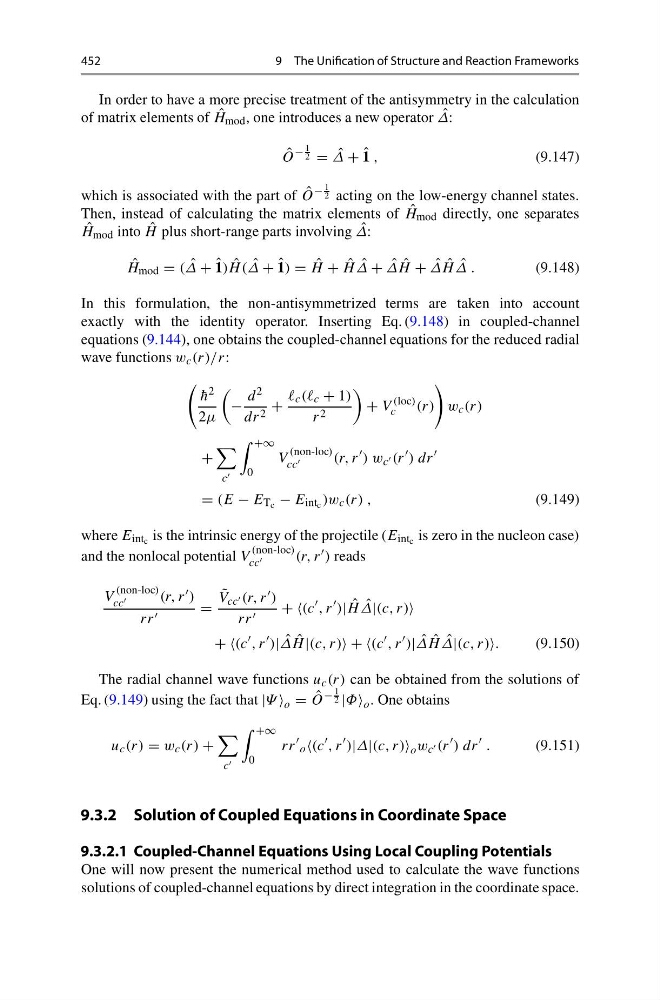
In order to have a more precise treatment of the antisymmetry in the calculation
of matrix elements of ˆ
H mod , one introduces a new operator ˆ
Δ:
ˆ
O
−
1
2 = ˆ
Δ + ˆ
1 ,
(9.147)
which is associated with the part of ˆ
O
−
1
2 acting on the low-energy channel states.
Then, instead of calculating the matrix elements of ˆ
H mod directly, one separates
ˆ
H mod into ˆ
H plus short-range parts involving ˆ
Δ:
ˆ
H mod = ( ˆ
Δ + ˆ
1) ˆ
H ( ˆ
Δ + ˆ
1) = ˆ
H + ˆ
H ˆ
Δ + ˆ
Δ ˆ
H + ˆ
Δ ˆ
H ˆ
Δ .
(9.148)
In this formulation, the non-antisymmetrized terms are taken into account
exactly with the identity operator. Inserting Eq. (9.148) in coupled-channel
equations (9.144), one obtains the coupled-channel equations for the reduced radial
wave functions w c (r)/r:
¯
h 2
2μ
−
d 2
dr 2 +
c (( c + 1)
r 2
+ V
(loc)
c
(r)
w c (r)
+
c
+∞
0
V
(non-loc)
cc
(r, r
) w c (r
) dr
= (E − E T c − E int c )w c (r) ,
(9.149)
where E int c is the intrinsic energy of the projectile (E int c is zero in the nucleon case)
and the nonlocal potential V
(non-loc)
cc
(r, r ) reads
V
(non-loc)
cc
(r, r )
rr
=
˜
V cc (r, r )
rr
+ +(c
, r
)| ˆ
H ˆ
Δ|(c, r)
+ +(c
, r
)| ˆ
Δ ˆ
H |(c, r) + +(c
, r
)| ˆ
Δ ˆ
H ˆ
Δ|(c, r)
(9.150)
The radial channel wave functions u c (r) can be obtained from the solutions of
Eq. (9.149) using the fact that |Ψ o = ˆ
O
−
1
2 |Φ o . One obtains
u c (r) = w c (r) +
c
+∞
0
rr
o (c
, r
)|Δ|(c, r) o w c (r
) dr
.
(9.151)
9.3.2 Solution of Coupled Equations in Coordinate Space
9.3.2.1 Coupled-Channel Equations Using Local Coupling Potentials
One will now present the numerical method used to calculate the wave functions
solutions of coupled-channel equations by direct integration in the coordinate space.
9 The Unification of Structure and Reaction Frameworks
In order to have a more precise treatment of the antisymmetry in the calculation
of matrix elements of ˆ
H mod , one introduces a new operator ˆ
Δ:
ˆ
O
−
1
2 = ˆ
Δ + ˆ
1 ,
(9.147)
which is associated with the part of ˆ
O
−
1
2 acting on the low-energy channel states.
Then, instead of calculating the matrix elements of ˆ
H mod directly, one separates
ˆ
H mod into ˆ
H plus short-range parts involving ˆ
Δ:
ˆ
H mod = ( ˆ
Δ + ˆ
1) ˆ
H ( ˆ
Δ + ˆ
1) = ˆ
H + ˆ
H ˆ
Δ + ˆ
Δ ˆ
H + ˆ
Δ ˆ
H ˆ
Δ .
(9.148)
In this formulation, the non-antisymmetrized terms are taken into account
exactly with the identity operator. Inserting Eq. (9.148) in coupled-channel
equations (9.144), one obtains the coupled-channel equations for the reduced radial
wave functions w c (r)/r:
¯
h 2
2μ
−
d 2
dr 2 +
c (( c + 1)
r 2
+ V
(loc)
c
(r)
w c (r)
+
c
+∞
0
V
(non-loc)
cc
(r, r
) w c (r
) dr
= (E − E T c − E int c )w c (r) ,
(9.149)
where E int c is the intrinsic energy of the projectile (E int c is zero in the nucleon case)
and the nonlocal potential V
(non-loc)
cc
(r, r ) reads
V
(non-loc)
cc
(r, r )
rr
=
˜
V cc (r, r )
rr
+ +(c
, r
)| ˆ
H ˆ
Δ|(c, r)
+ +(c
, r
)| ˆ
Δ ˆ
H |(c, r) + +(c
, r
)| ˆ
Δ ˆ
H ˆ
Δ|(c, r)
(9.150)
The radial channel wave functions u c (r) can be obtained from the solutions of
Eq. (9.149) using the fact that |Ψ o = ˆ
O
−
1
2 |Φ o . One obtains
u c (r) = w c (r) +
c
+∞
0
rr
o (c
, r
)|Δ|(c, r) o w c (r
) dr
.
(9.151)
9.3.2 Solution of Coupled Equations in Coordinate Space
9.3.2.1 Coupled-Channel Equations Using Local Coupling Potentials
One will now present the numerical method used to calculate the wave functions
solutions of coupled-channel equations by direct integration in the coordinate space.