

9.3 Computational Methods for Solving the Coupled-Channel Gamow Shell. . .
451
{|(c, r) o }, as presented in Ref.[64]) (see also Ref.[65]):
o (c
, r
)|(c, r) o =
δ(r − r )
rr δ cc .
(9.138)
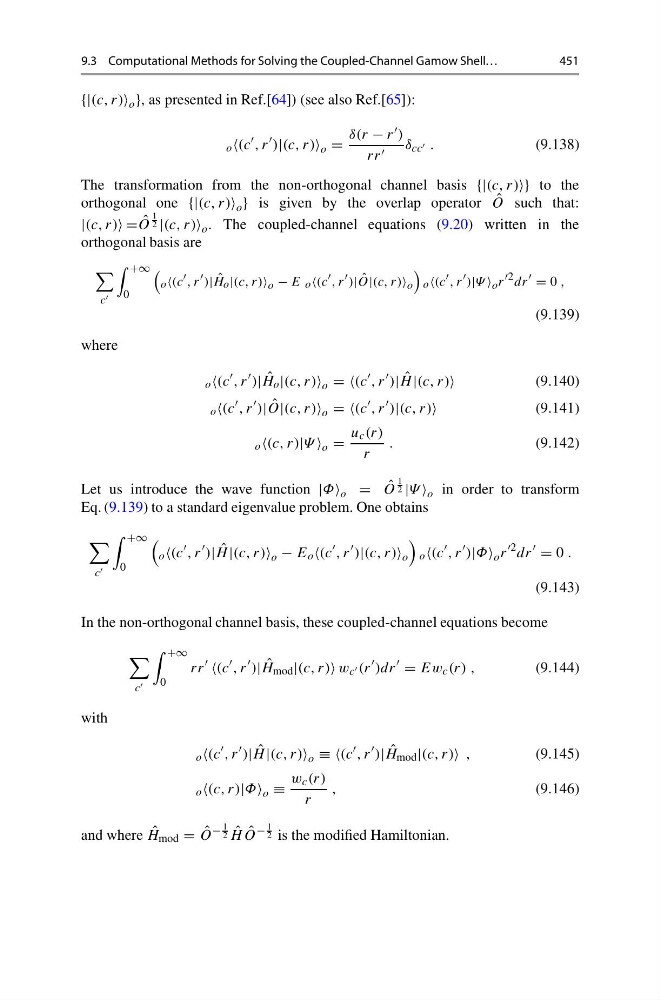
The transformation from the non-orthogonal channel basis {|(c, r)} to the
orthogonal one {|(c, r) o } is given by the overlap operator ˆ
O such that:
|(c, r) = ˆ
O
1
2 |(c, r) o . The coupled-channel equations (9.20) written in the
orthogonal basis are
c
+∞
0
o (c , r )| ˆ
H o |(c, r) o − E o (c , r )| ˆ
O|(c, r) o
o (c , r )|Ψ o r dr = 0 ,
(9.139)
where
o (c
, r
)| ˆ
H o |(c, r) o = =(c
, r
)| ˆ
H |(c, r)
(9.140)
o (c
, r
)| ˆ
O|(c, r) o = =(c
, r
)|(c, r)
(9.141)
o (c, r)|Ψ o =
u c (r)
r
.
(9.142)
Let us introduce the wave function |Φ o = ˆ
O
1
2 |Ψ o in order to transform
Eq. (9.139) to a standard eigenvalue problem. One obtains
c
+∞
0
o (c
, r
)| ˆ
H |(c, r) o − E o (c
, r
)|(c, r) o
o (c
, r
)|Φ o r
dr
= 0 .
(9.143)
In the non-orthogonal channel basis, these coupled-channel equations become
c
+∞
0
rr
(c
, r
)| ˆ
H mod |(c, r) w c (r
)dr
= Ew c (r) ,
(9.144)
with
o (c
, r
)| ˆ
H |(c, r) o ≡ ≡(c
, r
)| ˆ
H mod |(c, r) ,
(9.145)
o (c, r)|Φ o ≡
w c (r)
r
,
(9.146)
and where ˆ
H mod = ˆ
O
−
1
2 ˆ
H ˆ
O
−
1
2 is the modified Hamiltonian.
451
{|(c, r) o }, as presented in Ref.[64]) (see also Ref.[65]):
o (c
, r
)|(c, r) o =
δ(r − r )
rr δ cc .
(9.138)
The transformation from the non-orthogonal channel basis {|(c, r)} to the
orthogonal one {|(c, r) o } is given by the overlap operator ˆ
O such that:
|(c, r) = ˆ
O
1
2 |(c, r) o . The coupled-channel equations (9.20) written in the
orthogonal basis are
c
+∞
0
o (c , r )| ˆ
H o |(c, r) o − E o (c , r )| ˆ
O|(c, r) o
o (c , r )|Ψ o r dr = 0 ,
(9.139)
where
o (c
, r
)| ˆ
H o |(c, r) o = =(c
, r
)| ˆ
H |(c, r)
(9.140)
o (c
, r
)| ˆ
O|(c, r) o = =(c
, r
)|(c, r)
(9.141)
o (c, r)|Ψ o =
u c (r)
r
.
(9.142)
Let us introduce the wave function |Φ o = ˆ
O
1
2 |Ψ o in order to transform
Eq. (9.139) to a standard eigenvalue problem. One obtains
c
+∞
0
o (c
, r
)| ˆ
H |(c, r) o − E o (c
, r
)|(c, r) o
o (c
, r
)|Φ o r
dr
= 0 .
(9.143)
In the non-orthogonal channel basis, these coupled-channel equations become
c
+∞
0
rr
(c
, r
)| ˆ
H mod |(c, r) w c (r
)dr
= Ew c (r) ,
(9.144)
with
o (c
, r
)| ˆ
H |(c, r) o ≡ ≡(c
, r
)| ˆ
H mod |(c, r) ,
(9.145)
o (c, r)|Φ o ≡
w c (r)
r
,
(9.146)
and where ˆ
H mod = ˆ
O
−
1
2 ˆ
H ˆ
O
−
1
2 is the modified Hamiltonian.