

450
9 The Unification of Structure and Reaction Frameworks
×
M L ,P γ
[g
L
M L ,P γ
(k, q, ϕ γ , θ γ )]
∗ g
L
M L ,P γ
(k, q, ϕ γ , θ γ )
×
M i ,M f
J f L J i
−M f M L M i
J f L J
i
−M f M L M i
×
M int
c e 0 J int M int |j c e M int c
e
0 J int M int |j c
e
M int
×
M T
c e M int J T M T |J i M i c
e
M int J T M T |J
i M i ,
(9.137)
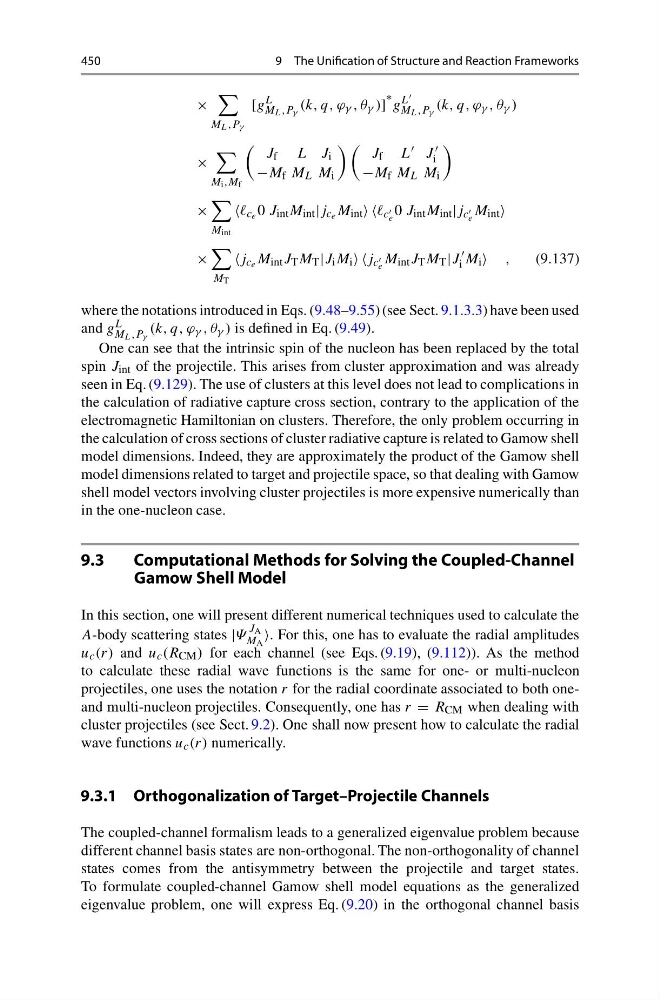
where the notations introduced in Eqs. (9.48–9.55) (see Sect. 9.1.3.3) have been used
and g L
M L ,P γ
(k, q, ϕ γ , θ γ ) is defined in Eq. (9.49).
One can see that the intrinsic spin of the nucleon has been replaced by the total
spin J int of the projectile. This arises from cluster approximation and was already
seen in Eq. (9.129). The use of clusters at this level does not lead to complications in
the calculation of radiative capture cross section, contrary to the application of the
electromagnetic Hamiltonian on clusters. Therefore, the only problem occurring in
the calculation of cross sections of cluster radiative capture is related to Gamow shell
model dimensions. Indeed, they are approximately the product of the Gamow shell
model dimensions related to target and projectile space, so that dealing with Gamow
shell model vectors involving cluster projectiles is more expensive numerically than
in the one-nucleon case.
9.3
Computational Methods for Solving the Coupled-Channel
Gamow Shell Model
In this section, one will present different numerical techniques used to calculate the
A-body scattering states |Ψ
J A
M A
. For this, one has to evaluate the radial amplitudes
u c (r) and u c (R CM ) for each channel (see Eqs. (9.19), (9.112)). As the method
to calculate these radial wave functions is the same for one- or multi-nucleon
projectiles, one uses the notation r for the radial coordinate associated to both oneand multi-nucleon projectiles. Consequently, one has r = R CM when dealing with
cluster projectiles (see Sect. 9.2). One shall now present how to calculate the radial
wave functions u c (r) numerically.
9.3.1 Orthogonalization of Target–Projectile Channels
The coupled-channel formalism leads to a generalized eigenvalue problem because
different channel basis states are non-orthogonal. The non-orthogonality of channel
states comes from the antisymmetry between the projectile and target states.
To formulate coupled-channel Gamow shell model equations as the generalized
eigenvalue problem, one will express Eq. (9.20) in the orthogonal channel basis
9 The Unification of Structure and Reaction Frameworks
×
M L ,P γ
[g
L
M L ,P γ
(k, q, ϕ γ , θ γ )]
∗ g
L
M L ,P γ
(k, q, ϕ γ , θ γ )
×
M i ,M f
J f L J i
−M f M L M i
J f L J
i
−M f M L M i
×
M int
c e 0 J int M int |j c e M int c
e
0 J int M int |j c
e
M int
×
M T
c e M int J T M T |J i M i c
e
M int J T M T |J
i M i ,
(9.137)
where the notations introduced in Eqs. (9.48–9.55) (see Sect. 9.1.3.3) have been used
and g L
M L ,P γ
(k, q, ϕ γ , θ γ ) is defined in Eq. (9.49).
One can see that the intrinsic spin of the nucleon has been replaced by the total
spin J int of the projectile. This arises from cluster approximation and was already
seen in Eq. (9.129). The use of clusters at this level does not lead to complications in
the calculation of radiative capture cross section, contrary to the application of the
electromagnetic Hamiltonian on clusters. Therefore, the only problem occurring in
the calculation of cross sections of cluster radiative capture is related to Gamow shell
model dimensions. Indeed, they are approximately the product of the Gamow shell
model dimensions related to target and projectile space, so that dealing with Gamow
shell model vectors involving cluster projectiles is more expensive numerically than
in the one-nucleon case.
9.3
Computational Methods for Solving the Coupled-Channel
Gamow Shell Model
In this section, one will present different numerical techniques used to calculate the
A-body scattering states |Ψ
J A
M A
. For this, one has to evaluate the radial amplitudes
u c (r) and u c (R CM ) for each channel (see Eqs. (9.19), (9.112)). As the method
to calculate these radial wave functions is the same for one- or multi-nucleon
projectiles, one uses the notation r for the radial coordinate associated to both oneand multi-nucleon projectiles. Consequently, one has r = R CM when dealing with
cluster projectiles (see Sect. 9.2). One shall now present how to calculate the radial
wave functions u c (r) numerically.
9.3.1 Orthogonalization of Target–Projectile Channels
The coupled-channel formalism leads to a generalized eigenvalue problem because
different channel basis states are non-orthogonal. The non-orthogonality of channel
states comes from the antisymmetry between the projectile and target states.
To formulate coupled-channel Gamow shell model equations as the generalized
eigenvalue problem, one will express Eq. (9.20) in the orthogonal channel basis