

9.3 Computational Methods for Solving the Coupled-Channel Gamow Shell. . .
455
(see Sect. 2.6.4). Once the eigenenergy for which Det[A] = 0 has been found, the
constants C
(0)
b , C
(+)
b are given by the eigenvector X of A of zero eigenvalue.
9.3.2.2 Use of Nonlocal Coupling Potentials
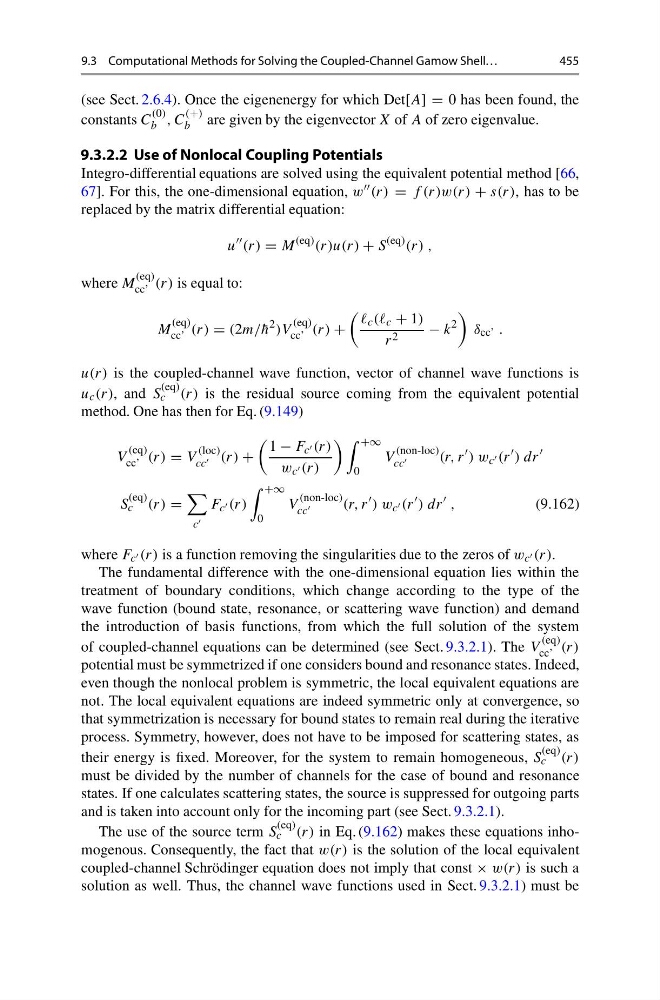
Integro-differential equations are solved using the equivalent potential method [66,
67]. For this, the one-dimensional equation, w (r) = f (r)w(r) + s(r), has to be
replaced by the matrix differential equation:
u
(r) = M
(eq) (r)u(r) + S
(eq) (r) ,
where M
(eq)
cc’ (r) is equal to:
M
(eq)
cc’ (r) = (2m/ ¯
h
2 )V
(eq)
cc’ (r) +
c (( c + 1)
r 2
− k
2
δ cc’ .
u(r) is the coupled-channel wave function, vector of channel wave functions is
u c (r), and S
(eq)
c (r) is the residual source coming from the equivalent potential
method. One has then for Eq. (9.149)
V
(eq)
cc’ (r) = V
(loc)
cc (r) +
1 − F c (r)
w c (r)
+∞
0
V
(non-loc)
cc
(r, r
) w c (r
) dr
S
(eq)
c (r) =
c
F c (r)
+∞
0
V
(non-loc)
cc
(r, r
) w c (r
) dr
,
(9.162)
where F c (r) is a function removing the singularities due to the zeros of w c (r).
The fundamental difference with the one-dimensional equation lies within the
treatment of boundary conditions, which change according to the type of the
wave function (bound state, resonance, or scattering wave function) and demand
the introduction of basis functions, from which the full solution of the system
of coupled-channel equations can be determined (see Sect. 9.3.2.1). The V
(eq)
cc’ (r)
potential must be symmetrized if one considers bound and resonance states. Indeed,
even though the nonlocal problem is symmetric, the local equivalent equations are
not. The local equivalent equations are indeed symmetric only at convergence, so
that symmetrization is necessary for bound states to remain real during the iterative
process. Symmetry, however, does not have to be imposed for scattering states, as
their energy is fixed. Moreover, for the system to remain homogeneous, S
(eq)
c (r)
must be divided by the number of channels for the case of bound and resonance
states. If one calculates scattering states, the source is suppressed for outgoing parts
and is taken into account only for the incoming part (see Sect. 9.3.2.1).
The use of the source term S
(eq)
c (r) in Eq. (9.162) makes these equations inhomogenous. Consequently, the fact that w(r) is the solution of the local equivalent
coupled-channel Schrödinger equation does not imply that const × w(r) is such a
solution as well. Thus, the channel wave functions used in Sect. 9.3.2.1) must be
455
(see Sect. 2.6.4). Once the eigenenergy for which Det[A] = 0 has been found, the
constants C
(0)
b , C
(+)
b are given by the eigenvector X of A of zero eigenvalue.
9.3.2.2 Use of Nonlocal Coupling Potentials
Integro-differential equations are solved using the equivalent potential method [66,
67]. For this, the one-dimensional equation, w (r) = f (r)w(r) + s(r), has to be
replaced by the matrix differential equation:
u
(r) = M
(eq) (r)u(r) + S
(eq) (r) ,
where M
(eq)
cc’ (r) is equal to:
M
(eq)
cc’ (r) = (2m/ ¯
h
2 )V
(eq)
cc’ (r) +
c (( c + 1)
r 2
− k
2
δ cc’ .
u(r) is the coupled-channel wave function, vector of channel wave functions is
u c (r), and S
(eq)
c (r) is the residual source coming from the equivalent potential
method. One has then for Eq. (9.149)
V
(eq)
cc’ (r) = V
(loc)
cc (r) +
1 − F c (r)
w c (r)
+∞
0
V
(non-loc)
cc
(r, r
) w c (r
) dr
S
(eq)
c (r) =
c
F c (r)
+∞
0
V
(non-loc)
cc
(r, r
) w c (r
) dr
,
(9.162)
where F c (r) is a function removing the singularities due to the zeros of w c (r).
The fundamental difference with the one-dimensional equation lies within the
treatment of boundary conditions, which change according to the type of the
wave function (bound state, resonance, or scattering wave function) and demand
the introduction of basis functions, from which the full solution of the system
of coupled-channel equations can be determined (see Sect. 9.3.2.1). The V
(eq)
cc’ (r)
potential must be symmetrized if one considers bound and resonance states. Indeed,
even though the nonlocal problem is symmetric, the local equivalent equations are
not. The local equivalent equations are indeed symmetric only at convergence, so
that symmetrization is necessary for bound states to remain real during the iterative
process. Symmetry, however, does not have to be imposed for scattering states, as
their energy is fixed. Moreover, for the system to remain homogeneous, S
(eq)
c (r)
must be divided by the number of channels for the case of bound and resonance
states. If one calculates scattering states, the source is suppressed for outgoing parts
and is taken into account only for the incoming part (see Sect. 9.3.2.1).
The use of the source term S
(eq)
c (r) in Eq. (9.162) makes these equations inhomogenous. Consequently, the fact that w(r) is the solution of the local equivalent
coupled-channel Schrödinger equation does not imply that const × w(r) is such a
solution as well. Thus, the channel wave functions used in Sect. 9.3.2.1) must be